
Borys Buryak
1953 — Podvirne, Chernivtsi Region (Ukraine). Works in Lviv (Ukraine)
Borys Buryak is a visual artist and fine arts teacher who belongs to the Lviv art school and represents Ukrainian expressionism. He is a cofounder of KUM (Klub Ukrainskykh Myttsiv [Club of Ukrainian Artists], 1987). Since 1987 he has been a member of the Union of Soviet Artists of Ukraine (now the National Union of Artists of Ukraine). In 2009 he became a senator of the Academic Senate of the International Academy of Contemporary Art in Rome. He was awarded the title of Honored Artist of Ukraine (2004) as well as of People’s Artist of Ukraine (2016).
In 1974 Buryak graduated from the Ivan Trush College of Arts (now the Ivan Trush Lviv State College of Decorative and Applied Arts) and later, in 1979, from the Lviv Academy of Arts (now the Lviv National Academy of Arts). He was influenced by his teachers: the artist Taras Dragan (1932–2009) and art historian Volodymyr Ovsiichuk. [1] Like most of his fellow students, Buryak was fond of the Renaissance masters as well as of French artists such as Pierre Bonnard (1867–1947), Georges Rouault (1871–1958), and Nicolas de Staël (1914–1955). This influence is evident in his stylized and decorative approach to form. He also found great inspiration in the work of the Ukrainian artist Roman Selskyi (1903–1990). [2]
Since 1976 Buryak has participated in national and international exhibitions around Europe and in New York. [3] As is true of other Ukrainian artists, he gained more renown at home after experiencing success abroad. His numerous exhibitions in Austria and Belgium, which were accompanied by acquisitions of his works, also expanded his circle of collectors in Ukraine. His best-known pieces include Dedication to the Stavropol Brotherhood (1986), Byzantine (1988), Death of Boychuk (1991), Conversation (1991), The Old Church (1991), Cathedral of St. Jura (1992), the series Dialogues (1993–99), and Motrya and Mazepa (1995).
Buryak works in the traditional easel painting technique, using mainly oil. His practice is also shaped by the visual language of Byzantine iconography and Ukrainian art traditions, including Boychukism—a significant cultural and artistic movement in Ukraine that was active from the 1910s to the 1930s. These national roots have clearly influenced his distinctive visual vocabulary. His expressionistic pieces combine vivid colors and impulsive strokes; he is a sensitive colorist, one who treats color not as pure paint but as what he calls a “complex substance” that is formed in the process of refining the painting and adding new layers. [4] His works contain various textural effects, from thin layers reminiscent of watercolor or stained glass to thickly applied paint that creates the effect of a relief on the surface. Buryak once defined his work as “post-traditionalist,” meaning that he adopts characteristics of the fine arts—in particular of painting movements such as impressionism and expressionism—that were once considered modern but are now viewed as traditional. [5]
Among the artist’s favorite motifs are landscapes, still lifes, female portraits, and nudes. His dedication to his native town of Lviv is evident. The city’s streets and squares appear on multiple canvases, as does King Danylo Romanovych Halytsky, who is believed to have built the city in the thirteenth century. The simplified forms of Buryak’s King Danylo of Galicia (1999) enhance the expressiveness of the silhouette. The artist employed rich, deep colors, intricate textures, and a centered composition to evoke an almost ceremonial atmosphere. Though firmly rooted in the tradition of historical portraiture, the work incorporates modern touches—in its expressive brushwork, vibrant color fields, and abstracted background reminiscent of abstract expressionist aesthetics—that bridge past and present, inviting viewers to reflect on the current relevance of this medieval figure to Ukraine’s cultural and national identity. Buryak’s simplified forms lend power to his compositions. In Friends (1998), although the figures lack individualized features, a great dialogue unfolds in the work, not only between the two characters but also among the colorful forms—bright yellow, red, and green—and painterly rhythms that animate the canvas. Departing from the principles of realism, the artist creates his own space, where physical characteristics do not dominate the intimate sphere of conversation.
Teaching has always accompanied Buryak’s art practice. He taught drawing at the Ivan Trush College of Arts in 1979, and later painting and drawing at the Lviv Academy of Arts. Today he runs a private art school in Lviv. The National Union of Artists of Ukraine awarded him a prize in 1991 for Death of Boychuk. He also received a prize at the republican exhibition Art Club (Khmelnytsky Regional Art Museum, 1996). In 2009 the Andrey Sheptytsky National Museum in Lviv held a retrospective exhibition of his work, and he was featured in the exhibition Directing Color at Kyiv’s AVS art gallery in 2012. Buryak’s works are held in the collections of numerous Ukrainian museums, the Tretyakov Gallery in Moscow, and private collections around the world.
Anna Luhovska
Notes:
1. Andrii Budevych, “Vershyna liudskoi tvorchosti—formuvannia dushi” [The pinnacle of human creativity is the formation of the soul], Texty.Org.Ua, 31 May 2018.
2. Budevych, “Vershyna liudskoi tvorchosti.”
3. Borys Buryak’s website.
4. Budevych, “Vershyna liudskoi tvorchosti.”
5. Iryna Kurii, “Borys Buryak: Kartyny zariadzhaiutsia vid avtora” [Borys Buryak: Paintings are charged by the author], Galinfo, 2008.
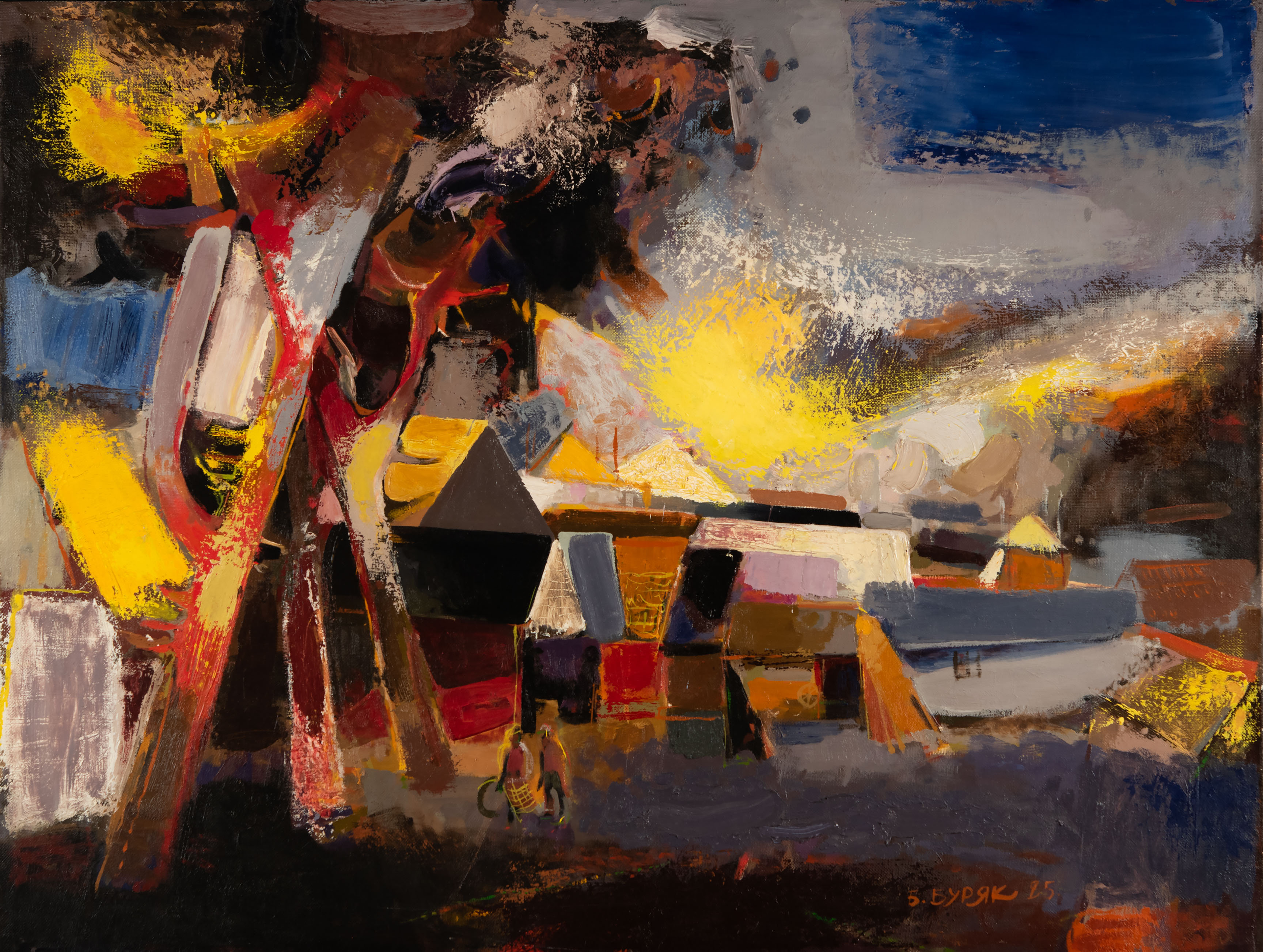
An Autumn Moment, 1985. Oil on canvas, 92 × 120.5 cm (36 1/4 × 47 7/16 in.). Norton and Nancy Dodge Collection of Nonconformist Art from the Soviet Union. D00841