
Concordia Klar
1938 — Pavlovsky district of the Leningrad region (now Saint Petersburg) (Russia) | 2004 — Tallinn (Estonia). Worked in Rakvere and Tallinn (Estonia)
Concordia Klar (Cora to friends) was born in the Pavlovsky district of the Leningrad region. To escape the war-torn area during World War II, the family moved to Estonia in 1942. After graduating from Rakvere I secondary school in 1952, Klar, at the urging of her art teacher, went on to study painting at Tartu School of Fine Arts and graduated in 1957. In the same year, she started her studies at the State Art Institute of the Estonian Soviet Socialist Republic (now Estonian Academy of Arts) in Tallinn, specializing in graphic art. After graduating in 1963, she requested a position as an art teacher in Rakvere, where her family lived. In 1964 she married the notable graphic artist Peeter Ulas (1934–2008), and the following year the couple, with their newborn daughter, the future artist Maria-Kristiina Ulas (b. 1965), went to live and work in Tallinn. Klar taught at the Tallinn Pedagogical Institute from 1966 to 1994 (for the last two years as an associate professor), while also active as an artist. Her works gained recognition at the Tallinn Print Triennial, and over her career she participated in several international biennials (including Ljubljana in 1971, Heidelberg in 1988, and Fredrikstad in 1992).
In the 1960s Klar started working with colored linocut (e.g., Meduusa pea [Head of Medusa] (1969, Art Museum of Estonia, Tallinn) and lithography (e.g., Metroo [The Metro] (1968, ZAM, D15687). She also wrote surrealist and existential poetry in the 1960s, but the poems were not published until 2006. Her art from the 1960s and ’70s resonates with her philosophical and psychological poetry, as seen in, for example, Massiiv [Array] (1971, ZAM, D15688). At the end of the 1960s, Klar started working in etching and soft-ground etching. In Muinaslinna väravas [At the Gates of a Primeval City] (1970, ZAM, D05804) she introduced the image of the piper, which appears in many of her graphic works and for which she is probably best known. The recurring motif of a woman playing music suggests the harmonious relationship between humankind and nature. In mystical compositions such as Mäng [Play] (1974, ZAM, D05627), Klar placed the female figure, nature, and music in a surreal and evocative relationship. Later compositions of musicians playing fantastical instruments include landscape, architectural elements, the sea and ships, and national references such as the Estonian bagpipe, ornaments of folk costumes, and the stone sowings (glacial erratics) and junipers of Saaremaa island. Klar herself has commented on this dominant motif of her graphic works of the 1970s and ’80s—a sculptural, almost monumental figure of a woman playing an instrument—as follows: “The main theme of my graphic works manifests itself in the interpretation of music and the female figure performing it. In life, as in music, rhythms are of great importance—cosmic rhythms, biorhythms, etc. . . . In my works, the female figure can be seen as a symbol of life, music—as the rhythm of life. Without a female character, music would not reach people's ears.” [1]
Few artists have remained so faithful to one motif: The same figure with a fantastical instrument can be found in Klar’s landscapes with junipers, the sea, and stones, and in complex compositions drawn from the history of Tallinn. In most cases, it is a wind instrument, such as an oboe or a clarinet, through whose sound holes the gothic arches of the village and floral motifs from folk embroidery seem to escape. Sometimes the musician simply holds a whistle or a double-bass bow, and at other times she plays on a keyboard.
In the late 1970s, Klar took up Tallinn-related themes in rich interpretations of cultural-historical motifs that form a separate body of works, such as Improvisatsioon vanalinna paekividele [Improvisation for the Limestones of the Old Town] (1980, ZAM, D08830). In some works of the 1970s and ’80s, her surreal vision encompassed gender roles and identity (e.g., Adam ja Eve [Adam and Eve], 1971, ZAM, D15689). Klar’s depiction of the human body was also very distinctive. In Tere [Hello] (ZAM, D04050), a work from the 1979 series Teraapia [Therapy] (Art Museum of Estonia), she placed an abstract figure in a somewhat hostile-looking space.This series is a distinctive representation of the body and illness in Soviet society, themes that were not very common in art at that time.
In addition to her art and teaching, Klar illustrated and designed books (including the novel Kolme katku vahel [Between Three Plagues], by Jaan Kross, in 1980–83 and the poetry collection Kellavalaja [The Bellmaker], by Aino Pervik, in 1985) and created posters and bookplates. The illustrations for Between Three Plagues were among her major achievements. The single illustrated luxury tome was planned after the four volumes of the novel had been published separately. It has been said that the eternal contradiction for the historical novelist between historical truth and imagination also challenged Klar as an illustrator of history.
Throughout her creative life, Klar had a very close relationship with nature. Her sister recalled how Cora used to go and draw in the fields with her cousin and always had a drawing pad in her hand. [2] Her husband, Peeter Ulas, recalled that from 1973, the family spent their summers at the Lõuka country house in Saaremaa, a place for spiritual growth and development. There, he said, she drew endless inspiration from the landscape and the world of plants, forest, and sea. [3] Klar herself wrote of her contact with nature, “When you are in your country home and when you step into the garden, you look at the radiant flowers again and again—sage, lemon balm, hyssop, tarragon, mint, basil . . . but somewhere in the back of your mind, the thought of your work as an artist still lingers. And then you take the plants with you to the city and, leaving a mark in the soft lacquer, you allow them to tell people their message—not anger and violence, but love and mutual understanding is the way to enter the third millennium.” [4]
In her later years, Klar mainly focused on plant motifs. Throughout her life, she conveyed both macro and micro perspectives on nature in southern Estonia, Saaremaa, and Nordic countries. All these different layers—figures, musicians, abstract bodies, nature—come together in a delicately surreal yet harmonious constellation in her last graphic series, Väike roheline rada [Little Green Path] (2004, private collection).
Eda Tuulberg
Photo portrait: Concordia Klar, 1984. Photo by Kalju Suur. Estonian National Archive. EFA.349.0.121783
Notes:
1. Mai Levin (ed.). Concordia Klar (Tallinn: Tallinna Raamatutrükikoda, 2006), 43.
2. Levin, Concordia Klar, 31.
3. Levin, Concordia Klar, 36.
4. Levin, Concordia Klar, 45.
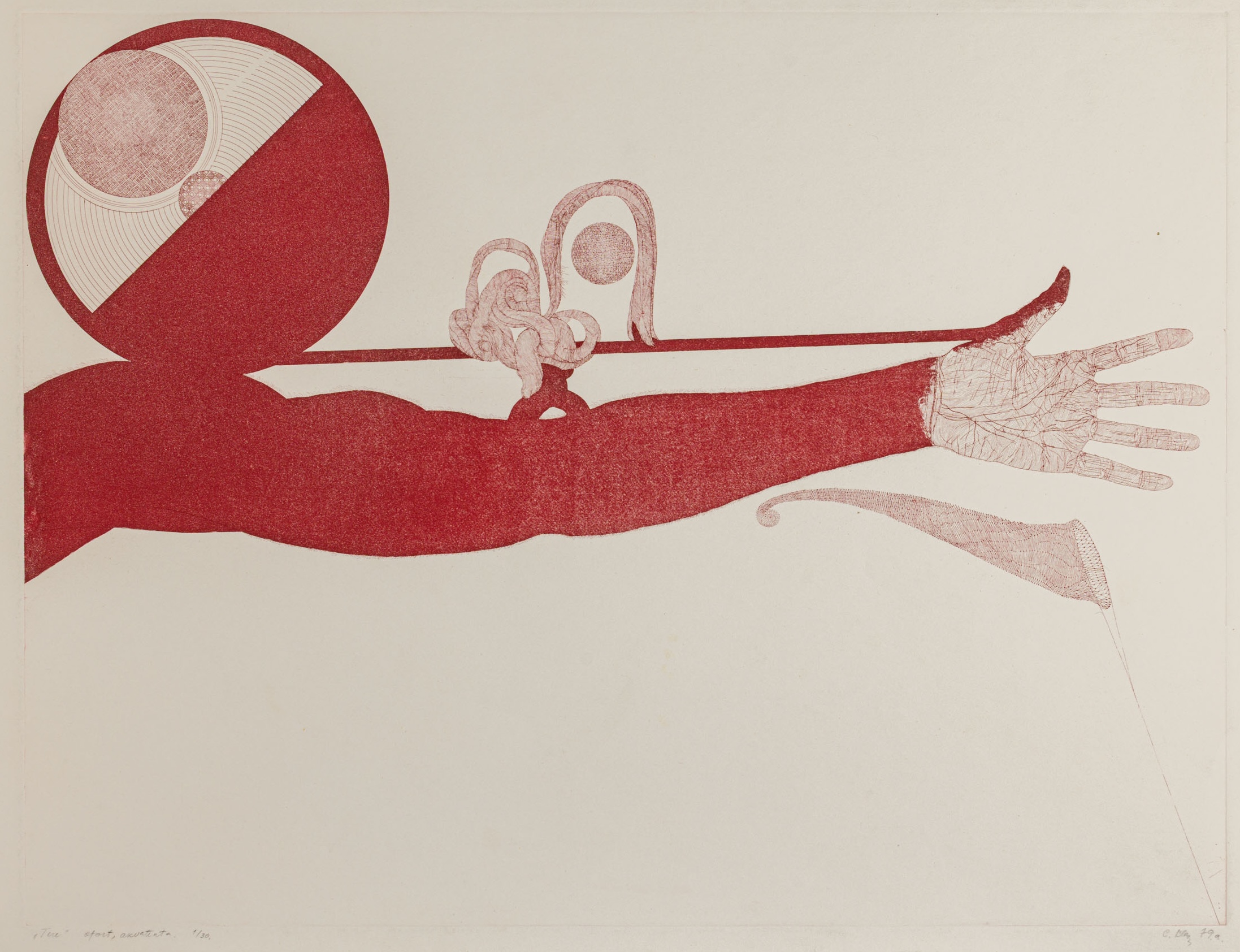
Hello, 1979. Etching and aquatint on paper, 49.1 × 64.7 cm (19 5/16 × 25 1/2 in.) / 60.2 × 77.5 cm (23 11/16 × 30 1/2 in.). Norton and Nancy Dodge Collection of Nonconformist Art from the Soviet Union. D04050
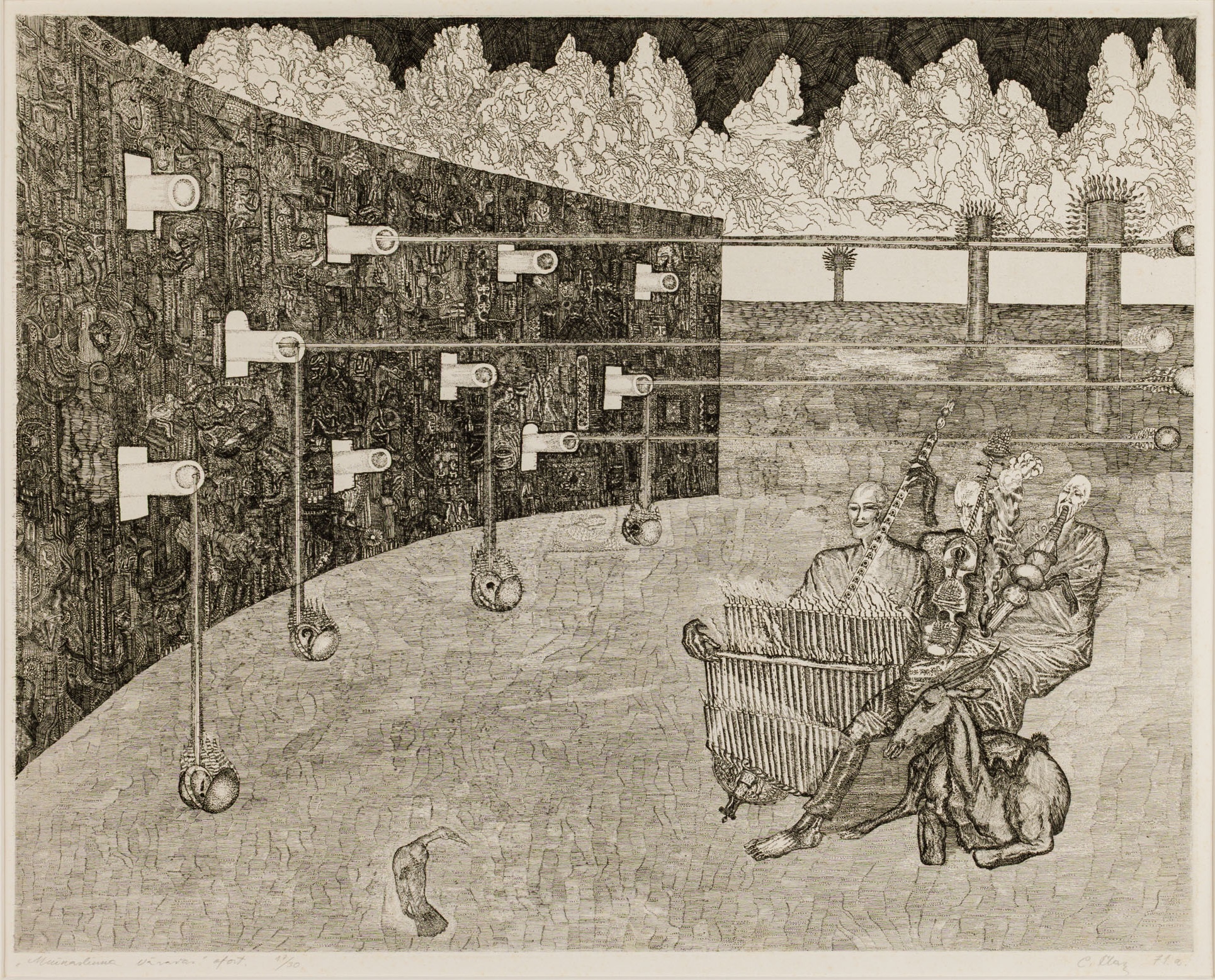
At The Gates of a Primeval City, 1971. Etching on paper, 45 × 56.8 cm (17 11/16 × 22 3/8 in.) / 62.1 × 74.9 cm (24 7/16 × 29 1/2 in.). Norton and Nancy Dodge Collection of Nonconformist Art from the Soviet Union. D05804
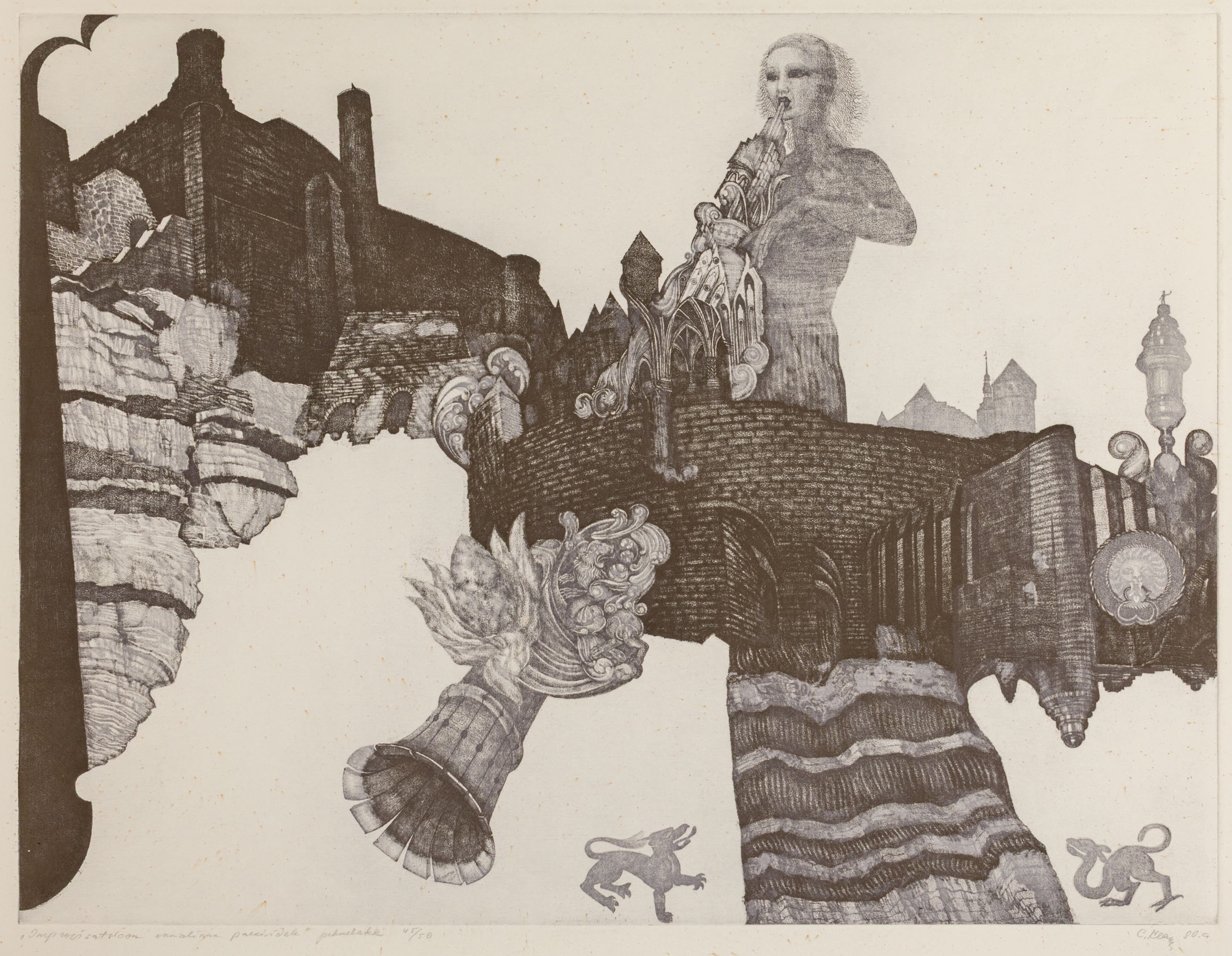
Improvisation for the Limestones of the Old Town, 1980. Soft-ground etching on paper, 49 × 64.4 cm (19 5/16 × 25 3/8 in.) / 60 × 75.7 cm (23 5/8 × 29 13/16 in.). Norton and Nancy Dodge Collection of Nonconformist Art from the Soviet Union. D08830
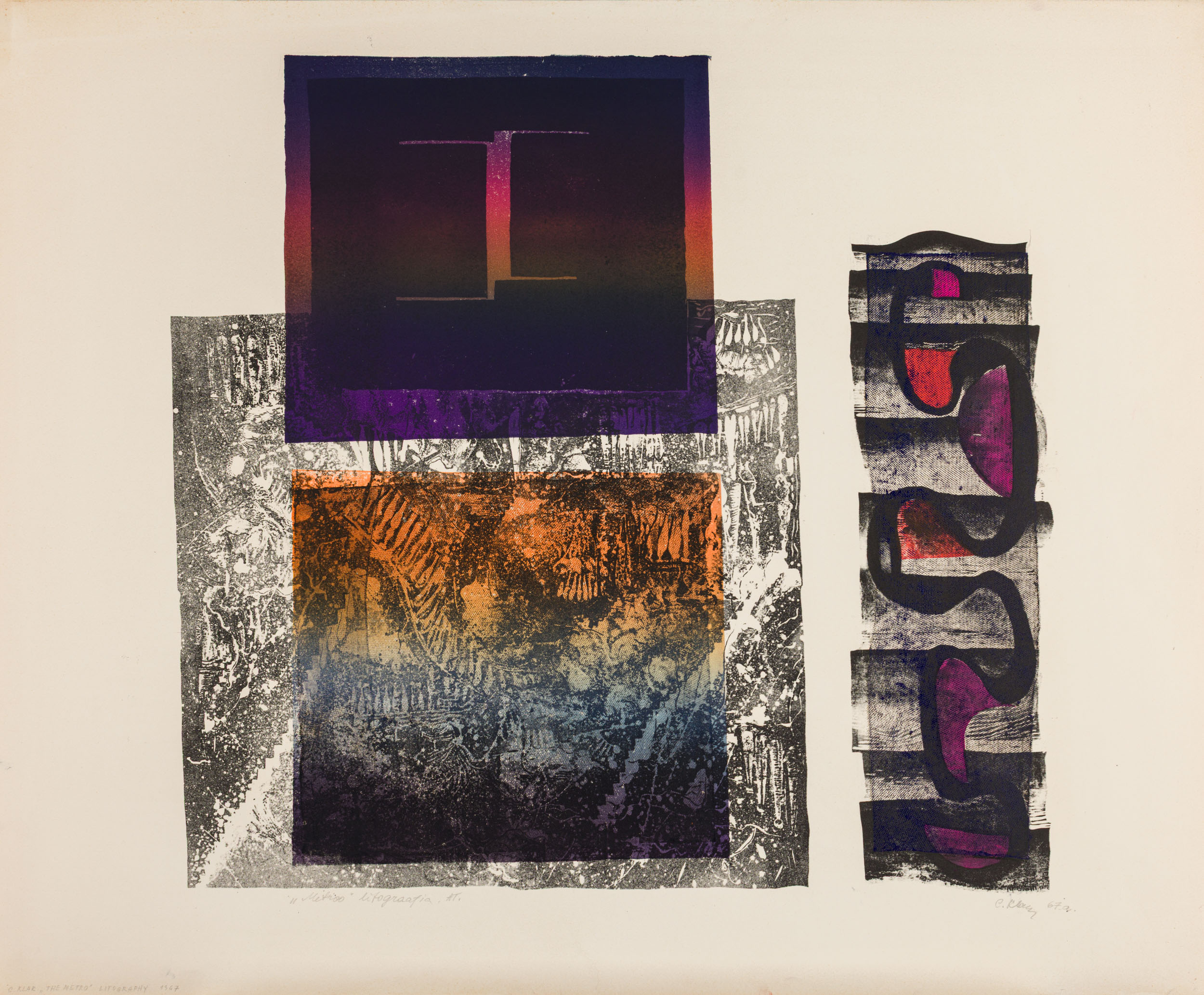
The Metro, 1967. Lithograph on paper, 64.2 × 76.6 cm (25 1/4 × 30 3/16 in.) / 64.2 × 76.6 cm (25 1/4 × 30 3/16 in.). Norton and Nancy Dodge Collection of Nonconformist Art from the Soviet Union. D15687
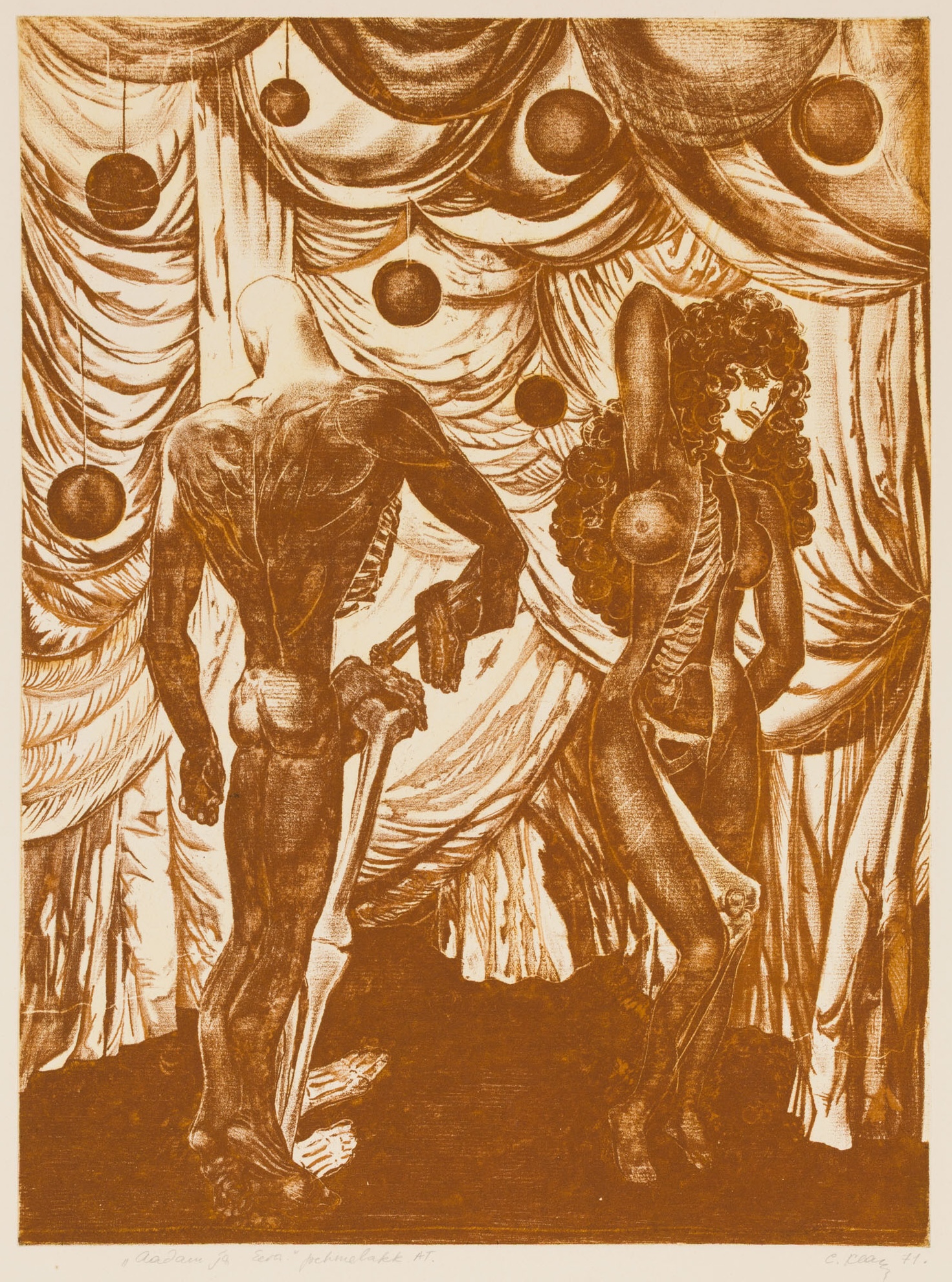
Adam and Eva, 1971. Soft-ground etching on paper, 50.2 × 37.2 cm (19 3/4 × 14 5/8 in.) / 66.6 × 52.5 cm (26 1/4 × 20 11/16 in.). Norton and Nancy Dodge Collection of Nonconformist Art from the Soviet Union. D15689