
Dmitri Aleksandrovich Prigov
1940 — Moscow (Russia) | 2007 — Moscow (Russia)
Dmitri Aleksandrovich Prigov was a Soviet and Russian multimedia artist and musician, as well as a prolific poet and writer of fiction and nonfiction. Starting in the 1970s, he was associated with Moscow’s unofficial and semiofficial artistic circles, particularly the loose grouping of artists and writers who created Moscow Conceptualism. The media he worked on included sculpture, drawing, concrete poetry, other text-based works on paper, video art, and performance art. Widely admired as an art maker, thinker, and theorist, he was considered, in his lifetime and today, to be among the most significant participants in the cultural life of his generation in Russia.
Prigov received his professional training as a sculptor, graduating in 1967 from the Stroganov Moscow State Academy of Art and Industry. As a student, he started writing poetry, but treated it as a youthful pastime. During this time, he befriended several other artists who would also later be part of the unofficial art scene. Upon graduation, Prigov gave up visual art, but he returned to it in the early 1970s. In the interim, between 1967 and 1974, he took a position at Moscow’s architectural authority, which allowed him access to the closed humanities library of the Russian Academy of Sciences. This led to several years of intense self-guided study focused primarily on the history of philosophy and religion, both Western and Eastern. From the early to mid-1970s, while working on official commissions (e.g., children’s playground decorations) for the Union of Artists, which Prigov joined in 1975, he shared a studio with Boris Orlov, a fellow semiofficial artist associated with the sots art movement. By the mid-1970s, Prigov became an active member of the underground, moving simultaneously in literary circles, which were maintained through readings in private salons and publications abroad, and through artistic circles, which thrived on studio visits and apartment exhibitions for the initiated. The studio shared by Prigov and Orlov became one of the spaces for such gatherings.
Prigov’s earliest works were text-laden objects from the 1970s that belong to the global visual and concrete poetry tradition; they bridge the gap between Prigov the poet and Prigov the visual artist. They also foreshadow several of the artist’s career-long interests. On the one hand, in these works, Prigov made visible and palpable the weight of the Russian literary tradition as something with which any aspiring young author in the language must contend, as well as the weight of Soviet ideology felt in and through language. The latter pursuit in particular was an interest Prigov shared with other sots art artists, Prigov’s friends and contemporaries whose work can also be found in the Zimmerli’s collection: for example, Komar and Melamid, Grisha Bruskin, Alexander Kosolapov, Vagrich Bakhchanyan, Leonid Sokov, and Ivan Chuikov. The collective exploration of foundational Soviet myths that had informed the worldview of this generation marked the moment from which these myths would begin to be seriously questioned, first in underground culture, then, by the mid-1980s, in ever wider circles of Soviet society.
On the other hand, these works reveal a concurrent fascination with the mechanisms and limitations of language, an interest he shared with another overlapping set of friends and contemporaries, the Moscow Conceptualists, notably fellow poets Lev Rubinstein and Andrei Monastyrsky (a founding member of the important Collective Actions group) and visual artists such as Rimma Gerlovina. In Prigov’s early works from the 1970s, words became a malleable visual material out of which he crafted verbal and nonverbal images at once, slipping in and out of ability to “make sense.” The power of words—both written and spoken—to transcend their utilitarian purposes and conjure nonlinguistic meaning would remain a constant concern for Prigov, particularly in the performances he started to create in the 1980s. There he created objects with complex, layered references, a deliberate ambivalence of purpose, and an eye to the microcosm of comic details of staid Soviet ideology and the workings of slippery meanings that question the easy certainties of how one thinks in language.
Examples of such works in the Zimmerli collection include My Uncle, a Most Worthy Gentleman (1975, 2003.0001), which plays on the iconic opening line of Alexander Pushkin’s Eugene Onegin. Pushkin, more than anyone, stood (now as then) for the figure of the poet in a country with a strong tradition of poets being seen as both cultural heroes and prophets—a legacy any poet writing in Russian could hardly ignore. The ubiquitous reverence for Pushkin’s genius and civic heroism as an ingrained cultural script was a frequent reference for Prigov’s tongue-in-cheek works. In a much later work, for example, the 2005 video-based “media opera” Донжуанский список Дон-жуана [Don Juan’s donjuanian list], cocreated with Iraida Yusupova and Alexander Dolgin, Prigov created a narrative (based on The Stone Guest, Pushkin’s retelling of the story of Don Juan) in which, after inviting to dinner the statues of great literary figures (Pushkin, Fyodor Dostoevsky, Nikolai Gogol, Vladimir Mayakovsky) found around Moscow, Prigov himself turns into Pushkin in the end.
Other textual pieces in the Zimmerli collection play with lines from the Book of Ecclesiastes, 1:17 (in the undated work And I Gave My Heart to Know Wisdom and to Know Madness and Folly, D21476); Mayakovsky (Were I a Negro Getting Up in Years, undated, D21474); Mikhail Bulgakov (the two different undated versions of Comrade, I Cannot Leave the Squadron, D21471 and D21475); Maxim Gorky (If the Enemy Does Not Surrender, He Will Be Destroyed, undated, D21470); and Dostoevsky (Student Comma Murdered Old Woman Comma, 1981, MANI2.02.33.07, from the series Telegrams, in which Prigov summarized the plots of major works of Russian literature, e.g., Crime and Punishment, in the format of telegrams).
Particularly emblematic of the dual concerns described above is the undated piece A Ya (ZAM, D21469), created on the page by the sequence of two Russia letters, a and ya, typed all around the negative space, which also forms the capital A and Ya. A (A) and Ya (Я) are the first and last letters of the Russian alphabet, respectively. Just as in the English phrase “A to Z,” the combination encapsulates the idea of all-encompassing totality. Both A and Ya are also words in Russian—A means “but” or “sometimes” and Ya means “I.” Hence, in the rectangular box beneath the large negative-space letters, we read, “notyounothenottheynotYou,” asking the viewer to logically finish the phrase with “but I.” Prigov’s exploration of the tension between the sense and nonsense that can be extracted from two arbitrary sounds is further overlaid here with another specific historical and biographical fact. A-Ya was the name of a magazine, the only one of its kind, which was published from 1979 to 1984 by Igor Shelkovsky, a Russian émigré artist in Paris, to bring Soviet underground art to the attention of a Western audience. Articles by and about Prigov appeared in several issues and were among his first significant literary publications. This work is thus also a way of expressing Prigov’s affiliation with Soviet underground and tamizdat [1] culture—a reference that would have been widely understood by his peers.
In the 1980s, Prigov’s visual language and way of working changed noticeably, though his concern with language remained a constant. Working with found printed words, particularly using newspapers, became his signature move. By the latter part of the decade, this resulted in large-scale installations, with vast quantities of newspapers, some of them altered, covering big spaces. The newspaper was a medium consistently charged in the Soviet Union with producing nonstop affirmations of the official vision of reality. At the same time, any one newspaper could so easily be discarded as to seem utterly inconsequential as a source of information. (As if to emphasize this point, due to chronic toilet paper shortages, Soviet citizens of all political leanings repurposed newspapers into toilet paper and also collected newspapers in order to get books in return through government-run recycling programs.) With the works on newspaper, Prigov took it upon himself to draw out of the surface reports of everyday occurrences of deep pathos, which could hint at the construction of a more profound framework, a suddenly more visible physical and mental geography.
Examples of such works in the Zimmerli collection include Perestroika (ZAM, L02270) and Glasnost (ZAM, L09269) (both undated but presumably from 1985 or after) and Moscow (1989, ZAM, D02729). Moscow is particularly representative of Prigov’s best-known work from the 1980s. It has the combination of white, black, and red to which Prigov returned often, the color symbolism suggesting the opposites of white and black as Being and Non-Being, or light and darkness and red symbolic of a blood-like vital substance. This work also contains a characteristic reference to written Church Slavonic that Prigov utilized frequently. In order to distinguish particularly sacred words and important names in books and on icons, Church Slavonic uses titlo signs and omits vowels or writes them as superscripts. Even though such words should be pronounced as usual, the visual alteration alerts the reader to the extraordinary power attributed to certain words. Here, Prigov does that with the word Slava (“Glory”), which he writes as Slva, making the ubiquitous Soviet phrase “Slava SSSR” (“Glory to the USSR”) take on the visual form of an Orthodox sacred text.
It was also in the 1980s that Prigov’s reading of his own literary works began to take on more exaggerated, even theatrical aspects (as, for example, when he performed his 1978 poetic cycle The Apotheosis of the Militia Man dressed as the Militsaner, the eponymous abstracted Soviet militiaman (i.e., policeman) who is a frustrated keeper of divine order). In 1986, Prigov created what was arguably his first work of performance art. In Обращения к гражданам (Addresses to Citizens), he posted in public places typewritten addresses to citizens that visually resembled the homemade announcements about goods and services that were common at the time. Prigov’s addresses, however, urged people to be virtuous, asked philosophical questions, and also seemed nonsensical, written as if coming from a kind of Christ-like but also simple-minded prophet. This project resulted in Prigov’s brief involuntary confinement in a clinic for the mentally ill, but he was quickly released thanks to a publicity campaign mounted by literary luminaries in Russia and abroad.
In the early 2000s, Prigov turned to performance art again quite seriously, forming in 2002 a performance art group called Prigov Family Group with his son, Andrey Prigov, and daughter-in-law, Natalia Mali. An example of their work together can be found in the video Народ и власть совместно лепят образ новой России (The People and the Powers That Be Together Sculpt the Image of a New Russia, 2003). Featured in this video along with his son, Prigov turns himself into the personification of state power as it works together with the “naked” Russian people. In this wryly humorous comment on the post-Soviet attempts to reimagine a new national identity, Prigov starts with a direct reference to his earlier character of the Militsaner. He returns to the pathos and supposed loftiness of the subject matter, adding the allusions to the figure of the demiurge, the creator-god as sculptor of matter, and straddling the thin line between sardonic satire and philosophical engagement.
In 1987, Prigov began exhibiting his work in official venues in Moscow for the first time as a member of the Avantgardist Club (Клуб авангардисов, or КЛАВА), the first formally registered group of unofficial Soviet artists. It was also the year of his first exhibition abroad, at Documenta VIII in Kassel, Germany. From that point on, he exhibited very actively until the end of his life in Russia and other countries, particularly Germany, where he showed in private galleries and museums.
In the 1990s, Prigov moved from working on newspapers to making a large series of drawings atop reproductions of various masterpieces of Western art. In doing so, he engaged with the heritage of the Western visual art tradition much as he engaged with literary heritage in his earlier text-based works. One of the artists with whose legacy he entered into frequent dialogue with was Kazimir Malevich—a figure, for purposes of Russian modern and contemporary art, of the same magnitude as Pushkin is for Russian literature. Numerous references to Malevich occur in Prigov’s work from the 1990s on. For Soviet artists, Malevich was, among other things, a shorthand for the history of the Russian avant-garde, which was suppressed from public memory from the mid-1930s through the 1980s. The rediscovery of this legacy starting in the 1970s provided proof that Russian art once actively participated in the radical experiments that changed Western art in the 20th century. The Zimmerli collection contains a very unusual and uncharacteristic work by Prigov—the 1982 collage titled Stop Ahead (D10189)—which in the bottom right-hand corner reads, “25 days Malevich passions” and attests to Prigov’s awareness of the artist by the early 1980s.
What makes this work uncharacteristic is its abstraction. Prigov, somewhat counterintuitively, moved in the direction of very traditional—if also uniquely strange—figuration and iconography in the works made from the late 1980s until the end of his life. This is reflected in several extensive series (not currently represented in the Zimmerli collection). One of these series, Bestiary, was made up of “portraits” of various living and historical people depicted as mythical creatures holding various symbolic attributes such as an egg, chalice, ball, or tree branch, each meant to represent the figure’s essence and relationship to cosmic order.
Also figurative are Prigov’s numerous so-called Phantoms of Installations. Prigov had a constant need to draw and produced hundreds of possible variants for large-scale installations of symbolism-laden scenes, only a small percentage of which would ever come to be realized. In serial form, however, the drawings have an added cinematic effect. For these installations, Prigov created a cast of recurring “characters,” from a humble cleaning woman, who represents human efforts against chaos and entropy, to an all-seeing, God-like eye. In the Phantoms of Installations, words frequently continue to take on a life of their own.
Prigov’s legacy as a visual artist remains complex, unsettled, and unsettling. He defined the entirety of his own existence as the “life-long artistic Project DAP” (DAP stands for Dmitri Aleksandrovich Prigov), which gave him a way to explain how one person’s creative output could reconcile a seemingly irreconcilable set of preoccupations, ideas, and ways of working. He produced works that were wry deconstructions of both Soviet ideology and the transparency of language, and works that show a profound and earnest engagement with the metaphysical, transcendent, and trans-epochal. He sought to uncover the deep archetypal structures and patterns that give individual lives their shape and order and tried to represent the various forces that exist beyond the limits of any system of representation. Prigov was acquainted with and referenced, even in his earliest works, the religious, philosophical, and mystical traditions with which humans strove to find ways to order the universe as a system of knowledge and represent such trans-human knowledge in human terms. Prigov’s own relationship to the sacred remains the deepest mystery in his work. Perhaps his greatest success as a conceptual artist was a lifelong ability to evade being pinned down, and to maintain a constant ambiguity of the speaking voice—one could not quite puzzle out which of the many cultural personae available to the artist was being channeled at any given moment. Nevertheless, the recurrence of the theme suggests constant attempts to understand the deep structures of historic cultural consciousness through the parallels with its many earlier layers. In doing so, he produced a space of intellectual freedom, which subverted and critiqued the claims of Soviet ideology—or any ideology—to produce undeniable truths.
Dmitri Prigov died in Moscow on July 17, 2007, at the age of sixty-six following a heart attack, and is buried at Moscow’s New Donskoye Cemetery. Following his death, in 2010, Prigov’s widow, Nadezhda Georgievna Bourova-Prigova, to whom Prigov had been married since 1964, established the Prigov Foundation, which undertook significant efforts to promote the study and presentation of Prigov’s legacy, as well as scholarly inquiry into Soviet unofficial culture and contemporary Russian avant-garde culture. Bоurova died in 2024, but the work of the Foundation continues to date.
Almost immediately after Prigov’s death, major Russian institutions began putting together large retrospectives of his work. These took place at the Moscow Museum of Modern Art (2008); the Venice Biennale as a project organized by the State Hermitage in Saint Petersburg (2011); and the State Tretyakov Gallery in Moscow (2014). [2]
In addition to the Zimmerli Art Museum, major collections where his work can be found include the State Russian Museum, Saint Petersburg, Russia; the State Tretyakov Gallery, Moscow, Russia; Moscow Museum of Modern Art, Moscow, Russia; Kunst Museum, Kiel, Germany; Kupferstichkabinett, Berlin, Germany; Ludwig Forum, Aachen, Germany; Ludwig Museum, Cologne, Germany; Moderna Galerija Ljubljana, Ljubljana, Slovenia; Tate Museum, London, UK; Centre Pompidou, Paris, France; and the Musée d’Art Moderne, Saint-Étienne, France.
Ksenya Gurshtein
Photo portrait: Georgy Kiesewalter, Dmitri Prigov, from the series Love Me, Love My Umbrella, 1984–86. ZAM, 2000.1588
Notes:
1. Tamizdat refers to literature or manuscripts smuggled out of the Soviet Union for publication abroad, bypassing state censorship.
2. For brief interviews with the curators of all three projects, see Valentin Dyakonov, “Dmitri Aleksandrovich Prigov: Kollektsia curatorov” in Art Guide, 9 June 2014.
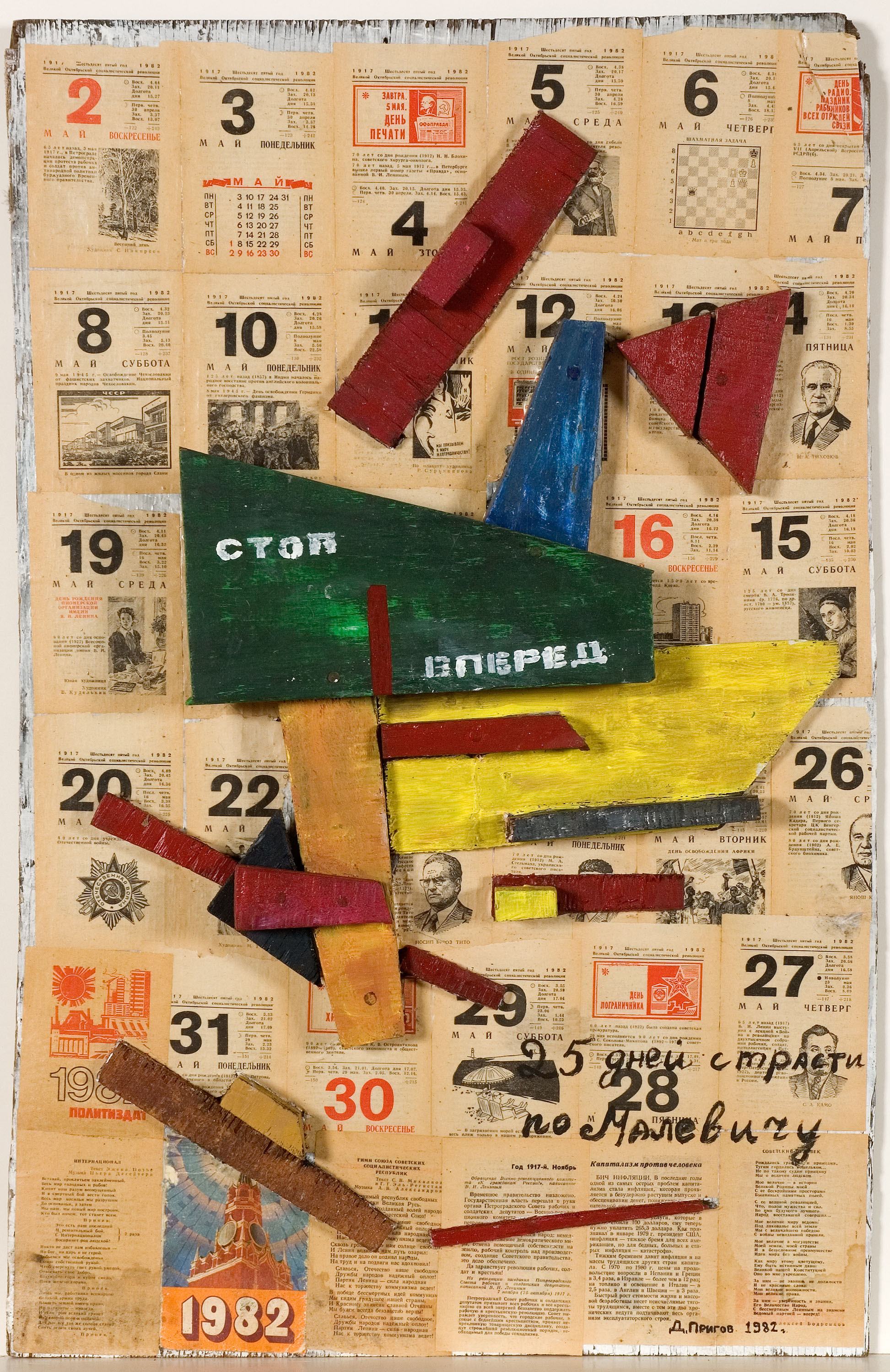
Stop Ahead, 1982. Painted wood and paper collage on plywood, 70 x 46 x 6 cm (27 9/16 x 18 1/8 x 2 3/8 in.). Norton and Nancy Dodge Collection of Nonconformist Art from the Soviet Union. D10189
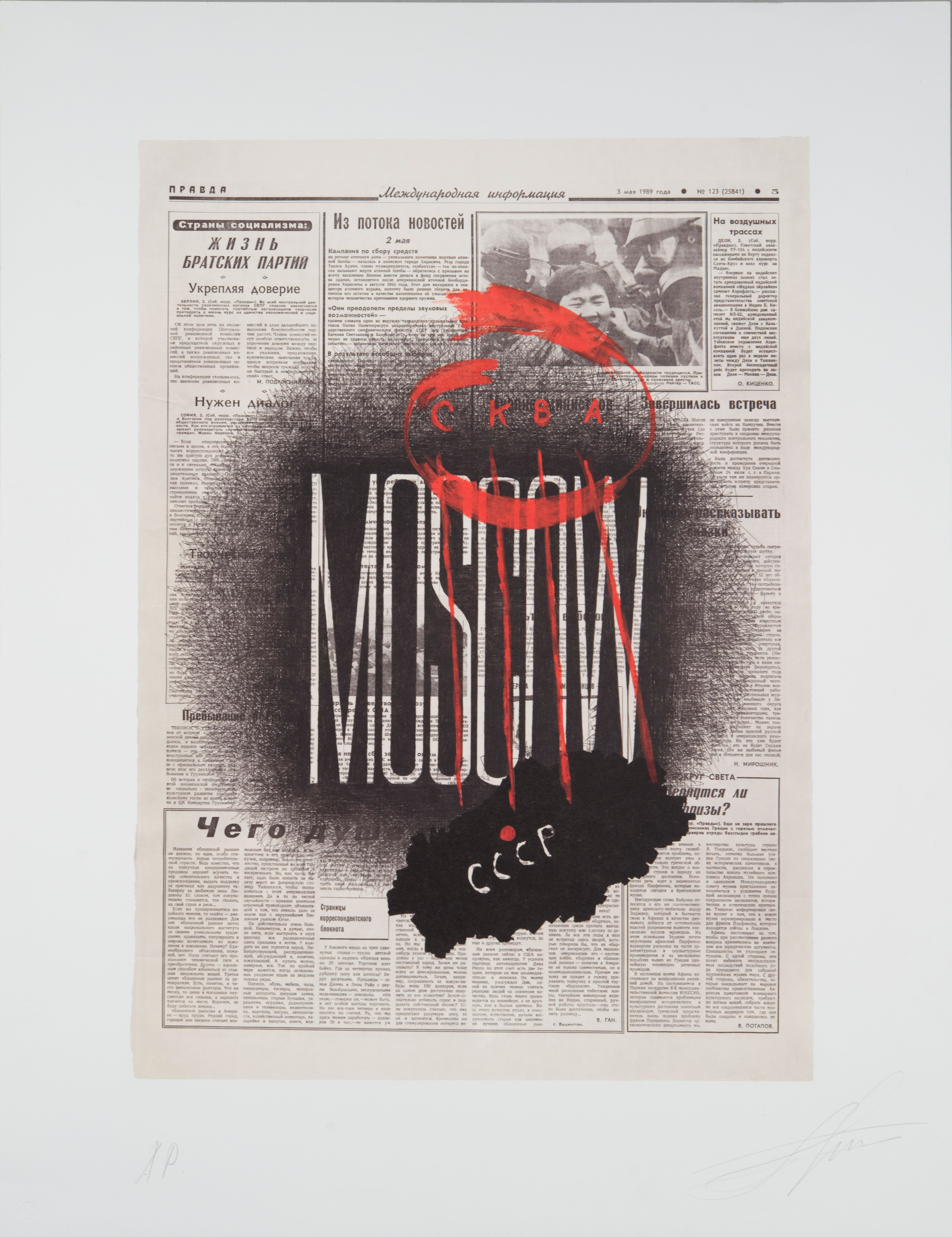
Moscow, 1989. Ballpoint pen and gouache on newspaper "Pravda," 57.5 × 41.1 cm (22 5/8 × 16 3/16 in.) / 76.1 × 58 cm (29 15/16 × 22 13/16 in.). Norton and Nancy Dodge Collection of Nonconformist Art from the Soviet Union. D02729
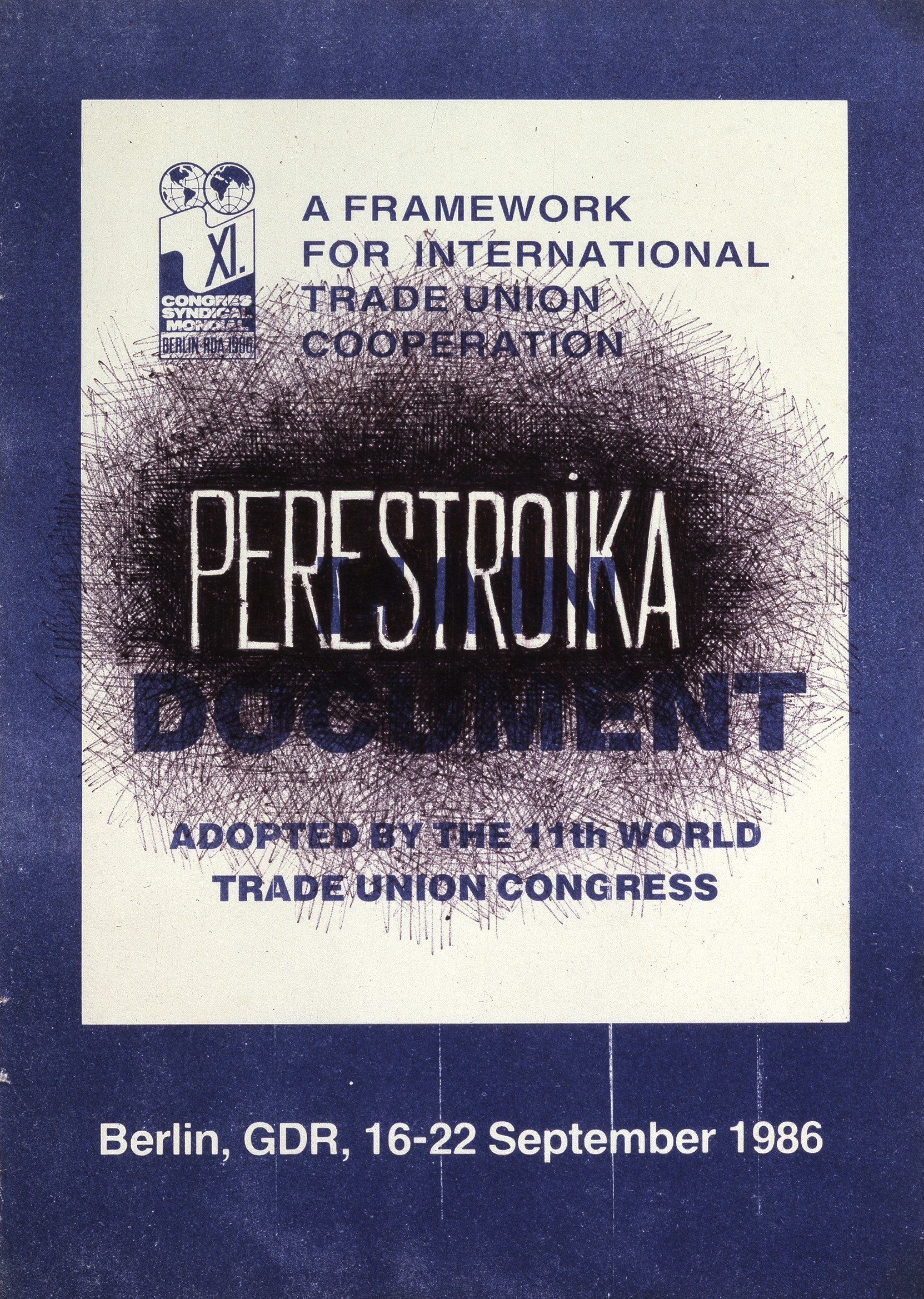
Perestroika, 1986–87. Ballpoint pen on printed paperback book cover, 20.3 x 14.5 cm (8 x 5 11/16 in.). On loan from the collection of Norton and Nancy Dodge. L02270
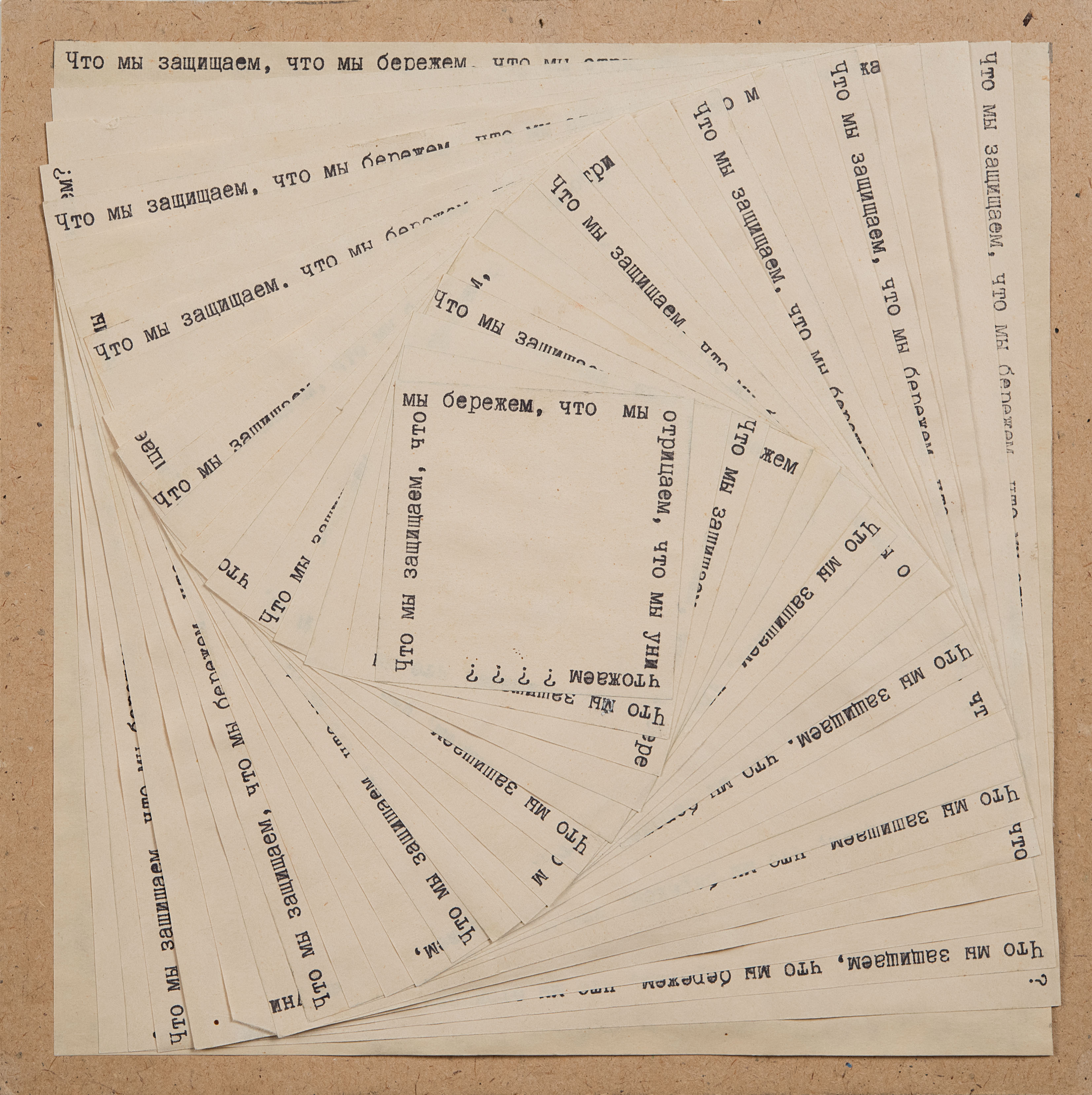
My Uncle, a Most Worthy Gentleman, 1975. Typewritten text on paperboard, 22.2 × 22.2 cm (8 3/4 × 8 3/4 in.). Purchased with funds donated by Norton Dodge and Nancy Dodge. 2003.0001
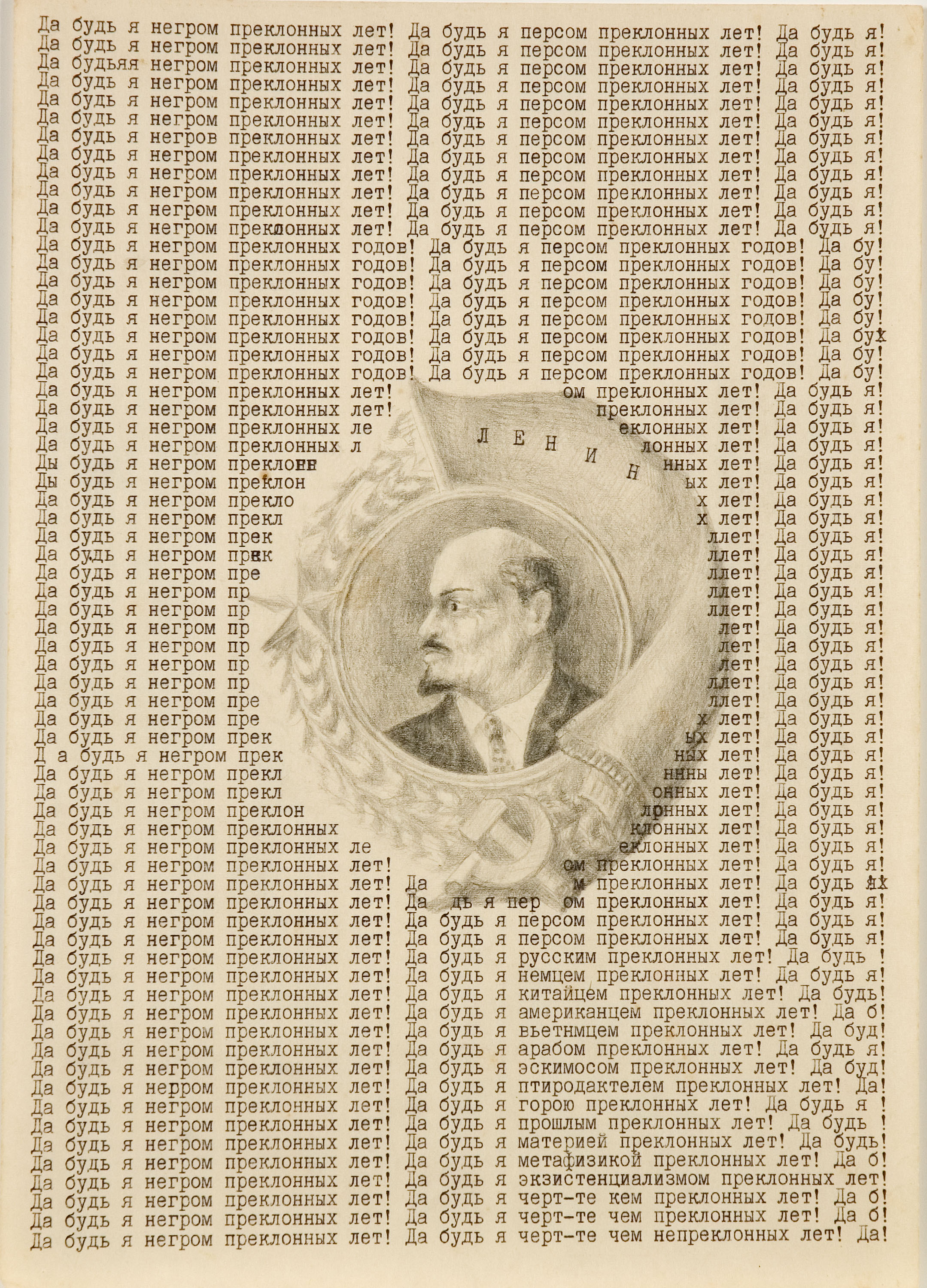
Were I a Negro Getting Up in Years, undated. Graphite and typewritten text on paper, 29.8 × 21.1 cm (11 3/4 × 8 5/16 in.). Norton and Nancy Dodge Collection of Nonconformist Art from the Soviet Union. D21474
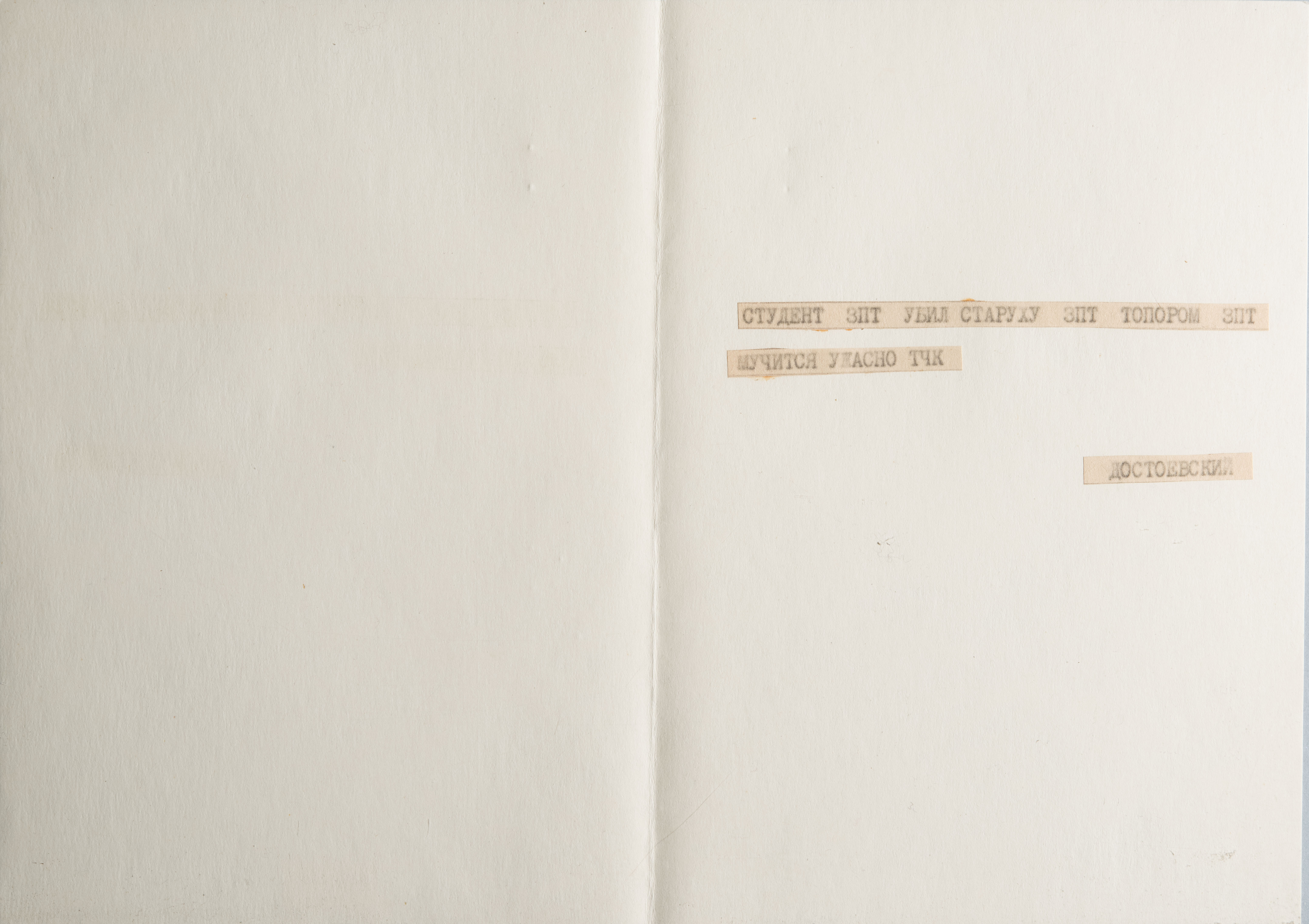
"Student comma murdered old woman comma..." from the series Dmitrii Pribov, Telegrammy, 1981. Typewritten text on cartridge paper collaged on paper, 21.1 × 30.3 cm (8 5/16 × 11 15/16 in.). Museum Purchase. MANI2.02.33.07
Selected Exhibitions
1991 100 Möglichkeiten. Installationen für eine Putzfrau und einen Klempner [100 possibilities. Installations for a cleaning lady and a plumber], Inter Art Agentur für Kunst, Berlin, Germany
1993 Der Schlaf der Walküren gebiert schlafende Ungeheuer [The sleep of Valkyries awakens sleeping terrors], Kunstwerke, Berlin, Germany
1995–96 Dmitrij Prigow: 1975–1995. Städtisches Museum, Mülheim an der Ruhr, Germany; Ludwig Múseum, Budapest, Hungary; Musée d’Art Moderne, Saint-Etienne, France
2001 Вагина Малевича [Malevich’s vagina], State Russian Museum, Saint Petersburg, Russia
2002 Phantom Installations, University Art Gallery, University of Pittsburgh, Pittsburgh, PA, USA
2004 Видение Каспару Давиду Фридриху русского Тибета [Caspar David Friedrich’s vision of Russian Tibet], State Tretyakov Gallery, Moscow, Russia
2008 Граждане! Не забывайтесь, пожалуйста! [Citizens! Please mind yourselves!], Moscow Museum of Modern Art, Moscow, Russia
2011 Дмитрий Пригов: Дмитрий Пригов [Dmitri Prigov: Dmitri Prigov], State Hermitage as part of the 54th Venice Biennale, Ca’ Foscari University, Venice, Italy
2014 Дмитрий Пригов. От ренессанса до концептуализма и далее [Dmitri Prigov: From Renaissance to conceptualism and onward], State Tretyakov Gallery, Moscow, Russia
2015 Дмитрий Пригов: в диалоге с авангардом. К 75-летию со дня рождения [Dmitri Prigov: In dialogue with the avant-garde. On the 75th anniversary of his birth], State Russian Museum, Saint Petersburg, Russia
Selected Publications
Degot, Ekaterina, ed, Граждане! Не забывайтесь, пожалуйста! [Citizens! Please mind yourselves!]. Exhibition catalogue. Moscow: Moscow Museum of Modern Art; Novoe Literaturnoe Obozrenie, 2008.
Dobrenko, Yevgeny, et al., eds, Неканонический классик: Дмитрий Александрович Пригов (1940–2007). Сб. статей и материалов [The uncanonical classic: Dmitri Aleksandrovich Prigov (1940–2007). A collection of articles and materials]. Moscow: Novoe Literaturnoe Obozrenie, 2010.
Golynko-Volfson, Dmitry. “Пригов-художник и Пригов-поэт: трудности расшифровки” [Prigov the artist and Prigov the poet: The challenges of decoding]. In Artterritory.com, December 12, 2012.
Gurshtein, Ksenya. “The Eloquent Spaces of Silence: D. A. Prigov's Visual Art.” In Russian Literature 76, no. 3 (October 1, 2014): 309–38.
Nicholas, Mary. “’Ėto odna kaša’: Word as Image in Work by Dmitrij Prigov.” In Russian Literature 76, no. 3 (October 1, 2014): 361–80.
See also