
Feodosii Humeniuk
1941 — Rybchyntsi, Vinnytsia region (Ukraine). Worked in Dnipropetrovsk (now Dnipro) and Kyiv (Ukraine) and Leningrad (now Saint Petersburg, Russia); currently works in Kyiv (Ukraine)
Born in 1941, Feodosii Humeniuk is a key figure of late twentieth- and early twenty-first-century Ukrainian nonconformist art. Humeniuk works primarily in the fields of painting and illustrations; however, his oeuvre includes works of monumental art, stained glass, murals, iconography, art theory, and pedagogy. He employs realism with an emphasis on decoration, modern deformation of forms, mythopoetic content, and use of folklore-song, archaic, and Christian imagery. His main theme is Ukrainian history, the traditions and beliefs of its people, the art of the Cossack Baroque era, and twentieth-century modernism.
Throughout his life, he lived and worked in Dnipropetrovsk (now Dnipro, Ukraine), Leningrad (now Saint Petersburg, Russia), and, since 1992, Kyiv. He also visited Canada, France, and the United States during his career. From 1959 to 1965, Humeniuk studied at the Dnipropetrovsk State Art School (now Dnipropetrovsk Professional Art College of Culture). Following this, from 1965 to 1971 he studied at the Ilya Repin Leningrad Institute of Painting, Sculpture and Architecture (now the Saint Petersburg Ilya Repin Academy of Arts), in the workshop of Iosip Serebrianyi (1907–1979), a Ukrainian-born People’s Artist of the USSR.
Upon graduating, Humeniuk presented his diploma work, Сільські музики [Village Musicians] (1971), and in doing so discovered the theme that would inspire his future work: the search for a synthesized image of his native land and its culture, a generalized image of Ukraine. Historical heroes and folkloric figures from Ukrainian culture would appear in the master’s artwork from the mid-1970s to the present day. This initially provoked the wariness of Soviet ideological censorship; however, it later gained recognition during the era of Ukrainian independence.
From 1972 to 1976, Humeniuk worked as a lecturer at the Leningrad Vera Mukhina Higher School of Art and Industry (now Saint Petersburg Stieglitz State Academy of Art and Design). The Zimmerli Museum collection features drawings and lithographs from this period (from 1972 to 1974), dedicated to Saint Petersburg (then Leningrad) and its famous suburbs, such as Gatchina (ZAM, D00302, D02885, D02894). In 1975, Humeniuk organized the First Exhibition of Ukrainian Nonconformist Artists in Moscow.
In following year, the artist created the painting Гонта і Залізняк [Honta and Zalizniak] (1976), glorifying the two heroes by depicting a sacrificial chalice on the ground between them, an icon of the Mother of God with the infant in the sky, and, in the center of the composition, a ritual procession flowing through the valley, with distant views of village churches and majestic cathedrals. The compositional center of the canvas is the crossed sabers held by the main figures of this mythopoetic work; they simultaneously serve as a protective symbol. The master skillfully plays with the aesthetic of Cossack elder portraiture, without resorting to mimicry, and captures the characteristic outlines of appearance and symbolic elements of the costume. This is produced with an impasto painting technique, a nearly monochromatic palette, and a combination of different perspectives in the composition, which enhance the distinctive stylization of the work.
The artist’s inclination toward a pronounced authorial control in his paintings led him to favor the genre of still life, which has remained a constant throughout his creative career, alongside his works in the historical genre. Humeniuk’s still lifes are always concise and meaningful. In the work Зелені свята [Green Holidays] (1976), the jugs are presented monumentally and arranged in a balanced composition in the foreground, with a bouquet of poppies and a large sunflower obscuring the horizon line, while the landscape with distant fields rises into an endless expanse, merging into the sky. [1] In other still lifes, the jugs and poppies are equal to distant mountains, tall trees, and the bell towers of Cossack Baroque-era churches.
In 1977, the artist returned with his family to Dnipropetrovsk and, until 1983, worked as a monumental artist at the Dnipropetrovsk Art and Production Complex (kombinat). Humeniuk’s work included the creation of stained-glass windows for public spaces in Kyiv: the Mayak restaurant, the Hotel Ukraina, the Institute of Agriculture, and various city hospitals.
In the 1980s, Feodosii Humeniuk became fascinated with the vivid art of folk paintings and Ukrainian iconography. He was attracted to the symbolism and codified strategies of the artistic means in folk and medieval works. In the painting Мій край [My Homeland] (1980), he creates a folklore-song image of Ukraine. The central figure in the densely filled composition is a beautiful woman in national attire, holding a sheaf of rye like a precious child. Around her are images of Cossacks, Chumak wagoners and traders on horseback, a rooster, and an angel playing the violin. The composition leads our gaze in a circular motion, like a flowing song with its various events, heroes, and rhythmic repetitions.
Humeniuk’s still lifes from the 1980s are imbued with symbolism. In Пробудження [Awakening], a Hutsul wooden candlestick with carved crosses is combined with the image of a rooster, symbolizing the Christian awakening of the soul to true life and faith. In this work, the rooster holds an elongated cross as a reminder of Christ’s sacrifice. These religious references were a risk during Soviet times and opened the potential for accusations of dissent and consequent punishment. Despite this threat, the artist remained true to himself and his national consciousness and professed traditional values. Humeniuk found using symbolic objects for his paintings allowed him to remain authentic. A notable example of this is Чумацька ікона [Chumak’s Icon] (1983), depicting a unique icon on a dried fish; the icon not only is a real object of veneration in Ukrainian history but is a specific one is preserved in Saint Petersburg at the Russian Museum of Ethnography. The fish is derived from early Christian symbolism; the artist brings it close to the viewer in the composition, against the background of a cross with icon hills inscribed below.
In 1988, Humeniuk became a member of the Union of Artists of the USSR while living in Leningrad (now Saint Petersburg) and, in 1992 permanently returned to Ukraine. In 1993, he joined the National Union of Artists of Ukraine and was awarded the Taras Shevchenko State Prize that same year. He was then invited to teach at the Ukrainian Academy of Arts (now the National Academy of Fine Arts and Architecture), leading the historical painting workshop. In 1995, he received the title of Honored Artist of Ukraine, and in 2009 was named the People’s Artist of Ukraine.
Since the early 1990s, Feodosii Humeniuk has been rethinking his artistic vision. In his earlier works, folklore-song images leaned toward the stylistics of folk paintings with their flat-decorative solutions or almost monochromatic painting, executed in a close color scheme. Trips to France and North America, visits to museum collections, and teaching at the National Academy of Fine Arts and Architecture revived the artist’s interest in the academic painting of the historical genre. From this time, Humeniuk’s works began to feature a harmonious combination of three-dimensional realistic portrayals of faces with flat decorative renditions of costumes, enhancing the overall rhythm of the composition. His historically themed works gained a monumental scale, with eventual emphasis on exhibiting in museum spaces.
A significant work of his recent historical paintings is Конотоп. 1659 рік. Зустріч гетьмана Івана Виговського [Konotop, 1659, Meeting of Hetman Ivan Vyhovsky] (2001). The mise-en-scène is brought to the foreground, with the artist presenting a stylized depiction of Cossack leaders and female figures, incorporating heraldry and images of saints while drawing on archetypes from the mythopoetics of Ukraine’s glorious past.
Humeniuk also worked as an icon painter for the iconostasis of the Holy Protection Church in Kyiv in the late 1990s and, in 2003, completed murals in the altar of this same church. As a theorist, he recorded his reflections in a scientific publication, “Historical Painting and the Tasks of Academic Art Education.” [2]
In recent decades, the artist has been interested in the history and art of Ukraine from the sixteenth to eighteenth centuries, known as the Cossack Baroque era. He is also close to the art of the National Revival period, such as the works of Heorhyi Narbut (1886–1920) and Mykhailo Boichuk (1882–1937). However, his creativity is not only based on the admiration of Ukrainian national art traditions; Feodosii Humeniuk incorporates the experiences of twentieth-century modernism in his compositional solutions, approach to color, and rhythm. His works, regardless of format, acquire a monumental tone using large rhythmic lines to form a structurally balanced composition. The artist combines flat and three-dimensional modeling of images, decorativeness, and nuanced fine painting. Humeniuk regarded the immortalization of Ukrainian history as the mission and purpose of this work and of the painting workshops he led at the National Academy of Fine Arts and Architecture and the Mykhailo Boichuk Kyiv State Academy of Decorative Applied Arts and Design.
Among the most significant representations of Humeniuk’s creativity are his still lifes from 1976 and his works on folklore-song themes. In the first still life drawing, Untitled (1976, ZAM, D05837), the composition features an array of contrasting items: large bottles of various shapes, a jug holding a poppy floral arrangement, a nearby angel, and the head of a bull. The piece symbolically relays the timelessness of rural life and its static, sacred nature. In the second still life, Untitled (1976), the artist again depicts his favorite bouquet of poppies in a tall vessel alongside more bottles of various sizes, a fish, and a rooster (ZAM, D09288). These latter images are understood as integral parts of everyday life but are also Christian symbolism, wherein the rooster represents awakening and the fish symbolizes the soul and, in turn, Christ.
In the genre folklore-song color drawing Untitled (1976, ZAM, D07129), the image depicts a girl and a Cossack man with a horse, against a background of fields containing a pair of oxen and a cart. With its plowed fields, colorful striped sky, the alternating colors of the girl’s costume, and the ribbons flowing from the wreath, Humeniuk’s world conveys the dynamism and integrity of folk songs and their iconic imagery.
Olga Lagutenko
Translated from Ukrainian by Ada Wordsworth
Notes:
1. “Green week, or green holidays, is a traditional Slavic seasonal festival celebrated in early June. It is closely linked with the veneration of the dead and the spring agricultural rites. In Eastern European villages, the seven weeks following Easter have historically been a time of festivity. Green week takes place during the seventh week leading up to the Pentecost, and includes the seventh Thursday after Easter, called Semik.”
2. Feodosii Humeniuk, “Istorychnyi zhyvopys i zavdannia akademichnoi khudozhnioi osvity” [Historical painting and the tasks of academic art education], Ukrainska Akademiia mystetstv. Doslidzhennia ta nauk.-metodychni pratsi [Ukrainian Academy of Arts: Collection of scientific works] 1 (1994).
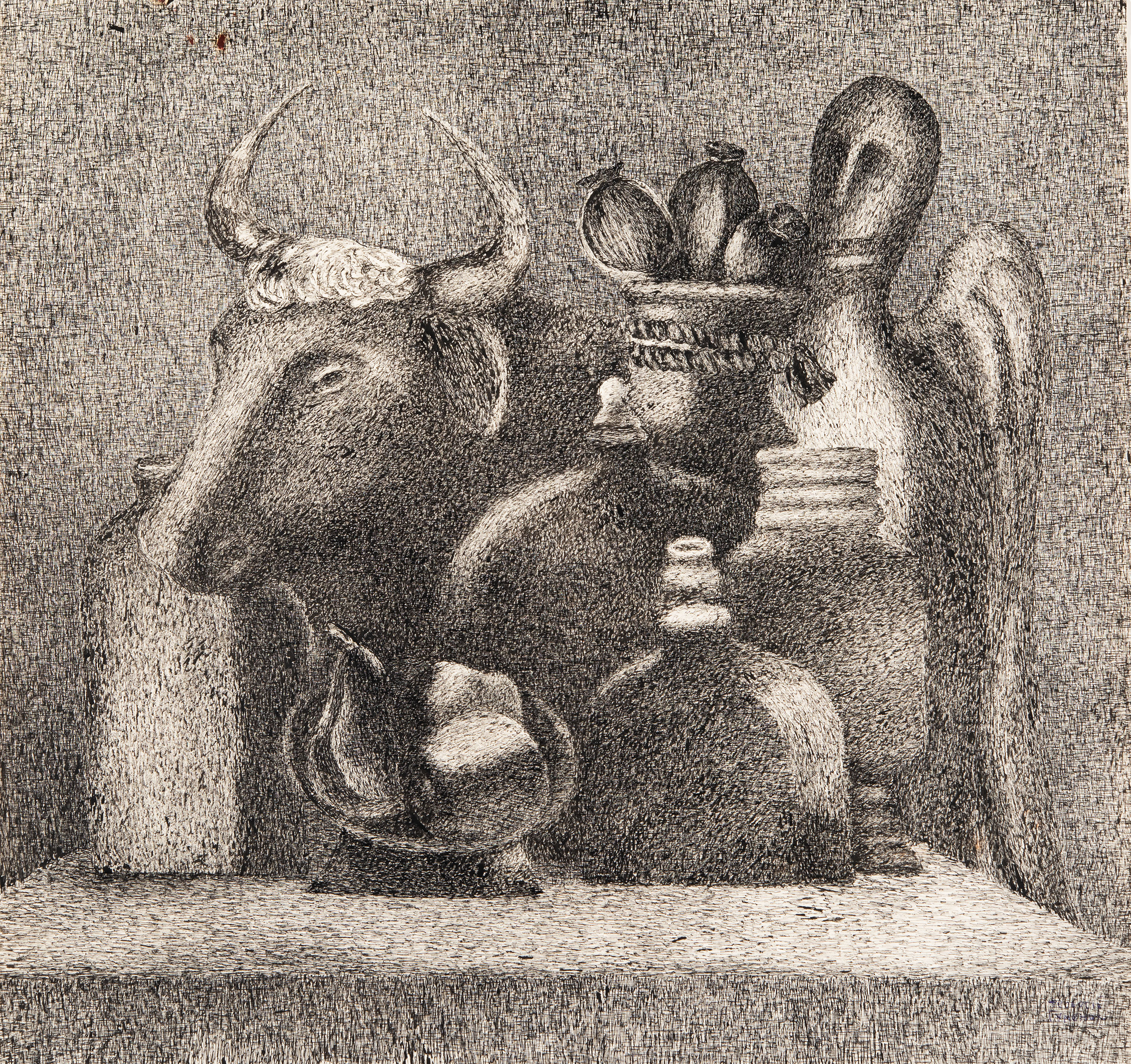
Untitled, 1976. Ink on paper, 65 × 66.6 cm (25 9/16 × 26 1/4 in.). Norton and Nancy Dodge Collection of Nonconformist Art from the Soviet Union. D05837
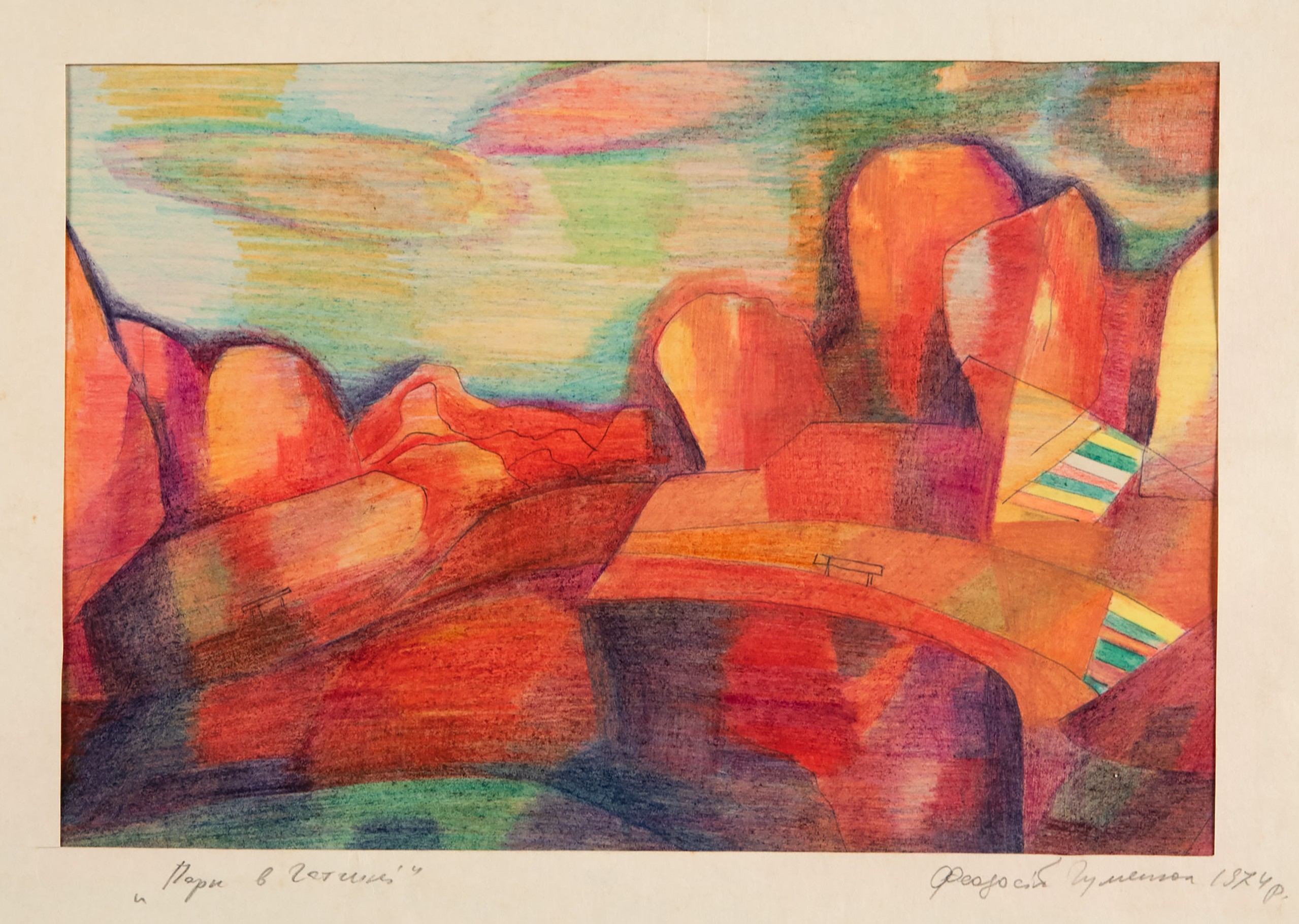
Park at Gatchina, 1974. Colored pencil on paper, 20.1 x 30.7 cm (7 15/16 x 12 1/16 in.). Norton and Nancy Dodge Collection of Nonconformist Art from the Soviet Union. D00302
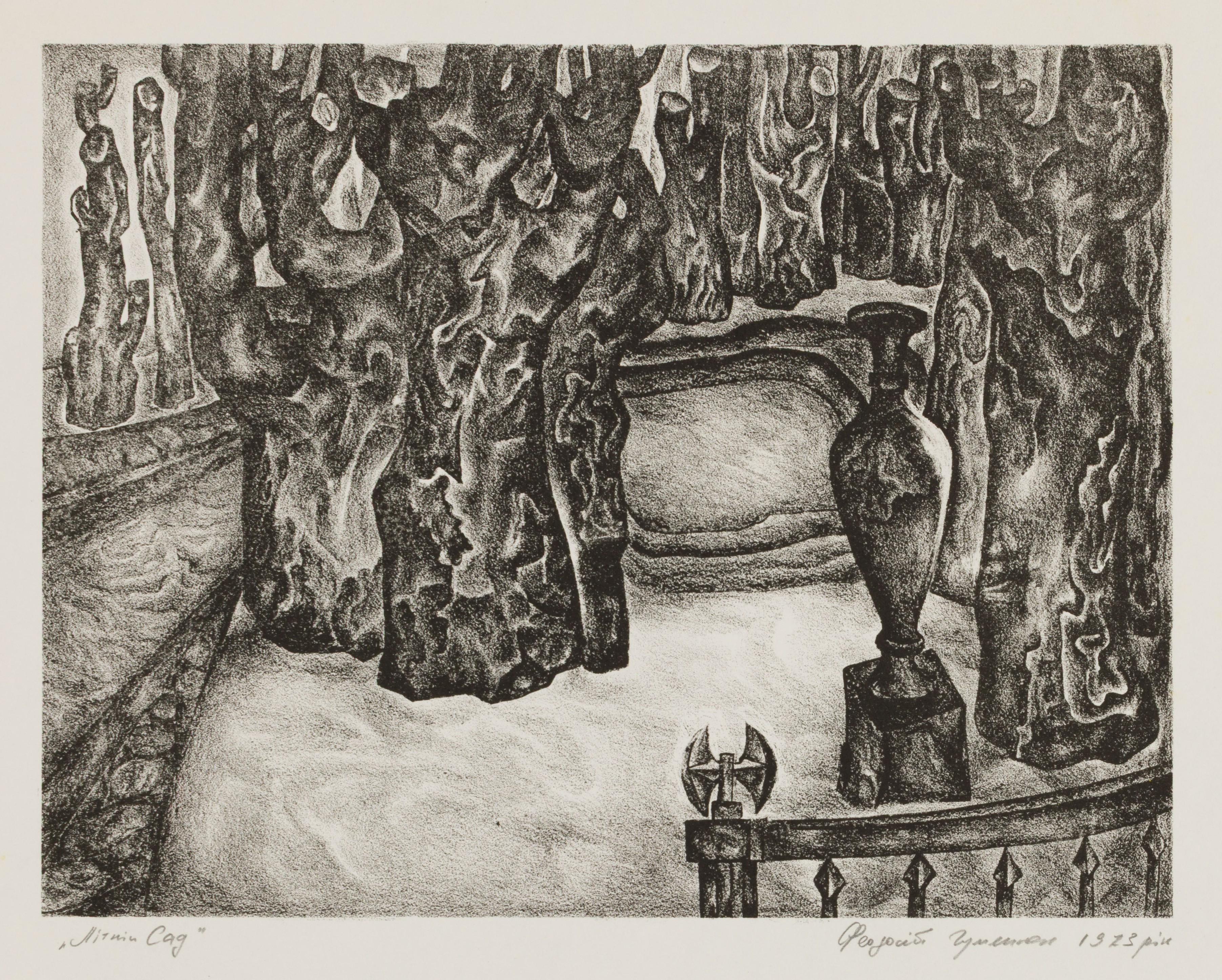
Summer Garden, 1973. Lithograph on paper, 21 × 27.3 cm (8 1/4 × 10 3/4 in.) / 40.5 × 62.1 cm (15 15/16 × 24 7/16 in.). Norton and Nancy Dodge Collection of Nonconformist Art from the Soviet Union. D02885
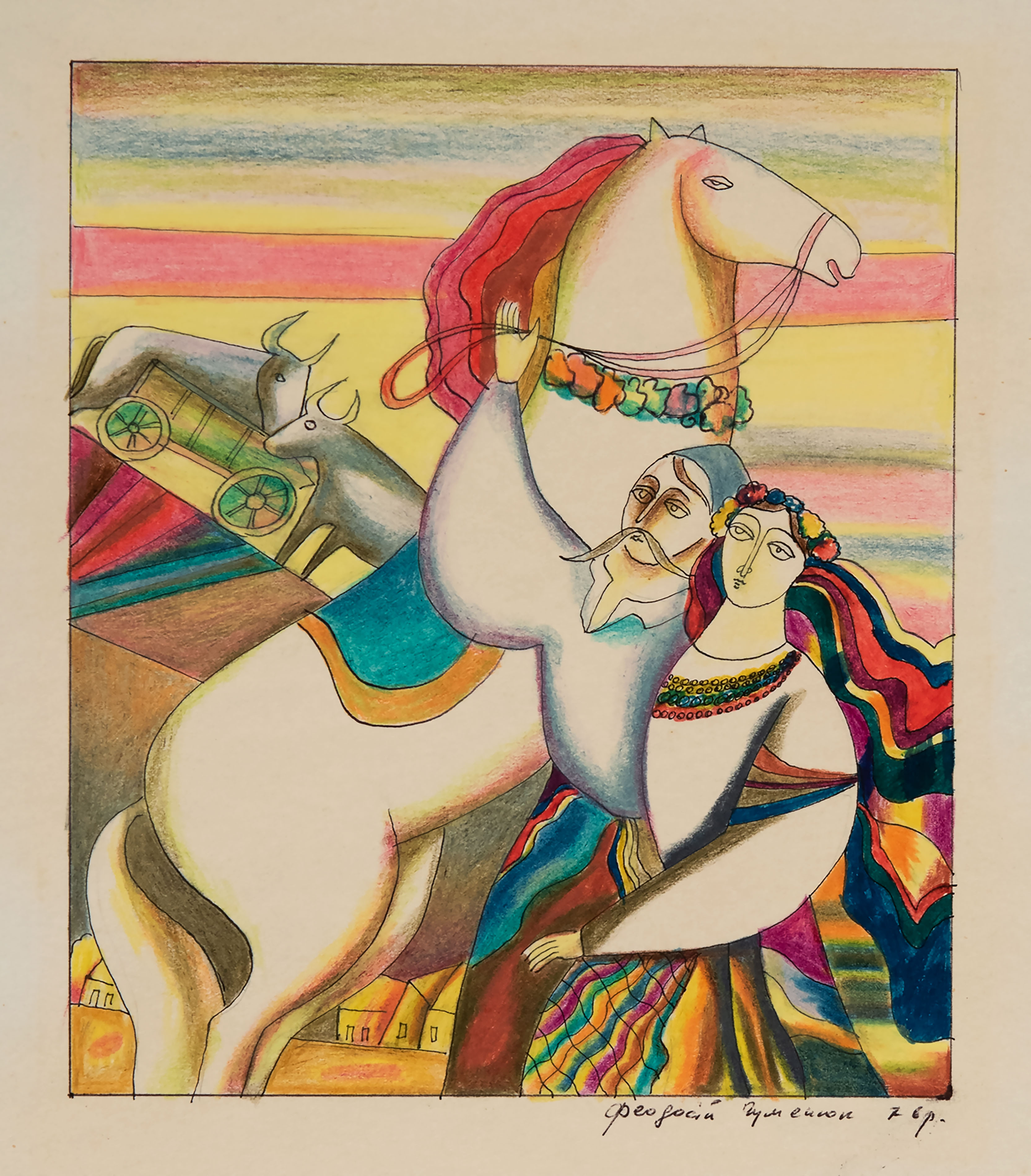
Untitled, 1976. Colored pencil and watercolor on paper, 16.9 x 14.6 cm (6 5/8 x 5 3/4 in.) / 42 x 29.7 cm (16 9/16 x 11 11/16 in.). Norton and Nancy Dodge Collection of Nonconformist Art from the Soviet Union. D07129
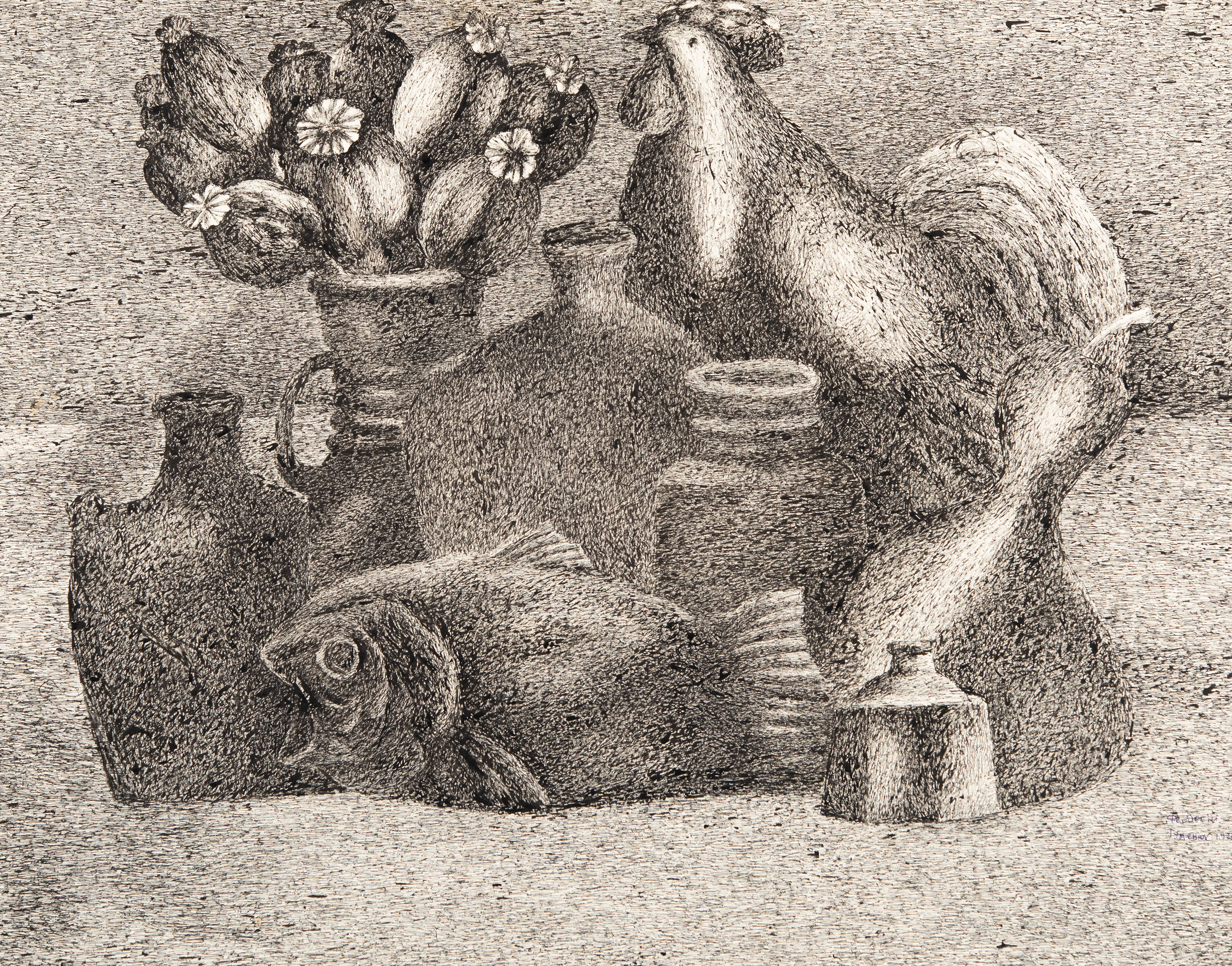
Untitled, 1976. Ink on paper, 58.4 × 72.4 cm (23 × 28 1/2 in.). Norton and Nancy Dodge Collection of Nonconformist Art from the Soviet Union. D09288