
Mykhailo (Moisei) Vainshtein
1940 — Druzhkivka, Donetsk Oblast (Ukraine) | 1981 — Kyiv (Ukraine). Worked in Kyiv (Ukraine)
Vainshtein was a Ukrainian artist of Jewish heritage, a member of the Union of Artists of the USSR, a painter, a graphic artist, and a sculptor; he also practiced photography. His subjects came from historical and domestic genres before he turned his attention to portraiture, landscape painting, and still lifes. His painting was influenced by expressionism and postimpressionism, as well as the Ukrainian baroque style.
Vainshtein was born to a tractor driver and a schoolteacher. During World War II, many of his relatives were lost; some died on the front, while his mother died in an evacuation in 1942. Together with his older brother, Volodymyr, he was originally raised by relatives before eventually being placed in a Kyiv orphanage for gifted children. In 1950 Volodymyr (who had just graduated from a Kyiv art school) died. The loss of Vainshtein’s family members would later be reflected in much of his work.
Having graduated from the Kyiv Art Secondary School, Vainshtein entered the Kyiv State Art Institute, where he studied under the painting faculty of Karpo Trokhymenko (1885–1979) and, between 1959 and 1965, Mykhailo Khmelko (1919–1975). His diploma painting, Ласкаво просимо Welcome], was inspired by trips to the village of Velykyi Pereviz in Poltava Oblast, where the artist first visited in 1961. Residents of the village posed for numerous sketches and studies. In 1965 the painting was displayed at that year’s Exhibition of Diploma Works, Sketches, Studies, and the Best Coursework of Students of the Kyiv State Art Institute, as well as at the Eleventh All-Union Exhibition of Diploma Works of Students of the USSR in Moscow. From that point onward, Vainshtein would regularly participate in exhibitions both at the level of the republics and the entire Soviet Union.
It was also at this time that Vainshtein met his future wife, Nina Shostak, then a student in the Department of the Theory and History of Art at the Kyiv Fine Art Institute. Shostak would later become the custodian of her husband’s legacy. Together, the couple had two children: Volodymyr, who was born in 1968, and Darya, born in 1974. Together, they were the artist’s favorite models. From 1965 to 1967, Vainshtein studied at the creative workshops of the Academy of Arts of the USSR in Kyiv under Serhii Hryhoriev (1910–1988). This period was hugely productive for the artist, as he produced numerous portraits and still lifes, including Брати, 1941 [Brothers, 1941] (1967); Шахи [Chess] (1966); Нічне чергування [Night Shift] (1966); and Лікнеп [Likbez] (1967). In 1967 Vainshtein entered the Union of Artists of the USSR.
Although Vainshtein’s short career spanned only two decades, it can nonetheless be divided into two distinct periods, the 1960s and 1970s. In the 1960s, he often turned to the genre of historical-revolutionary painting, as was characteristic of socialist realism, which at that time was still strictly stylistically regulated. In Vainshtein’s case, the generalization of form and conscious limitation of the color palette recall the traditions of national modernism of the 1920s, and in particular the monumental school of Mykhailo Boichuk (1882–1937) and expressionism. In accordance with the leading trends of the 1960s in Ukraine, Vainshtein was also concerned with the sociopolitical context in which he lived and worked and the fate of man in the context of the events and changes of the twentieth century, especially the revolution of 1917 and World War II. In 1968 he painted the work Перші [The First], which depicts Komsomol members of the 1920s. The work was later lost, although the artist re-created it in 1980.
The young artist very quickly became a prominent figure in Ukrainian artistic life, joining the cultural elite of the 1960s. Among his acquaintances were the artists Hryhorii Havrylenko (1927–1984), Yakym Levych (1933–2019), Davyd Myretskyi (b. 1939), Vilen Barskyi (1930–2012), the writer Viktor Nekrasov, and the composer Volodymyr Huba (aka Guba).
In the 1960s, Vainshtein also developed a fascination with photography. Recently, the art critic Valeryi Sakharuk discovered and published an archive of 150 film rolls. [1] For Vainshtein photography was more of an auxiliary activity, as the majority of his attention was focused on painting. However, nowadays the photographs can be organized into whole cycles that reproduce the geography of the places where the artist lived, worked, or traveled: Sedniv, Velyykyi Pereviz, Konotop, Myrhorod, Khomutets, Kyiv, and others. The photographs are remarkable not only for their compositional perfection but also for the breadth of themes that they cover: landscapes, everyday life, events, and portraits.
Vainshtein regularly frequented All-Union houses of creativity, where he socialized with the leading artists of the USSR. His stay at “Senezh,” near Moscow, in 1971 inspired the painting 3x4, which marked a change in his creative direction and a departure from the artistic trends of the 1960s. It reflected the clear influence of pop art aesthetics. The work depicts twelve cultural figures as close-ups: artists Zuleika Bezhbeuk-Melykian (b. 1939), Ihor Obrosov (1930–2010), Borys Kocheishvili (b. 1940), Dzhambul Dzhambaev (1846–1945), Leonid Pinchevsky (1942–2019), Lucien Dulfan (b. 1942), Evhen Bachurin (1934–2015), and Togrul Narimanbekov (1930–2013), as well as poet Eduard Limonov. Odesan nonconformist Volodymyr Strelnikov (b. 1939) is the only one among them depicted as a small figure inscribed in a geometrical cityscape.
In 1973 the 250th anniversary of the birth of Hryhoryi Skovoroda (1722–1794) was widely celebrated in the USSR. Vainshtein worked a great deal on the image of the Ukrainian philosopher, in particular in the style of the Ukrainian Baroque. His large-scale painting Григорій Варсава Сковорода [Hryhoryi Varsava Skovoroda] (1972, National Art Museum of Ukraine) is a life-size representation of the itinerant thinker, absorbed in thought as he composes poetry. According to Soviet interpretations of Skovoroda, the philosopher should have been depicted as a peasant, barefoot in simple, almost shabby, clothing. For the painting, the artist created a number of preparatory sketches and studies in which he searched for the appropriate representation. In one of these sketches, which is in the Zimmerli collection (ZAM, D10497), Skovoroda appears as an ascetic in an almost monochromatic color palette, reminiscent of early twentieth-century expressionism. The image of the philosopher thus has been made comparable to traditional images of apostles or prophets, devoted to their faith and vocation.
Although Vainshtein continued to create works in the vein of socialist realism throughout the 1970s (Урожай: Хлібороби України [Harvest: Breadmakers of Ukraine], 1977; Відродження [Renaissance], 1979; and День Перший [First Day], 1980), by this time his work was dominated by paintings of a more personal nature, in contrast to the generalized themes of socialist realism. These subjects included landscapes, which he usually painted either in Kyiv or Sedniv; portraits of family members; self-portraits; still lifes of flowers; and interiors. He also painted portraits of his artist friends, for example of Anatolii Lymarev (1929–1985) in 1979, Valerii Akopov in 1979, and his old colleague Serhii Otroshchenko in 1972. In the 1960s, the artist had begun to engage in sculpture, in which he also developed his craft, as can be seen in Чекання [Waiting] (1968), which depicts a laconic image of a pregnant woman. In the 1970s, Vainshtein’s art acquired a new dynamism, a soft humor, and an expressive texture (Друзі [Friends], 1974; Художник Михайло Штаєман [The Artist Mykhailo Shtaeman], 1974–75; and Художник Ігор Григор’єв [The Artist Ihor Hryhorev], 1975–79, among others).
The common theme that weaves throughout the artist’s work from the 1960s onward is that of orphanhood. It first appears in the painting Мати: Тривога [Mother: Anxiety (1967)], then further dramatically reveals itself in Брати,1941 [Brothers: 1941 (1967)], in which Vainshtein uses the technique of the colored photograph to endow the painting with a documentary quality The most powerful work in the series is Батько: 1941 рік [Father: 1941], created in the same dark tones that became characteristic of his works in the 1970s. The painting depicts a father and small son, who together form a single whole. It is notable that Автопортрет з сином [Self-Portrait with Son], which was painted a year earlier, is similar in composition. Vainshtein seems to experience the tragedy of orphanhood not only from his experience as an orphan himself but also through his experience of parenthood.
Self-portraiture is the second overarching theme. During the 1960s and the first half of the 1970s, Vainshtein painted himself almost annually. The culmination of this genre is the work Self-Portrait (1973), which express a Renaissance-style, Rembrandtesque self-awareness of art as timeless and eternal.
Mykhailo Vainshtein’s last completed work, Ранок [Morning] (1981), reveals a bright, optimistic tone: It is dedicated to the joys of everyday family life. On May 26, 1981, Vainshtein died in a Kyiv hospital from an illness he had lived with since childhood. His first solo exhibition was held posthumously in Kyiv in 1987, in the exhibition hall of the Union of Artists of the Ukrainian USSR.
Oksana Barshynova
Translated from Ukrainian by Ada Wordsworth
Notes:
1. Valeriy Sakharuk, Mykhailo Veinshtein: Fotoarkhiv [Photoarchive]. Kyiv: self-published, 2016.
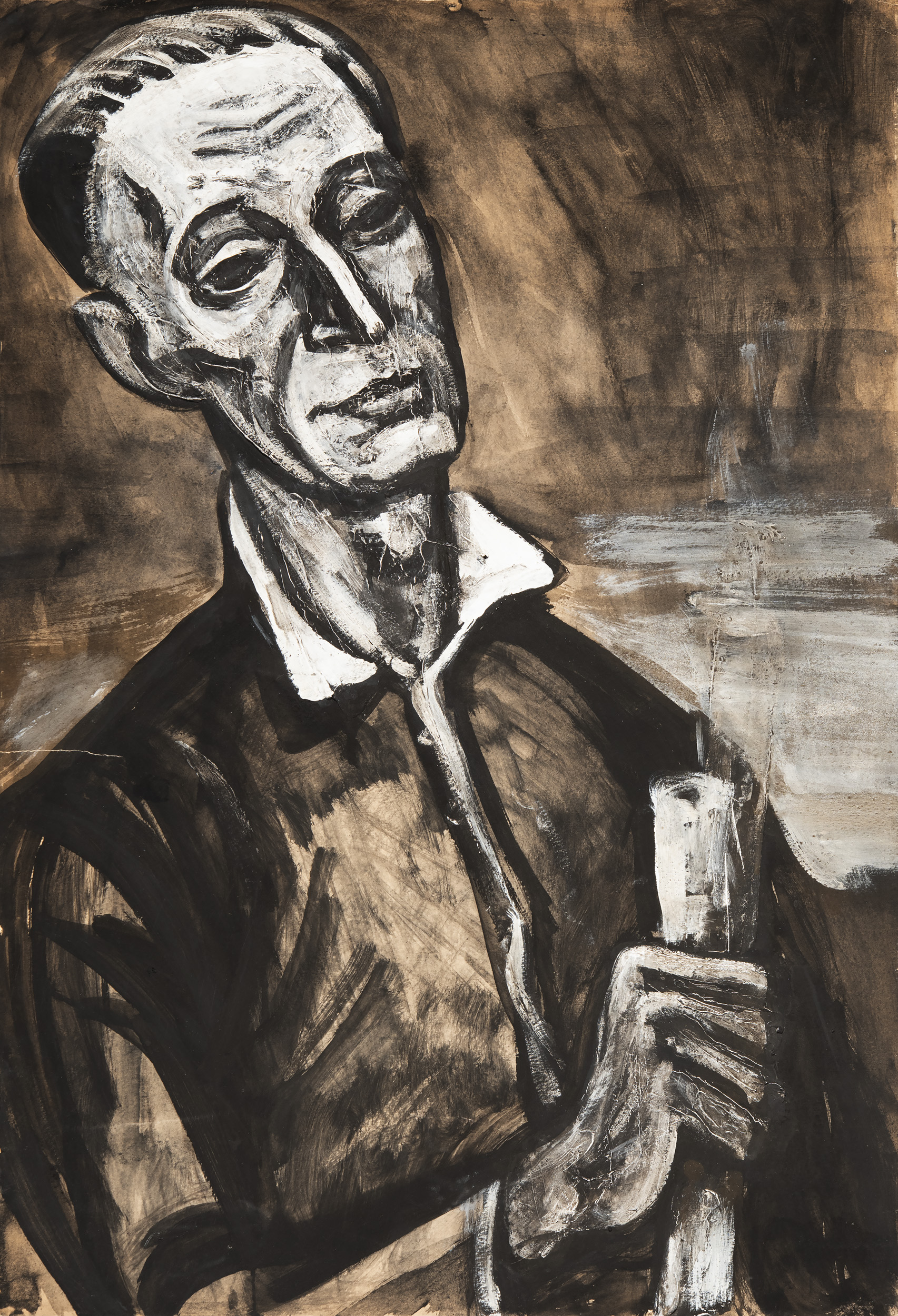
Sketch or Hryhoryi Varsava Skovoroda (1972), early 1970s. Tempera on paper, 92 × 55.2 cm (36 1/4 × 21 3/4 in.). Norton and Nancy Dodge Collection of Nonconformist Art from the Soviet Union. D10497