
Nikolai Gazeev
1948 — Samara (Russia). Lives and works in Almaty (Kazakhstan)
Nikolai Gazeev graduated from the Art College of Alma-Ata in 1970, and from Leningrad’s Repin Institute of Painting, Sculpture and Architecture (now the Saint Petersburg Repin Academy of Fine Arts) in 1978. After finishing his studies at the Academy, Gazeev was sent on a work assignment to Tyumen, where he worked for Tyumen’s Artists’ Union. For some time, he lived in Tobolsk. He became interested in the culture, history, and architecture of the city, sketching and painting many landscapes. In 1983, he became a member of the local Artists’ Union. Three years later, he returned to Leningrad and spent some time working there. During this period, the artist began to make ensemble compositions with his paintings, consisting of a painting and its reverse image (later called a “pictorial pause”). One of his representative compositions of the time is a paired portrait, a painting made of four paintings: a portrait of a woman and its reverse side, and a portrait of a man and its reverse side (1985–88). Later, Portrait of a Woman (part 1 and 2) from this composition was acquired for the Zimmerli Museum’s collection (ZAM, 2001.0129.01-02).
Gazeev works mainly as a draftsman, graphic artist, and painter, although his approach is to combine various formal endeavors and migrate between art forms. He works on the images of the subjects of his portraits for a long time, returning over and over again the same themes. In his practice, he is focused on both the landscape and the person, however he never mixes up the two in a single work, assuming that they’re equally important, and that neither can serve simply as a background or a measure of scale. This is why his landscapes are always devoid of people, and his people are always depicted against an abstract background. Gazeev has said that he developed his approach to drawing as a youth, and neither the art college nor the academy interfered with his search for a method. His professor Yury Neprintsev, a well-known master of socialist realism, gave his student room to develop his own artistic language.
The combination of a strong academic education and formal experimentation is particularly noticeable in Gazeev’s albums of Saint Petersburg landscapes, called Санкт-Петербург, мимолетные впечатления [Saint Petersburg, fleeting impressions], such as Дорога на Париж [Road to Paris] (1993); Санкт-Петербург. Вниз, вверх по течению [Saint Petersburg, downstream, upstream] (1993); and Санкт-Петербург и его окрестности [Saint Petersburg and its environs] (1993–96). The landscapes in the albums are medium-sized graphic studies, drawn on paper in pencil and graphite or retouched. Yet all of these sketches are accomplished works on their own, not preliminary studies for a larger painted canvas. They are a record of the artist’s emotional and sensory memories. At the same time, each work depicts a concrete part of Saint Petersburg’s cultural heritage: Троицкий собор [Trinity Cathedral] (1993), Заячий остров: Петропавловская крепость [Rabbit island: Peter and Paul Fortress] (1993); Соляной городок [Salt Town] (1993); and many others. Gazeev’s style is distinguished by his light touch, ample presence of space, recognizability, impressionistic fragmentation of light and shadow, and a kind of abstract universal quality that helps to complete the image.
After his return to Alma-Ata, the artist traveled through the Tien Shan mountains, stayed at his friends’ dachas, and made drawings, recording his impressions of mountain landscapes, the southern sun, and the sublimity of nature. He made a couple of albums documenting his mountain journeys: Короткое путешествие к заснеженным вершинам [A short trip into the snowy mountain heights] (1993); and Предгорье Тянь-Шаня [Foothills of the Tien Shan] (1997). A surprising outcome of these nature studies around Alma-Ata was the action Пейзаж за Моной Лизой [Landscape behind the Mona Lisa], which the artist did on September 26, 1999, in the mountains 2,250 meters above sea level. Gazeev described his thinking as follows: “One can think that the landscape behind the Mona Lisa is a landscape of premonitions, a universal formula of the earthly in its cosmic dimension. I want to trace the origin of this landscape, to see it closely, down to the smallest details.” [1] The album that came from the action is a record of the artist’s new working method—a search for universal truths.
In Gazeev’s studio on the outskirts of Almaty, in a house in the Ile Alatau foothills, there are about 30,000 drawings in which the image of a person is transformed. Each painting is usually preceded by a large number of such note-sketches (one composition may go through anywhere from ten to a hundred iterations). The artist draws, de-structuring the body as if examining it from different sides, turning parts inside out, increasing their number, and as a result creating a figure that is barely recognizable but still somehow alludes to classical themes and characters. The artist captures these “thought-forms” in order to have time, later, to recapture and recall the impression or idea that came to mind. Over the years of such reflective drawing, Gazeev has developed a special system of signs and compositions that allow him to design a color scheme for each work. This is how his plan for each palette comes into being—not just for an individual work, but as a kind of formula in which each particular color has a place. In addition to this color formula, Gazeev also works out a formula in language: “Idea for a painting / One painting composed of 3-5 / The same woman, facing herself / Yesterday today tomorrow / Yesterday—in green and yellow (viridian green / Today in red and blue (cobalt red) / Tomorrow, the same woman in golden-olive, with a predominance of blue (cobalt blue).” [2]
Since the late 1990s, Gazeev has been painting canvases that can be seen as an attempt to create simultaneous compositions composed of several paintings: a single painting that consists of two, another out of three, a painting of four canvases, another of six or eight. As a rule, each group of paintings contains the painting itself, the background, and a “pictorial pause.” It’s as though Gazeev divides the content of the painting into several layers. The subject of the painting becomes a person who’s undergoing a kind of constructive process: Человек записывающий, запоминающий собой цвет вечернего солнца [A person recording, memorizing, with himself, the color of the evening sun] (2024); or В ожидании авиарейса в Мадрид человек сидящий напротив [Waiting for the flight to Madrid a person sitting across] (2015); or Слегка темнокожая женщина (Тенерифе) прошла улыбнулась мне и прибрежной волне [Slightly dark-skinned woman (Tenerife) passing by smiled at me and the incoming wave] (2016).
The ongoing process occupying the subjects of the paintings is not emphasized by the composition, since the figurative image is complicated to parse. The process occurs instead in the gradation of colors that faction the figure into multicolored facets, and in the doubling and tripling of body parts—eyes, eyelashes, genitals, hands, and so on. Such, in part, is the painting Планета Венера, первая вечерняя звезда – вторая Луна: Одна картина из трёх-четырех: Картина [The planet Venus, the first evening star, a second Moon: One painting of three or four. A painting] (2018). The background and the “pictorial pause” also take part in the process—“It isn’t that I wanted to close off one space or another—there’s space outside of the painting, there’s the painting itself, and there’s a point inside of it that organizes all of that space.” The background and the pictorial pause are often notable for the emphasized presence of a classical cartouche, which seems to ensure the blending of one color into another and one picture into another, creating an extension and facilitating the movement of thought and the record of that movement. This is particularly notable in The Planet Venus, the First Evening Star, a Second Moon: One Painting of Three or Four. Pictorial Pause (2018); and The Planet Venus, the First Evening Star, a Second Moon: One Painting of Three or Four. Background (2018).
Spanish curator Juan Saliquet says of Gazeev’s working method: “Nikolai’s works are not short on conceptual references, though these are drawn more from the magnifying glass of obsession than from a technical manual. His ‘approach’ in art, his way of focusing on the imaginary with the aid of a ‘psychological magnifying glass,’ which becomes a triptych, often borrows from classical art, where the painting is fragmented within itself, showing the viewer the simultaneous evolution of several scenes. Nikolai, on the other hand, offer a viewer scenes not as in the original painting or in his own takes on it, but rather as seen through his particular magnifying lenses—in this way he’s able to expand the simple light spectrum to make visible a hidden Venus, which consumes our mind without our knowledge, as in the triptych called The planet Venus, the first evening star, a second Moon.” [3]
An important aspect of the creation of a painting is the color layer. For Gazeev, paint is crucial to the artistic world he has created. In order to preserve the freshness of the color, the artist invented a special technique: after painting, he stretches a fiberglass film onto the damp surface of the canvas, which forms a tension film with the paint layer, compacts it, and keeps it from developing gaps or voids, promoting the drying of the paint through the canvas. This technique allows the artist to preserve the original brightness of the paint, avoiding problems common to the surfaces of the paintings—cracks, withering, and dryness.
Working in this experimental laboratory mode allows Gazeev not only to lay claim to his own method, and even his own visual universe, but also to comprehend the worlds of other artists. His own path has led to an understanding of the logic of other masters—Diego Velázquez, Francisco Goya, Sergey Kalmykov. It was the Alamty genius Kalmykov who was the focus of Gazeev’s attention for many years. At the request of the National Archive of the Republic of Kazakhstan, from 1998 to 2000, Gazeev researched materials through the Sergey Kalmykov Foundation, looking through the artist’s diaries, paintings, albums, and drawings. The result was an exhibition of Kalmykov’s works in the Dostyk business center in Almaty (2001).
Yulia Sorokina
Translated from Russian by Elina Alter
Photo portrait by Alexandra and Andrei Roganov. From the Nikolai Gazeev archive.
Notes:
1. A. Lednev, “Неожиданно—абсолютная тишина…” [Unexpected—absolute silence…]. In Новое поколение [New Generation], January 2000.
2. Nikolai Gazeev, Textual formula of color, unpublished manuscript.
3. Juan Saliquet, FADING TRACES. Nikolai. Exh. cat. Almaty: Esentai gallery, 2024.
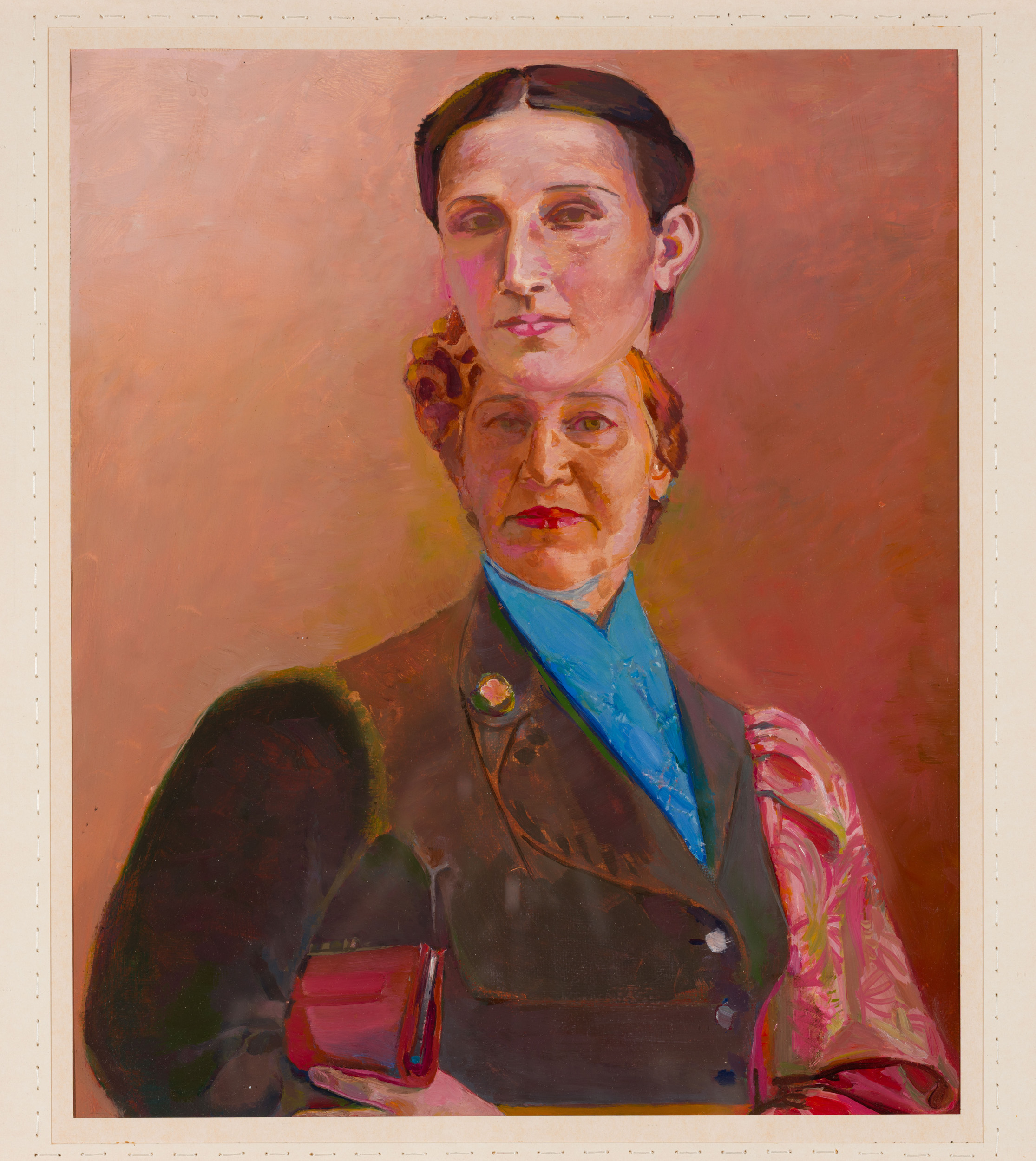
Album-Portrait (Portrait of a Woman) Part 1, 1985–88. Oil on canvas, 51 × 47 cm (20 1/16 × 18 1/2 in.). Purchased with funds donated by Norton Dodge and Nancy Dodge. 2001.0129.01
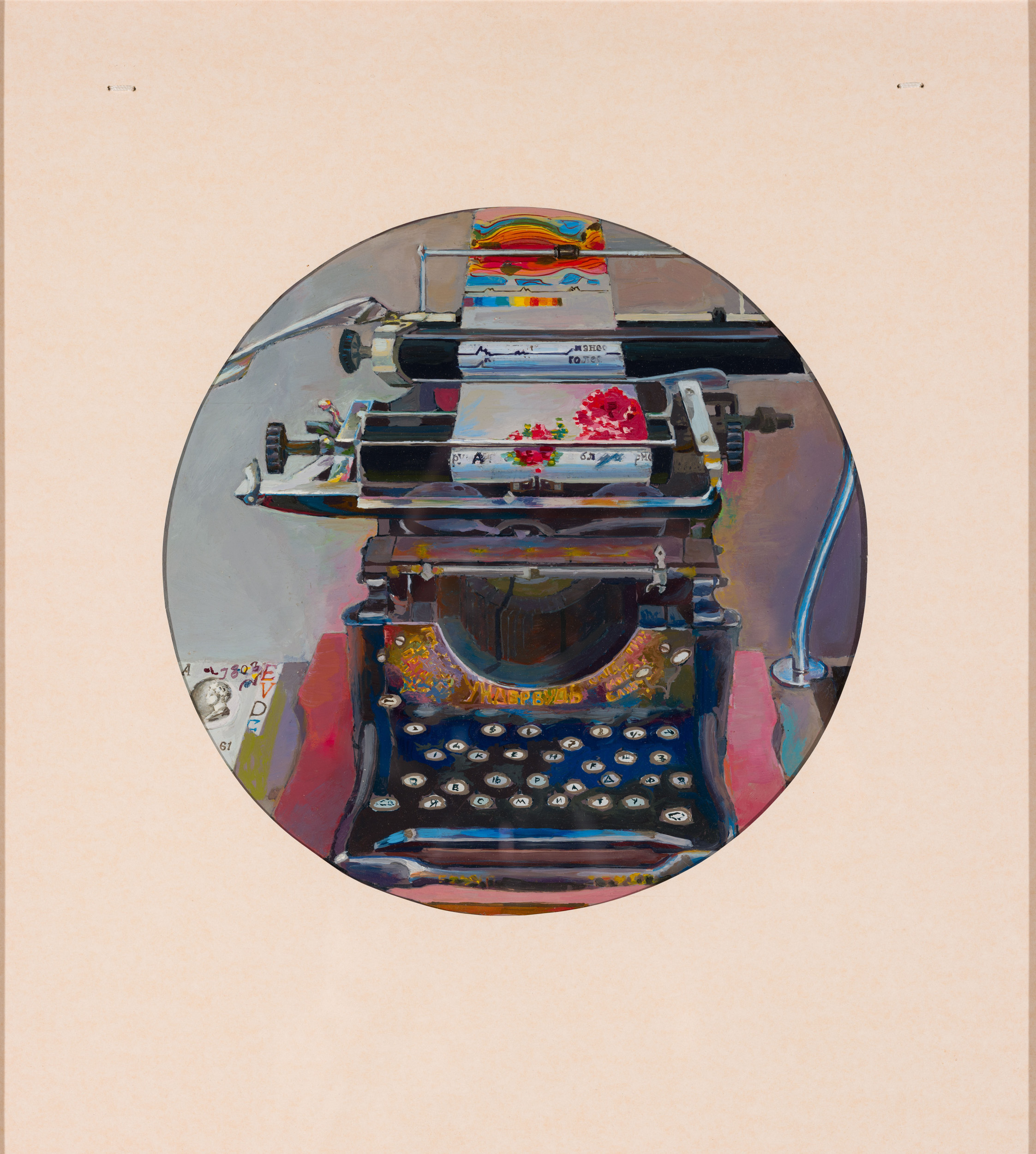
Album-Portrait (Portrait of a Woman) Part 2, 1985–88. Oil on paperboard, 55 × 50.1 cm (21 5/8 × 19 3/4 in.). Purchased with funds donated by Norton Dodge and Nancy Dodge. 2001.0129.02