
Olesia Tavadze
1944 — Tbilisi (Georgia). Lives and works in Tbilisi (Georgia)
Painter, graphic artist, theater and film designer, decorative artist, illustrator, and writer Olesia (Lesia) Tavadze has been an important figure on the Georgian art scene since the 1970s.
Tavadze was born in Tbilisi in 1944 to Pimen Tavadze, a biologist, and Alexandra Kosyurina-Tavadze, an artist. From her mother she inherited a talent for painting and needlework, as well as a poetic outlook on the world.
She studied the basics of drawing and painting at the Iakob Nikoladze Tbilisi Art College. She began her studies in 1957 and graduated in 1963, and that same year enrolled in the Faculty of Painting at the Tbilisi State Academy of Arts.
During 1966–68, she lived in Moscow, studying book design at the Moscow Polygraphic Institute. Upon her return to Georgia, she resumed her studies at the Academy of Arts, this time focusing on theater design. She graduated in 1970; for her final project, she designed stage sets and costumes for a circus performance.
That year, Tavadze created sketches of sets and costumes for the jubilee performance of the Tbilisi circus. She also designed sets and costumes for the Tbilisi Russian Youth Theater, the Theater of Miniatures, and the Batumi Drama Theater. During the 1970s and 1980s, she collaborated with Gela Kandelaki’s Hand Shadow Theater and with Rero, a vocal instrumental ensemble. She also worked as a graphic designer for the newspaper Literaturuli Sakartvelo and for the Georgian State Museum of Theater, Music, Cinema and Choreography. At this time, she also served as a guest lecturer at Tbilisi State University, teaching a course on the history of costume design.
Since 1974, Tavadze has been a member of the Artists’ Union of Georgia. She has participated in several group trips to various Soviet republics, including a journey to Turkmenistan in the 1980s. The trip was very influential on the artist, prompting several later visits to the region. Turkmenistan’s natural beauty and distinct local culture inspired many of her landscapes and still lifes, paintings as well as drawings, which are displayed on the walls of the artist’s home in Tbilisi.
Book design, especially the design of books for children, has been another important aspect of Tavadze’s career. This includes her design for a book of fables by the Georgian writer Sulkhan-Saba Orbeliani (1658–1725), for which Tavadze received the Iakob Gogebashvili Prize in 2019. Tavadze is herself an author, writing for children as well as adults. In 2011, she wrote and illustrated the fairy tale Paskulina and Busunsula, about the feud and subsequent friendship between two dogs. That same year, the book received the international Step by Step award for children’s literature. Popular with all ages, Paskulina and Busunsula was translated into sixteen languages.
In 2018, she produced a series of fifty works based on the poetry of Robert Frost (1874–1963). Every sheet features a handwritten verse in English and in Russian translation, accompanied by a drawing by Tavadze. [1] Not illustrations in the usual sense, the compositions are creative interpretations of Frost’s poems; generalized and abstract, they suggest the influence of Chinese art. The combination of handwritten text and visual image stemmed from Tavadze’s own habit of handwriting her favorite verses in a pocket notebook. In the introduction to her essay “My Robert Frost,” the artist writes: “My path leading to Robert Frost contains all my life … the encounter with Frost was like falling in love at first sight. All the idols retreated, and Frost occupied the icon’s place.” [2] In 2018, her Frost-inspired works were exhibited at the Tbilisi History Museum (Karvasla).
Tavadze is herself a writer of fictional tales as well as essays that address her life experiences and her contacts with literature, art, nature, and people. The artist describes her writing as a vehicle to convey those emotions that cannot be expressed through the language of fine arts. Tavadze’s Sad Accounts (2011) and The Nut Winds (2013) feature collections of her or short essays, which she terms “prosaic miniatures.”
From the 1970s through the 1990s, the artist created many decorative panels from scraps of fabric. During these decades, she also produced numerous costumes for dolls and people, including herself; the artist often wears clothes of her own making.
Tavadze’s painted portraits, still lifes, and landscapes from throughout her career are marked by a rich, varied palette. Her graphic works also feature a pictorial quality, whereby hatchings function in a manner akin to brushstrokes. The artist’s figurative compositions convey her emotions and inner life. The Norton and Nancy Dodge Collection includes her expressionist painting ეკლესია (Ekhlesia, Church, ZAM, 1980, D21229).
In recent years, the image of motherhood has figured largely in Tavadze’s oeuvre. These works are a dialogue between the daughter and her mother, with whom the artist was very close and to whom she is grateful for everything she gave and taught her. Along with her love, these works also express her sadness for misunderstandings with her mother. In her book Everything That I Owned, the artist describes the years following her mother’s passing as “life after death.” [3]
Tavadze spends much of the year with her husband, literary critic Zaza Abzianidze, at their vacation home in Tsveri, near Tbilisi. She draws inspiration from her communion with nature, deriving great joy from working on the land.
In 2024, Tavadze was awarded the title of Honorary Citizen of Tbilisi (საპატიო თბილისელი Sapatio Tbiliseli).
Ketevan Kintsurashvili
Translated from Georgian by Nino Gabunia
Notes:
1. Tavadze, Olesia. “My Robert Frost.” In David Andriadze, Olesya Tavadze: The Graphic Series “My Robert Frost.” Tbilisi: Georgian National Museum and Tbilisi History Museum, 2018: 6.
2. Andriadze, Olesya Tavadze: 5.
3. Tavadze, Olesia. რაც რამ მებადა [Everything That I Owned]. Tbilisi: Saqartvelos Matsne, 2024: 668.
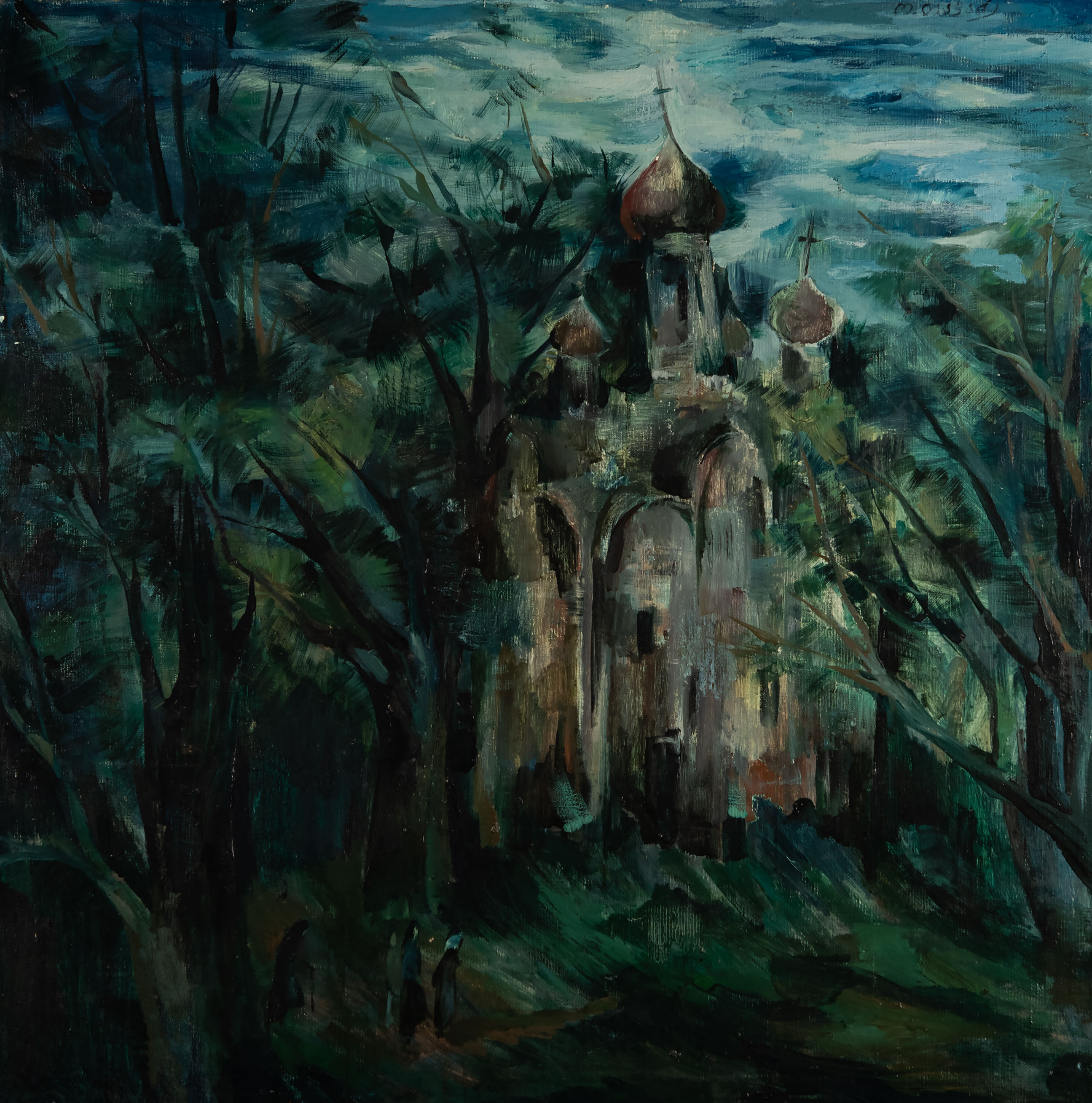
A Church, 1980. Oil on linen, 99.5 × 100.5 cm (39 3/16 × 39 9/16 in.). Norton and Nancy Dodge Collection of Nonconformist Art from the Soviet Union. D21229