
Olga Florenskaya
1960 — Leningrad (USSR). Works in Tbilisi (Georgia) and Saint Petersburg (Russia)
Olga Florenskaya (née Semchenko), born in Leningrad, spent her childhood in the art studio of her parents, sculptors Natalia Dolinskaia and Andrei Semchenko. They wanted Olga to become an artist, while she dreamed of becoming an archaeologist. In 1977, she enrolled in Leningrad Vera Mukhina Higher School of Art and Design (now Saint Petersburg Stieglitz State Academy of Art and Design) in the ceramics department. Her classmates included Alexander Florensky (her future husband) and Nikolay Polissky. In the Mukha, as it was informally called during the Soviet period, she felt the ceramics department was the most interesting one. After graduating from the academy in 1982, the artist started working at the Leningrad Experimental Factory at the All-Union Research Institute of Porcelain Industry. Once she finished her work duties, she had time to explore her own projects. She used this opportunity to paint porcelain molds with original designs and engage in various creative experiments.
The most important thing was happening in a studio of Alexander and Olga Florenskaya, which was located in a late-nineteenth-century revenue house at 19 Kuznechnyi Lane. The artists married in 1981 and even collaborated on their graduation project, which involved decorating the aviary at the Leningrad Zoo. Together with friends, they discussed art, painted, read poetry, and had drinks. In 1984, thanks to a story written by the artist and writer Vladimir Shinkarev, the myth of the Mitki was born, named after the artist Dmitry (called Mitia) Shagin. The image of the “cute scamp” Mitia Shagin created in the book, his vocabulary, and the behavior of the “little Soviet man” became a model for artists and others. The Mitki quickly became one of the main phenomena of Leningrad’s unofficial art scene that emerged at the end of the Soviet era. According to Shinkarev, “The Mitki was a small functioning model of human society, a brief summary of our country.”
In 1985, Florenskaya became one of the founders of the Mitki. The artists in the group were united by their admiration for their “forefathers”—the unofficial artists of the 1950s and ’60s, such as Richard Vasmi, Vladimir Shagin, and Aleksandr Arefiev. They were also deeply inspired by the art of the 1920s and ’30s, the Makovets society, Cézannism, and the Parisian school.
Olga Florenskaya turned to kitsch and lubok (Russian traditional woodblock prints) in her work, inheriting the primitivist experience of Mikhail Larionov (1881–1964) and Niko Pirosmani (1862–1918). She developed her own mythology, turning to the biblical themes and traditions of urban folklore. In the late 1980s, according to the artist, she decided to create large-scale paper graphics. They took her a long time to paint, and she wanted to maintain the competitive nature that existed within the group. Since these collages were so difficult to store and almost impossible to move around for exhibitions, Florenskaya switched to fabric collage. Before that, she had already worked with textiles, making fabric dolls. According to her recollections, the group members immediately fell in love with her large-scale fabric collages, as they looked spectacular and took up a lot of space at exhibitions. In Florenskaya’s work at the Zimmerli Art Museum, Siniaia Boroda [Bluebeard] (1992), Bluebeard is ready to strike his next female victim, who is tenderly naked and depicted in a stylized way, reminiscent of a lubok or a signboard. Forbidden keys to the bloody rooms and the bodies of the wives he has already killed are flying around the figures. On one hand, this textile panel clearly originates from a paper collage. At one time, Florenskaya was influenced by Henri Matisse’s Jazz series, which she saw at an exhibition at the State Hermitage; however, the large fabric panels refer to the tradition of the ancient Russian gonfalon.
In 1990, the legendary curator Pontus Hultén brought the Institut des hautes etudes en arts plastiques in Paris, which he founded in 1988, to Leningrad. There he opened the exhibition Территория искусства [Territory of art] at the State Russian Museum, dedicated to twentieth-century art. Hultén also opened a laboratory, inviting the most interesting young artists from various countries. Florenskaya and Florensky, her husband, participated in seminars held at the museum by Hans Haacke, Daniel Buren, Serge Fuchs, and Sarkis, and created a collaborative work titled Bublik dlia frantsuzov [Bublik for the French] (Russian Museum). After these seminars, the Florenskys were invited for an internship at the Institut in Paris.
In 1992, Olga started making animation. Florensky had her create the credits for his animated film Митькимайер [Mitki–Mayer] (1992). Over time, she became increasingly involved in the project and ended up producing her own segment of the animation using plasticine. In 1994, she made a plasticine animation based on her own fairy tale, Рассказ о чуде из чудес [A story about miracle of miracles], for which she received professional plasticine from the United States. In 2004, together with her husband, Florenskaya directed the animation Трофейные фильмы [Trophy films].
As the author of the ever-expanding project Психология бытового шрифта [Psychology of everyday fonts] and founder of the Mitkilibris publishing house in 1994, Florenskaya held her first exhibition of objects, Русский дизайн [Russian design], that same year. She created all kinds of airplanes and steam locomotives from various old objects found in the attic at her cabin. This theme continued in her joint projects with Florensky: Движение в сторону ЙЫЕ [Movement toward Iye] (1995), Русский патент [Russian patent] (1996), and Русский трофей [Russian trophy] (2006).
Movement toward Iye is dedicated to the Russian polar explorer Ivan Petrovich Barinov, a fictional character created by the artists, and to the imaginary people of Iye, supposedly discovered by him in 1969. The artists reconstructed the fictional archive of the polar explorer, including geographical maps, manuscripts, and diaries that described the customs of the Iye people.
In 1998, Florenskaya and Florensky created Передвижной бестиарий [Mobile bestiary]—a series of five allegorical animal figures. They were first exhibited in wooden, glass-fronted “houses” in Saint Petersburg’s Summer Garden in May 1998, serving as a reminder of when a menagerie had been located there during Peter the Great’s time. Each of the figures was linked to literary and cinematic associations. For example, the dog symbolized the selflessness of man’s best friend. Drawing on the principles of readymade and naive art, the artists presented Военная собака-связист с полевым телефоном и снарядным ящиком [Military dog-telephonist with a field telephone and shell box], Русский ресторанный медведь с подносом, вином и фруктами [Russian restaurant bear with a tray, wine, and fruit], Австралийский кенгуру-спортсмен с боксерскими перчатками и порядковым номером [Australian kangaroo-athlete with boxing gloves and a serial number], Осетровая рыба-трофей с раздвижным устройством [Sturgeon trophy fish with a sliding mechanism], and Схема разделки мясной туши (говядины) в Санкт-Петербурге [Butchering scheme of a beef carcass in Saint Petersburg].
Florenskaya’s Таксидермия [Taxidermy] project expanded on the concept of Mobile Bestiary, proposing the creation of artificial taxidermy animals from improvised materials as a humane alternative to traditional, bloodthirsty methods of taxidermy. Действующее чучело собаки Павлова [Animatronic Pavlov’s dog mannequin] is equipped with a light bulb, an electric bell, and a fistula, as in natural science museums. However, rather than evoking memories of painful experiments on conditioned reflexes, the soft toy invites play: pressing an electric bell triggers a light bulb to glow and releases “gastric juice.” As in other objects from this series, it develops the idea of automatons, invented to entertain the public. “Maybe a man doesn’t have to kill to satisfy his despotic ambitions—or, as one of my friends, a Russian born in Germany and not fluent in the language of his ancestors, used to say, primertvliat’ animals—to half-kill them, in his peculiar phrasing. Let the artificial animal be entirely artificial—let it be, with all its deviations from the truth and anatomy!” says Florenskaya. [1]
In Универсальный музей Вильгельма Винтера [Wilhelm Winter universal museum], Florenskaya and Florensky turned to the idea of a panopticon. They found this name in an 1887 issue of Peterburgskiy Listok, which reported on Wilhelm Winter’s publicly accessible panopticon museum. The project began in 2005 with a display of Культовые сооружения [Religious buildings] at the State Museum of History of Religions in Saint Petersburg. This exhibition consisted of models of temples of the religions of the world, made of hat boxes, kitchen utensils, and other household antiques. Then, the artists presented Географические карты [Geographical maps] and Скелеты разные [Various skeletons] (2007), assembled from various artifacts. At Wilhelm Winter Universal Museum, which focuses on diverse fields of art, science, and technology, Florenskaya and Florensky recreated the eighteenth- and nineteenth-century curiosity cabinets through a series of assemblages. Florenskaya creates assemblages, continues to work on Psychology of Everyday Fonts, makes fabric and paper collages, and is engaged in primitivism-inspired painting.
Olesya Turkina
Translated from Russian by Anna Matveeva
Photo portrait: Olga Florenskaya, 2001. Photo by Sergei Sveshnikov. Courtesy of Olga Florenskaya
Notes:
1. Florenskaya, Оlga, and Alexander Florensky. Движение в сторону книги: Тексты с картинками,расставленные строго в хронологической последовательности [Movement toward the book: Texts with images, arranged strictly in chronological order] Saint Petersburg: Retro, 2002: 384.
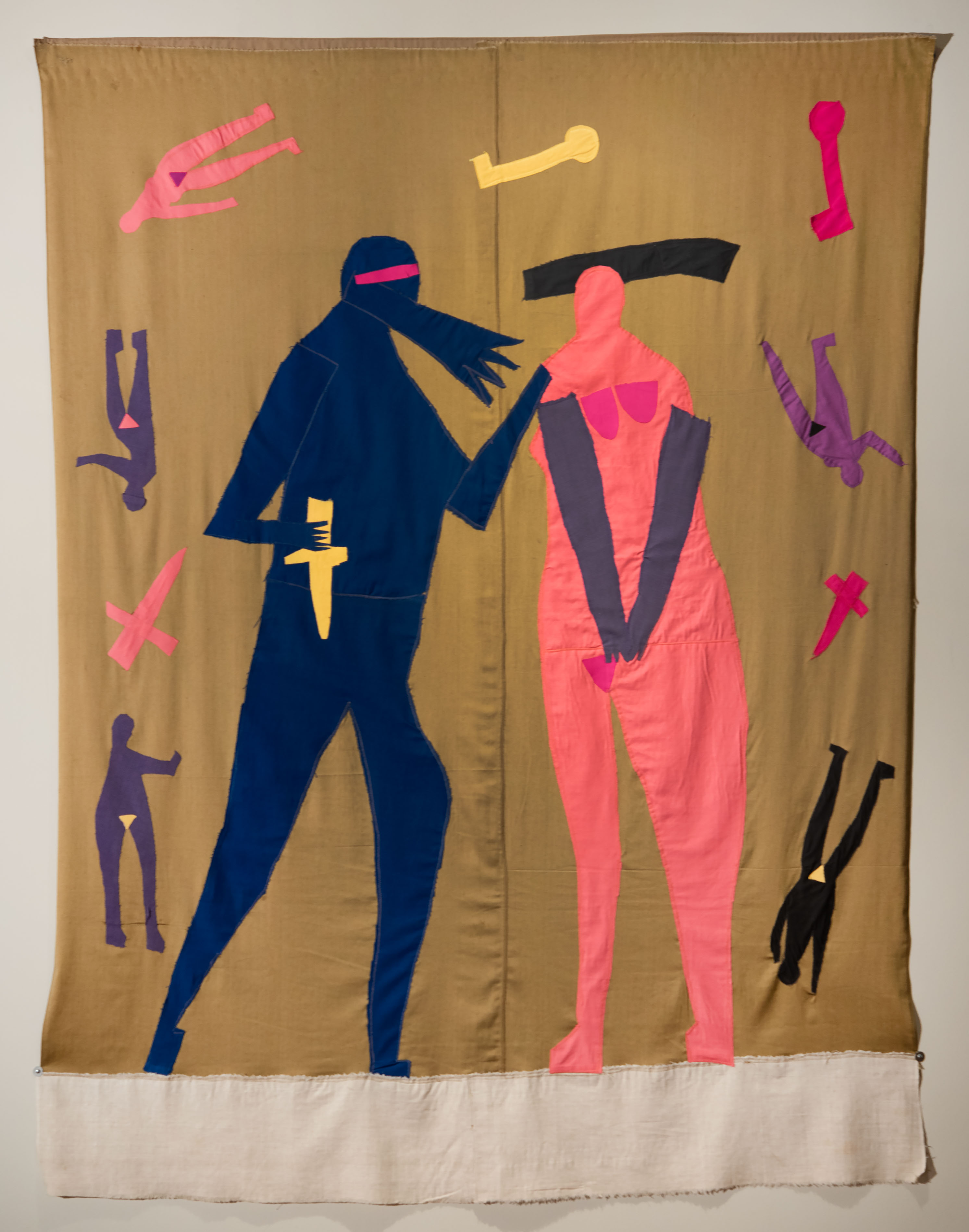
Bluebeard, 1992. Cloth appliqué and collage on cloth, 214 x 175 cm (84 1/4 x 68 7/8 in.). The Claude and Nina Gruen Collection of Contemporary Russian Art. 2007.0008