
Saken Gumarov
1937 — Bukey Horde (Kazakhstan) | 1995 — Oral (Kazakhstan). Lived and worked in Uralsk (now Oral, Kazakhstan)
Saken Gumarov studied at the Leningrad State Institute of Theater, Music, and Cinema (now the Russian State Institute of Performing Arts), and graduated from Institute of Theatre Arts in Moscow. He worked as an actor and director at the Alexander Ostrovsky Uralsk Russian Drama Theater, and was also the director of Uralsk television in 1960–64.
He drew and wrote poems from an early age, and his interest in visual art arose on this basis. The artist insisted that all of his intentions originated in childhood: “I’ve been drawing ever since I can remember. I haven’t limited myself in relation to genre or theme. Neither have I stuck to national, social, or racial questions. [Instead,] I’m trying to catch a kind of energy. Is it mystical? Cosmic? [I’m] a free artist, with a free volition and my own choice of theme.” [1]
His first works date to 1955, and his entire body of work includes over a thousand works in various museums and private collections.
Gumarov worked outside of established canons and frameworks, following his own ideas and thoughts. Like all artists who came from another professional environment, Gumarov conveyed in his works something that was marginal, not quite right, but very unique and personal to him. He was interested in transcendental philosophy, biofield theory, magneto-optics, psychology, alternative history, and the whole range of scientific and pseudoscientific disciplines that interested Soviet intellectuals during the periods of stagnation and perestroika. The ideas of Lev Gumilev, especially his book Ethnogenesis and the Biosphere, resonated with Gumarov’s vision of the world. The book is an attempt to explain the historical destinies of various peoples through the interaction of nature and man and biological and social factors, with a special emphasis on the role of driven, impassioned individuals and the natural environment in the formation of ethnic groups.
It is difficult to see all of Gumarov’s work as done in a single style, since his artistic projects form a complex palimpsest of scientific ideas, archetypes from nomadic culture, borrowings of archaic and religious images, cosmological fantasies, and political references. Gumarov himself understood his work as a new artistic movement, which he called “attractivism”—a movement that admitted nothing negative to its worldview, and through which the artist would express his personal perception of the world and the meaning of existence through art. His method can be described as the creation of “thought forms,” both on his canvases and in his poems.
My ancestor’s saber flashed through my thoughts
And came down as a white brushstroke on the canvas
A steppe fire was kindled in my soul
And passed to the cardboard as a rearing steed
And a black camel.
On my path toward the objective world
The thought-form of love appeared,
And I … glimpsed a different plane.
Severe brow arched,
Like a drawn bowstring,
Pulled free of the forehead,
Turned out to be a sparrow …
I saw behind the daily
And plunged into a flow of color
The domain of the prophets. [2]
The artist seemed to pour his thoughts onto the surface of his paintings in the form of various freehand shapes. Gumarov’s recurrent subjects included figures from Turkic myth, angels, birds, historical figures, and mystical and astral symbols. Art critics have chosen to view his work through the prism of nonconformism and the underground, for example: “Gumarov’s paintings could serve as evidence confirming the theories of consciousness and the collective unconscious. Spirits, shamans, lines resemble the vibrations of thought. Zoo-bio-anthropomorphic creatures, whimsical lines and forms—are these a play of the imagination? Or is this what the first stages of life resembled? … Saken’s nonconformism reveals itself in the fact that he doesn’t attempt to paint current events or accord with the tastes and opinions of those ‘knowledgeable about art,’ but stays true to his particular talent—a kind of elevated insight into the limits of the world that lie outside of rational reasoning.” [3]
Gumarov’s works were usually done in series; he often returned to his favorite and most significant “thought-forms.” His series Bestiary, White Goose (Kasteyev Art Museum), Mother and Child, Memory of the Past, The Turkic, and The Astral express the search for a visual embodiment of values particularly significant for the artist and for humanity in general. The image of a white goose is an important archetype in the Tengrian faith of the Turkic peoples of Central Asia. Gumarov doesn’t tell the tale as a narrative, but brings to his canvases a subtly implied image, emphasized by a light palette and flowing, rhythmic lines.
Some of Gumarov’s paintings bring together easily recognizable figurative images and more formal elements, which seem to break the image into fractals, as in the painting Thousands of Sunbeams (1987, Saken Gumarov Museum), which Gumarov thought may emit a particular healing energy. Some canvases are meant to remind viewers of danger and the proximity of evil. Several canvases are topical, depicting a nuclear test site in the Kazakh steppe or the personality cult and Red Terror of the Stalinist period (Composition with a Dancing Skeleton and Worms, 1979, Saken Gumarov Museum). The poetics of such paintings are naive and frightening at once, reminiscent of childhood nightmares.
The artist also returns frequently to the image of Abai, a famous Kazakh poet, educator, and founder the Kazakh literary tradition, as well as a philosopher and thinker of the nineteenth century, and the author of Words of Edification, a treatise on humanitarian values in steppe societies. Abai appears in Gumarov’s paintings as a steppe prophet, and like the ancestor from primordial mythology, it’s as though he moves the artist’s hand.
For a long time, Gumarov’s creative work was misunderstood and not particularly in demand in the epoch of socialist realism. In the last five years of his life, from 1990 to 1995, he held about forty exhibitions in various cities of the USSR and abroad, including Kyiv, Moscow, Budapest, Yekaterinburg, Crimea, Sochi, Jūrmala, and Almaty, as well as Hungary and the Czech Republic.
After Gumarov’s death in 1995, his studio in Oral became the Museum of Saken Gumarov. The museum’s collection includes the artist’s paintings, personal belongings, and photo documentation, introducing younger generations to the artist’s legacy.
Yulia Sorokina
Translated from Russian by Elina Alter
Notes:
1. Liudmila Eniseeva. Миры и отражения Сакена Гумарова [Worlds and reflections of Saken Gumarov]. Exhibition brochure. Almaty: Tribuna Gallery, 1995.
2. L. Abalin. “Я знал, что мы встретимся” [I knew we would meet]. In Казахстанско-российская газета [Kazakh-Russian newspaper] 10 (1995).
3. M. Irkhina. Сакен Гумаров: Мыслеформы и пространства [Saken Gumarov: Thought-forms and spaces]. Oral: Polygraphy, 1995.
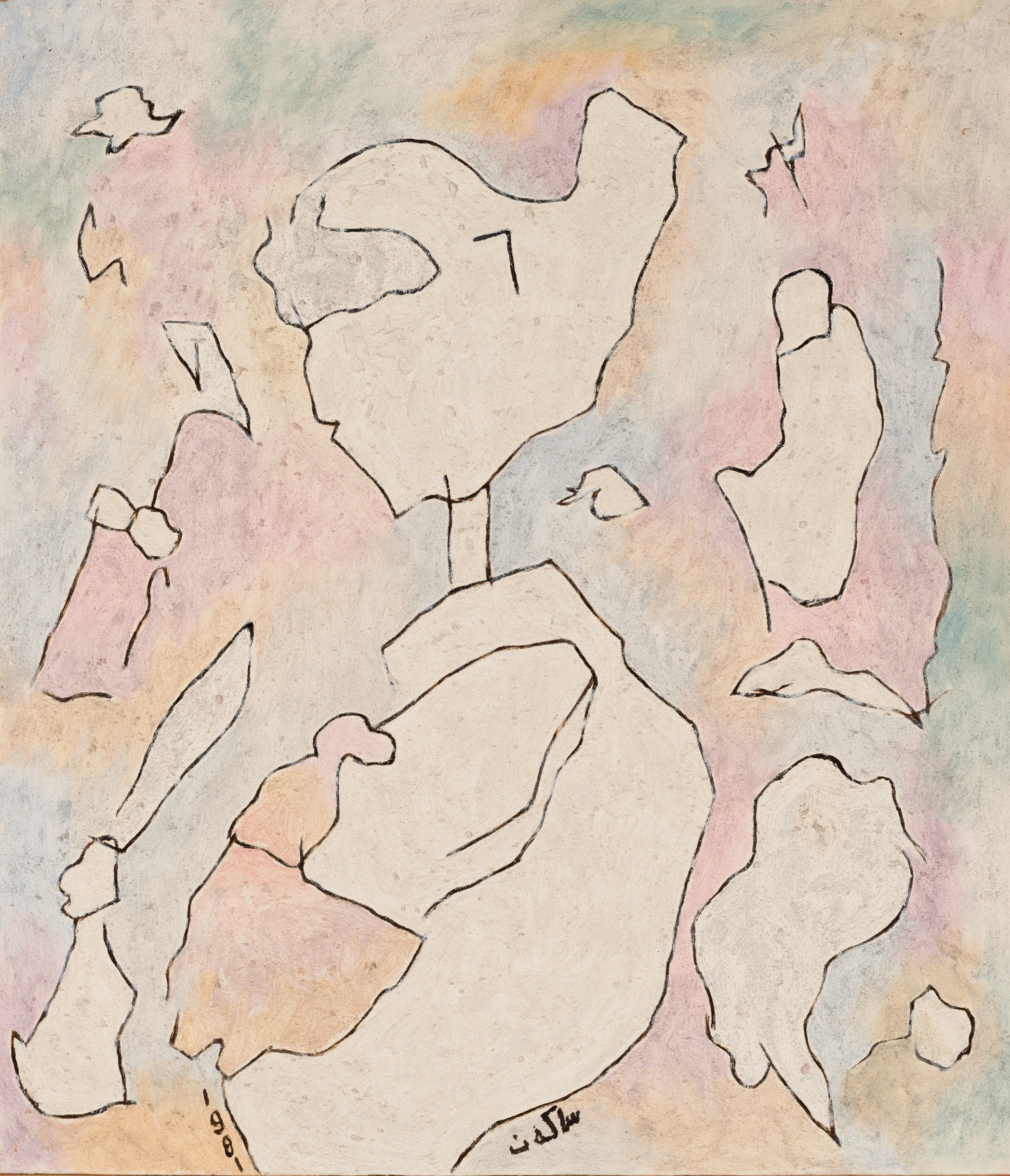
White Madonna, 1981. Oil on canvas, 80 × 69.5 cm (31 1/2 × 27 3/8 in.). Purchased with funds donated by Norton Dodge and Nancy Dodge. 2000.0014
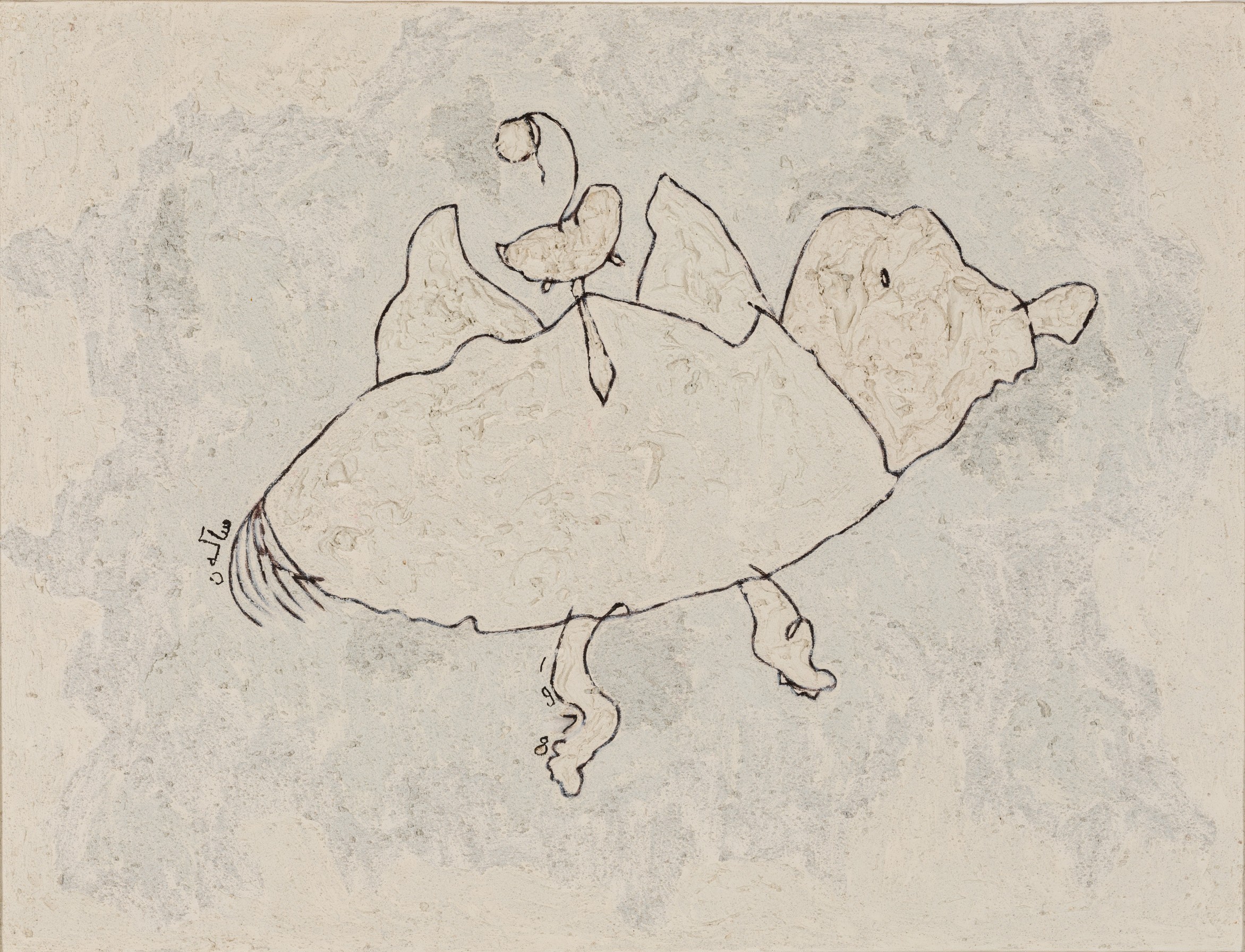
Information about an Abduction, 1978. Oil and mixed media on canvas, 60.5 × 80 cm (23 13/16 × 31 1/2 in.). Purchased with funds donated by Norton Dodge and Nancy Dodge. 2000.0015