
Sergey Poyarkov
1965 — Oster, Chernihiv region (Ukraine). Works in Kyiv (Ukraine)
Sergey Poyarkov is a Ukrainian graphic artist and illustrator. In the past two decades he has also become known as a media figure—host of the Poyarkov News program on the Priamyi TV channel and of a video blog—and as an assistant consultant to several Ukrainian deputies.
In 1985 he graduated from Kyiv Art and Industry College (now the Mykhailo Boychuk Kyiv State Academy of Decorative Applied Arts and Design). His education continued at the graphic design department of the Kyiv branch of the Ukrainian Printing Institute named after Ivan Fedorov (now the Institute of Publishing and Printing), where he studied from 1987 to 1990. He later graduated from the National Academy of Fine Arts and Architecture, where from 1990 to 1995 he studied in the graphics department, in the book graphics workshop.
Poyarkov’s passion for science fiction was already quite visible at the beginning of his artistic career. The artist won the 1991 Golden Award of the “L. Ron Hubbard’s Illustrators of the Future” contest, which he received in Los Angeles. [1] And every year from 1995 to 1998 he participated in the World Science Fiction Convention.
From 1989 to 1991, Poyarkov worked in the mass media, contributing to the magazines Ogonek and Yunost and the newspaper Sobesednik. From 1991 to 1992, he illustrated books in the United States and won a Grand Prix at the “992 Fandom Directory” contest. At the same time, he worked for Kyiv publishing houses in advertising, book illustration, and design. Later he also published his illustrations in other countries (Bulgaria, the Czech Republic, and Sweden).
As the artist recalls, his interest in graphics and illustration derives from his early love of books. [2] In those days of the Soviet era, literature provided him a kind of refuge from reality. Although he began his career as an illustrator, winning numerous prizes and competitions, he later felt the limitations of the illustrating process. He became more interested in the freedom of his own artistic pursuits and in inventing his own stories. Poyarkov calls his creative works “anti-illustrations”—pictures that need to be illustrated with their own stories. [2] Each work reflects the artist’s ironic postmodernist philosophy, employing satire and the grotesque in order to critique the system, advocate for individual freedom, and explore Ukrainian identity within the context of globalization.
Poyarkov often works on paper because of the wide range of textures that can be applied to the medium. He mixes watercolor, which is characterized by lightness, transparency, and calmness of color, with bright, soft pencils. He also frequently uses ink and gouache. [2] His illustrations often have a complex and surrealistic nature. They combine depictions of people, animals, architecture, and landscapes, resulting in visually intricate compositions. He avoids direct narratives, leaving space for the viewer’s interpretation. His visual language is full of allegories; the artist has developed his own system of symbols, where fish, for example, mean life or a woman; winding tree branches represent confusing circumstances; and chess symbolizes both a medieval alchemist’s formula and a stockbroker’s chart. “If you look at my works, you will often notice that in each of them some unusual or completely absurd action is taking place,” says Poyarkov. “And at the same time, the characters remain serene. They calmly perform monotonous daily work, live their lives, not even realizing the absurdity of what is happening.” [2] This reflects the artist’s own perceptions of the various systems and political regimes under which he has lived, including in the Soviet Union, Ukraine, and the United States.
Poyarkov has exhibited internationally in both solo and group shows in galleries and museums in Germany, the US, Russia, France, the UK, and Ukraine. His solo shows have been presented in such institutions as Saarbrücken City Hall, Germany (1999), the National Art Museum of Ukraine (2000), the Odesa Museum of Western and Eastern Art (2000), and the Kyiv National Museum of Russian Art (Now the National Museum "Kyiv Art Gallery") (2001). He has also published his own books, including Balance of Contradictions (2001), in which he not only presents his work but also conveys his philosophy of art, expressing pride in his roots and appreciation of new friends in other countries. [1] Flawless Imperfection (2003), published by the National Historical Museum of Ukraine, is a more conceptual project that positions itself in the preface as an “anti-curatorial manifesto of extreme individualism.” [3]
Reflecting on his career in a 2013 interview, Poyarkov commented that “now art is divided into two areas: fine art and marketing art” and “a professional artist cannot be non-commercial. His job is to sell the painting. . . . A non-commercial writer or a ballerina are just those who don’t know how to do their work.” [4] Being a commercially successful artist, he is a good illustration of his own theory. In his political work, he has surrounded himself with influential people, even referring to the Ukrainian Parliament as “a club of my collectors.” [3]
As a nonconformist artist, Poyarkov has often gone against general opinion, not being afraid of political and social criticism. He has frequently expressed his sometimes contradictory political views in interviews and publications and on his own YouTube channel, using the negative attention for his own promotion. The theme of the absurdity of the world we live in penetrates his artistic practice, creating a generative resistance between logic and freedom.
Anna Luhovska
Notes:
1. "Sergey Poyarkov". L. Ron Hubbard Presents: Writers and Illustrators of the Future.
2. Sergey Poyarkov, “Bezdohanna nedoskonalist: tvorchist Serhiia Poiarkova” [Flawless imperfection: The work of Sergey Poyarkov], Nevsepic, February 23, 2011.
3. Kostyantyn Rodyk, “Balans bezdohanno nedoskonalykh protyrich hry” [The balance of the game’s flawlessly imperfect contradictions], Knyznyk Review (2004): 16.
4. “Poiarkov: U mene take vidchuttia, shcho ya z dytynstva pomichnyk deputata” [Poyarkov: I have a feeling that I have been an assistant to a deputy since childhood], Tabloid: Ukrainska Pravda, December 5, 2013.
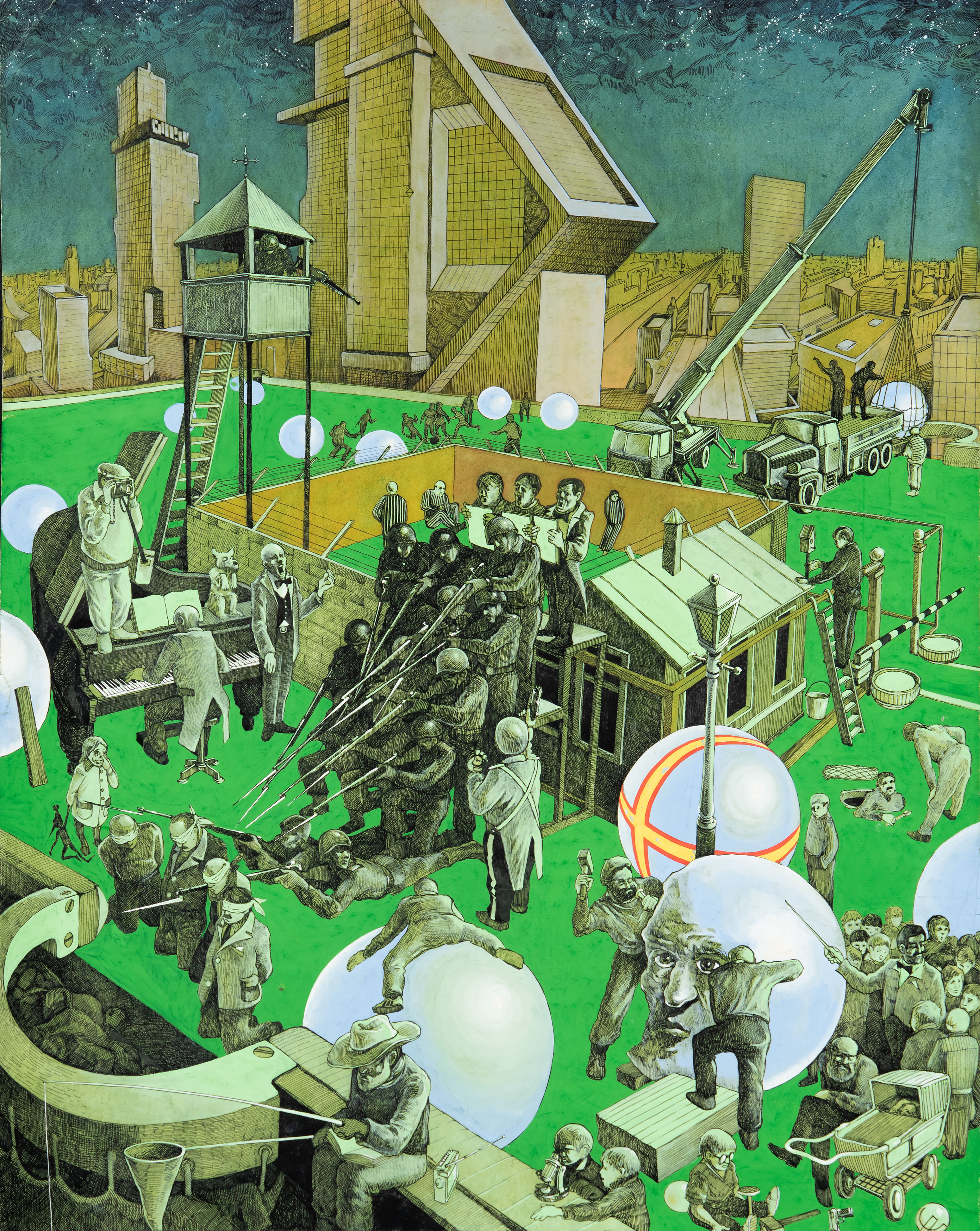
Playing Pool, 1985. Ink, watercolor, and gouache on paper, 70.5 × 55.3 cm (27 3/4 × 21 3/4 in.). Norton and Nancy Dodge Collection of Nonconformist Art from the Soviet Union. D18642
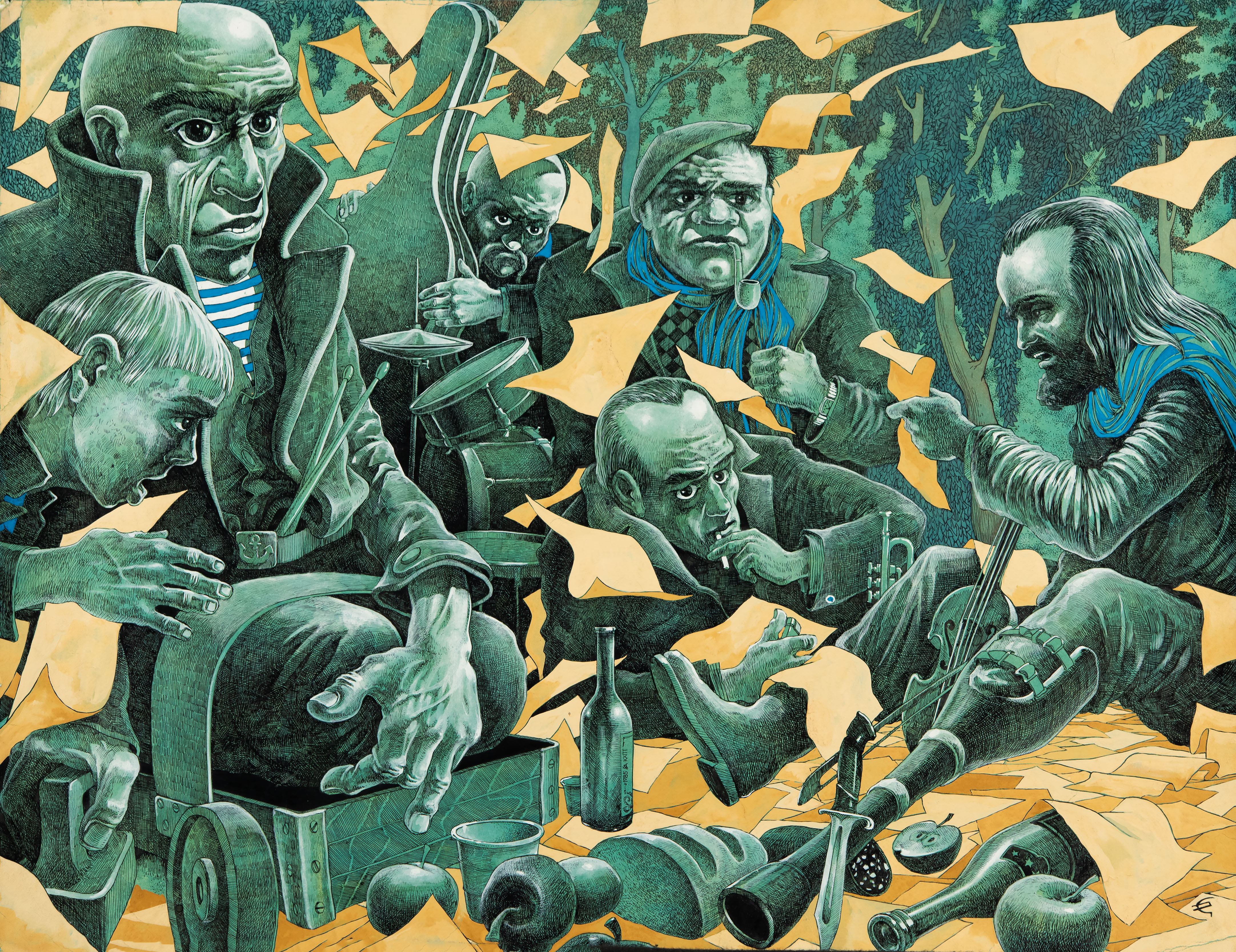
Orchestra that Plays at the Cemetery, 1985. Ink, watercolor, and gouache on paper, 55.4 × 70.4 cm (21 13/16 × 27 11/16 in.). Norton and Nancy Dodge Collection of Nonconformist Art from the Soviet Union. D18643
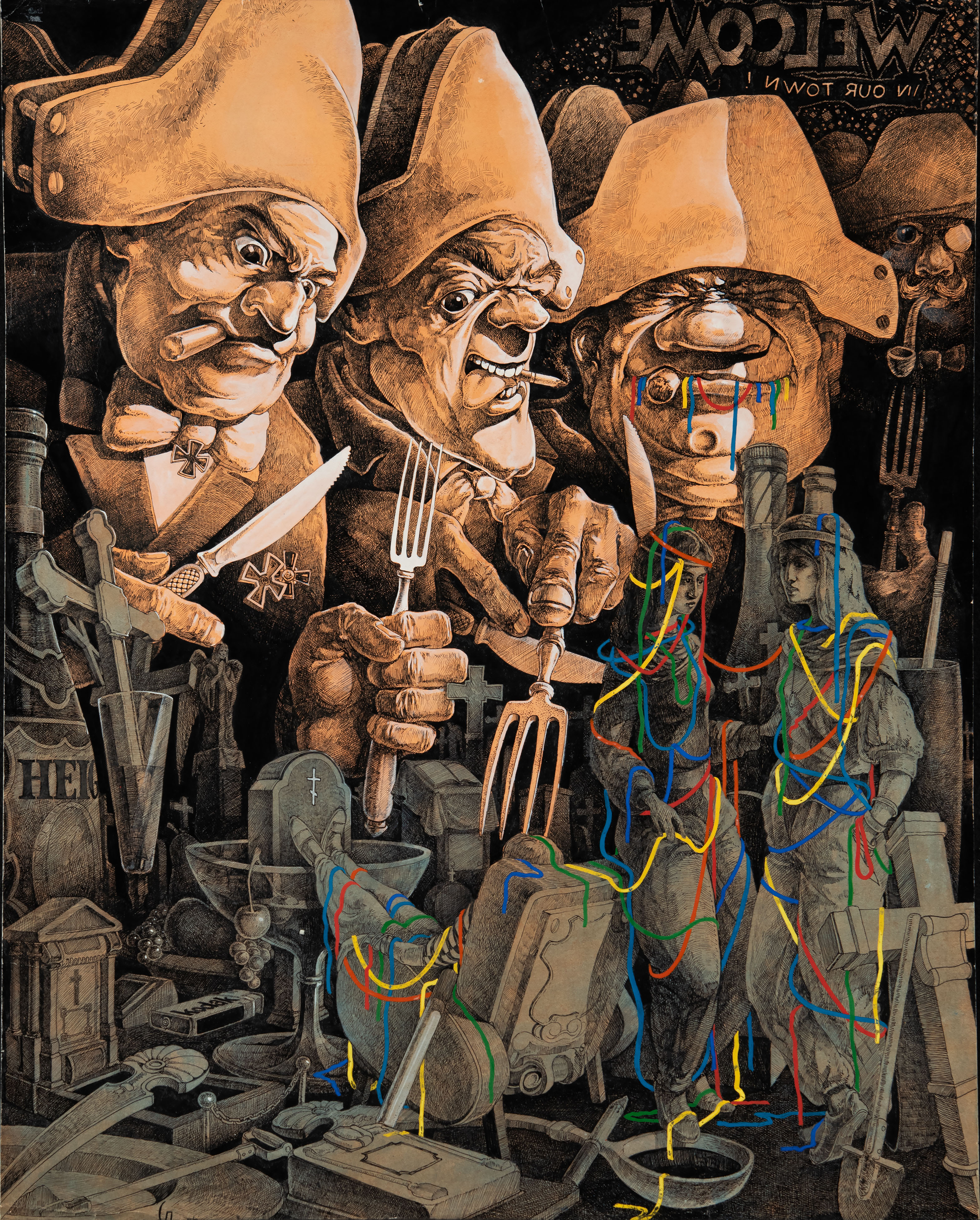
Dinner, 1985–86. Ink, watercolor, and gouache on paper, 69.5 × 55.4 cm (27 3/8 × 21 13/16 in.). Norton and Nancy Dodge Collection of Nonconformist Art from the Soviet Union. D18644
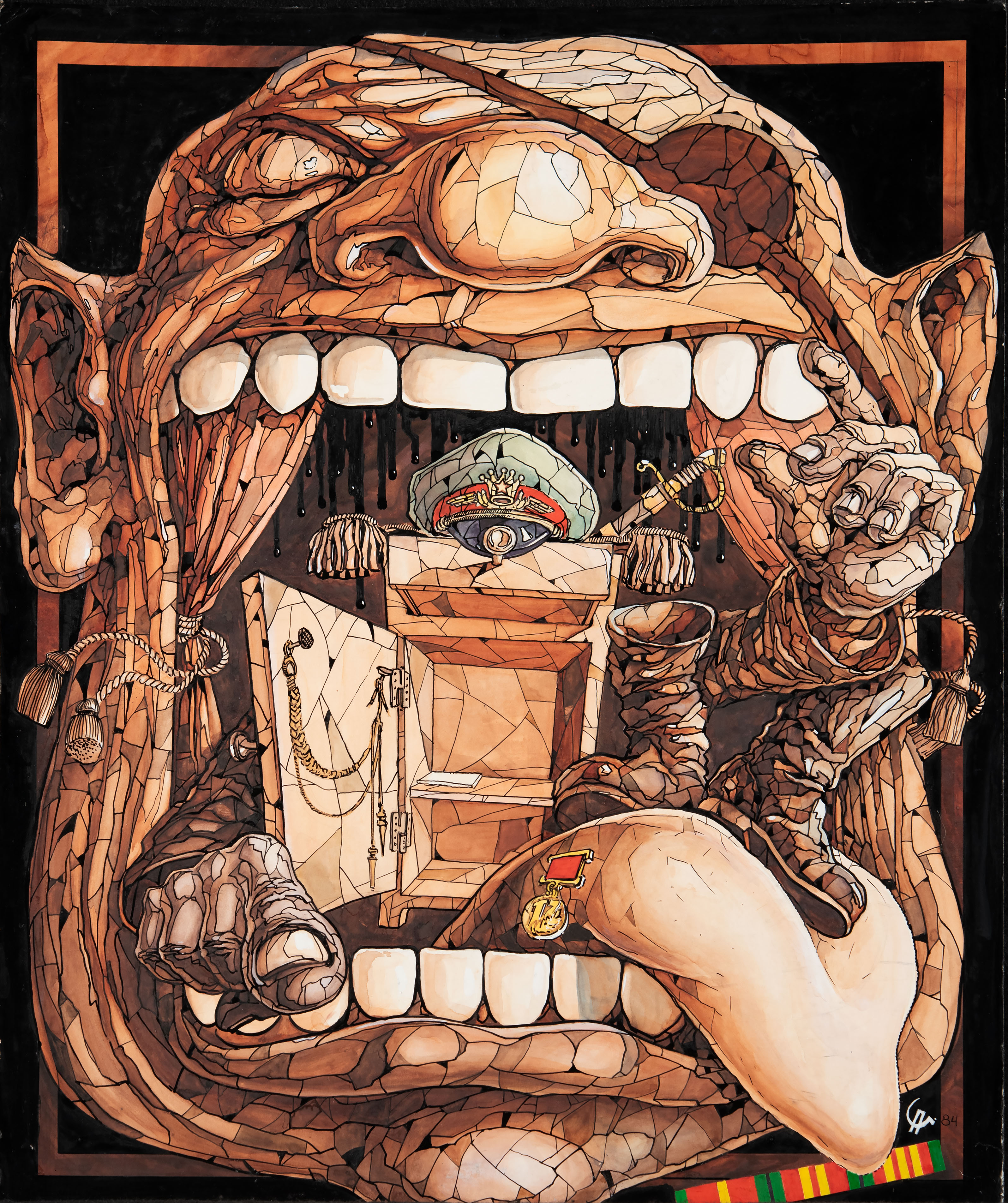
Untitled, 1984–85. Gouache on posterboard, 59.5 × 49.2 cm (23 7/16 × 19 3/8 in.). Norton and Nancy Dodge Collection of Nonconformist Art from the Soviet Union. D18896
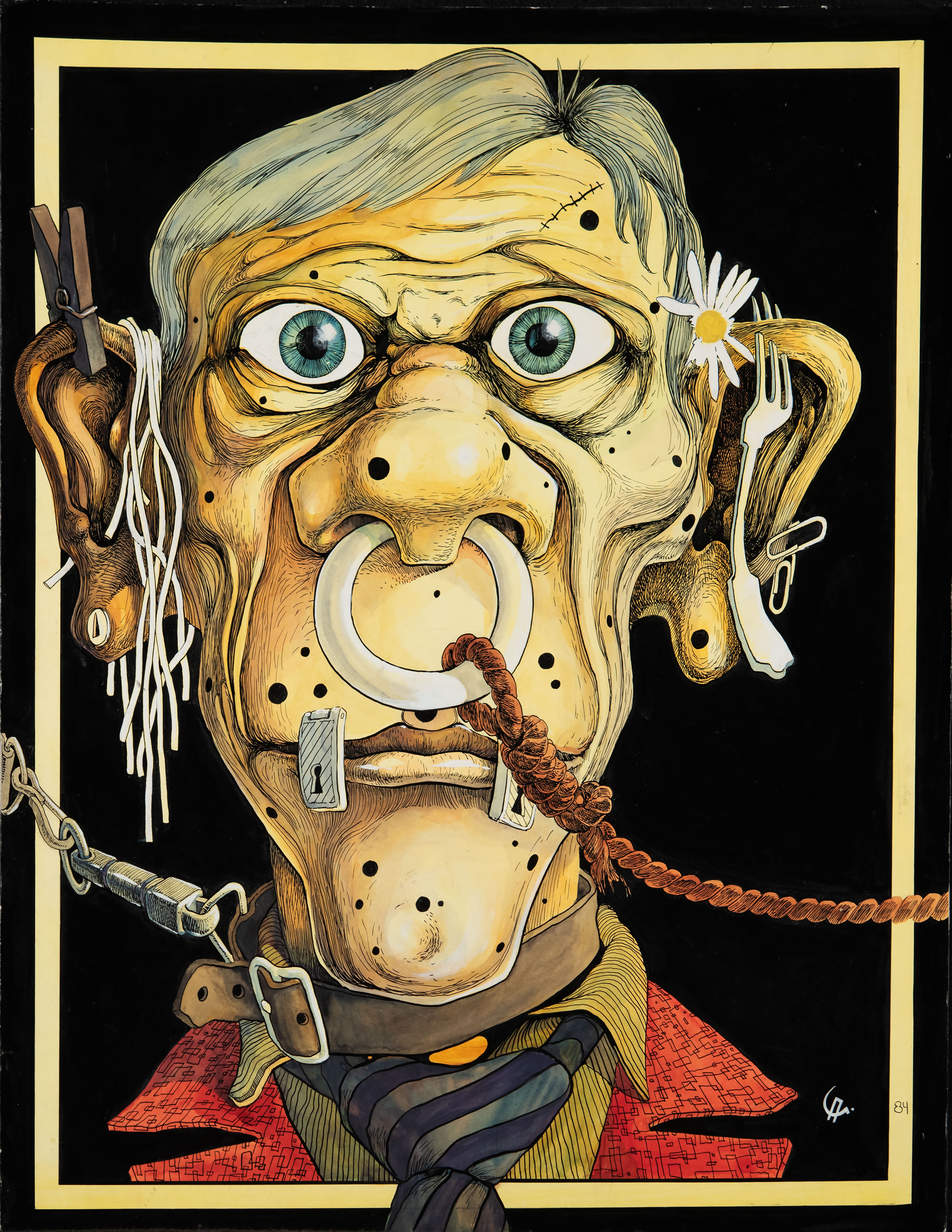
Untitled, 1984–85. Gouache on posterboard, 60 × 49.5 cm (23 5/8 × 19 1/2 in.). Norton and Nancy Dodge Collection of Nonconformist Art from the Soviet Union. D18897