
Seth Semerjian
1957 — Yerevan (Armenia). Worked in Yerevan (Armenia); currently works in Los Angeles, CA (USA)
Seth Semerjian belongs to the generation of abstract painters who entered the Armenian art scene in the early 1980s. During perestroika and the subsequent collapse of the Soviet Union, these artists were all associated with the avant-garde movement known as Third Floor. Oriented toward the West, Third Floor artists embraced ideas of democracy, globalization, human rights, and freedom, including artistic freedom—all of which became central to the period’s intellectual and political agenda. Thus, they inevitably positioned themselves in opposition to the previous generation of 1960s-era modernists and to the concept of “national modernism.”
In 1978, Semerjian graduated from the fine arts department of the Khachatur Abovyan State Pedagogical Institute (now Khachatur Abovyan Armenian State Pedagogical University). One of his teachers at the institute was Ashot Melkonyan, a respected artist of the 1960s known for his subtle lyricism. Because of his broad knowledge of painting, Melkonyan became a significant figure in Semerjian’s artistic formation. At the same time, as a representative of the older generation, Melkonyan held conservative views on painting, and discouraged the young Semerjian’s attempts to experiment with bold color and form. In 1978, Semerjian was featured in a showing of young artists’ work at the Youth Palace in Yerevan—his first exhibition—contributing an abstract painting inspired by the work of Arshile Gorky.
In 1980, Semerjian briefly worked as a graphic designer at the progressive literary-artistic magazine Garun (Spring). He also played jazz and participated in jam sessions at Yerevan’s jazz club. He had learned to play jazz guitar from books he received from the USA. Semerjian sees his passion for jazz as connected to his work as an abstract painter. [1] As means for creating jazz compositions and nonobjective paintings, variation and spontaneity beget synesthetic associations, in the spirit of Russian avant-garde artist Vasily Kandinsky (1866–1944).
Semerjian’s early creative explorations were curtailed by a tragic incident—in 1982, he was poisoned by turpentine fumes in his studio, from which it took him a long time to recover. For a long period, he was prohibited from working with paints or any strong-smelling chemicals; playing the guitar to some extent compensated for his inability to work with paint. [2] Semerjian returned to painting in 1990, and that same year produced several lyrical abstract works whose painterly texture results from interactions among multiple underlying layers. The artist characterizes these paintings as “structural” works. [3] At an early stage of his career, he also experimented with a mop and with spilling paint on a canvas on the floor. Was the young painter aware of Jackson Pollock’s working methods? It hardly matters—experimentation and the search for a novel painterly language were hallmarks of the times in which Semerjian’s artistic sensibility took shape. This approach to painting, somewhat reminiscent of the color field painting of the 1960s, did not extend into Semerjian’s later work.
In 1992, Semerjian presented his structural paintings in Third Floor’s Graffiti exhibition; ever since, he has been associated with second-wave Armenian abstract expressionism. Also in 1992, the artist emigrated to the US, settling in Los Angeles. There, his artistic activity became less constant. He worked at the nonprofit art space LA Artcore and the Eduard de A Bobo gallery, a short-lived Armenian art venue. During this time (1993–94), Semerjian created several abstract paintings, and these rare examples of his early American period ended up in the Norton and Nancy Dodge Collection (Untitled, ZAM, D10979; Untitled, ZAM, D10980; Untitled, ZAM, D10988; Untitled, ZAM, D10989; Space Inside, ZAM, D14023; and Drifting Lotus, ZAM, D14024).
In 1994 and 1995, a humanitarian and energy crisis upended life in Armenia. Through the efforts of contemporary artists and curators, and with support from the Armenian Ministry of Culture, two historic exhibitions of contemporary Armenian art were held at this time in Yerevan and Moscow: Abstract Art in Armenia (Artists’ Union, Yerevan) and Contemporary Art in Armenia 80–95 (Central House of Artists, Moscow). Two of Semerjian’s large structural paintings that had been left behind in his Yerevan apartment were included in these shows and appeared in the accompanying catalogues. Thus, Semerjian’s paintings lived their own exhibition life independently of their creator, as it were, migrating from one place to another. At some point, they ended up in the storerooms of Yerevan’s Akanat Gallery, where they remained for many years, until Tatul Arakyan, gallerist and collector of contemporary Armenian art, found, restored, and displayed them in the exhibition The Dynamics of Development of Abstract Art in Armenia 1980–1990 in 2004.
Evoking its ties to abstract expressionism, Semerjian’s painting style is characterized by a feeling of spontaneity and gestural freedom. This impression, however, is deceptive, and what Semerjian does is actually the opposite of action painting. His main expressive element is not gesture but color, from which he derives a harmony of relations and pure sound. A splendid colorist, Semerjian sometimes collides, and other times harmonizes, spectral and nonspectral colors in rich interrelations. In some paintings, one senses Gorky’s influence, yet the artist’s effort to distance himself from influences and devise his own formula for lyric abstraction is evident. In this respect, Space Inside (1993–94), mentioned above, is probably his most significant painting.
As he had earlier in his career, Semerjian experienced a long period of separation from art. This ended in 2020, when, isolated during the Covid-19 pandemic, he again returned to painting. At that time, the artist’s experiments and explorations became more intensive than ever before. His lack of a large studio space forced Semerjian to switch from his beloved medium of oil painting to acrylic painting on paper. Acrylic paint’s rapid drying time, however, posed a technical challenge for the artist, clashing with his manner of painting using a multilayered wet-on-wet technique and requiring speed and extraordinary focus. Consequently, the element of time as the fourth dimension is present in these later works, in which he achieves an alla prima effect through interactions of color layers painted over one another. In this almost magical technique, the painter has discovered for himself the principle of the “controlled accident” in the spirit of Eastern Zen aesthetics.
Semerjian states: “Very often, people ask me if I have an idea of an artwork in mind before I start painting. Or sometimes they ask me: ‘How did you come up with something like that?’ As Picasso said once, ‘I am not searching, I am finding.’ I like the element of surprise in the process of finding. I don’t know what I’m looking for until I find it. The final result is completely unknown to me until the very end. So, I hope it is as surprising to me as to any observer.”[4]
Semerjian’s works are held in the Norton and Nancy Dodge Collection (New Brunswick, NJ, USA) and in private collections.
Lilit Sargsyan
Translated from Russian by Ilya Bernstein
Notes:
1–4: Author’s conversation with the artist.
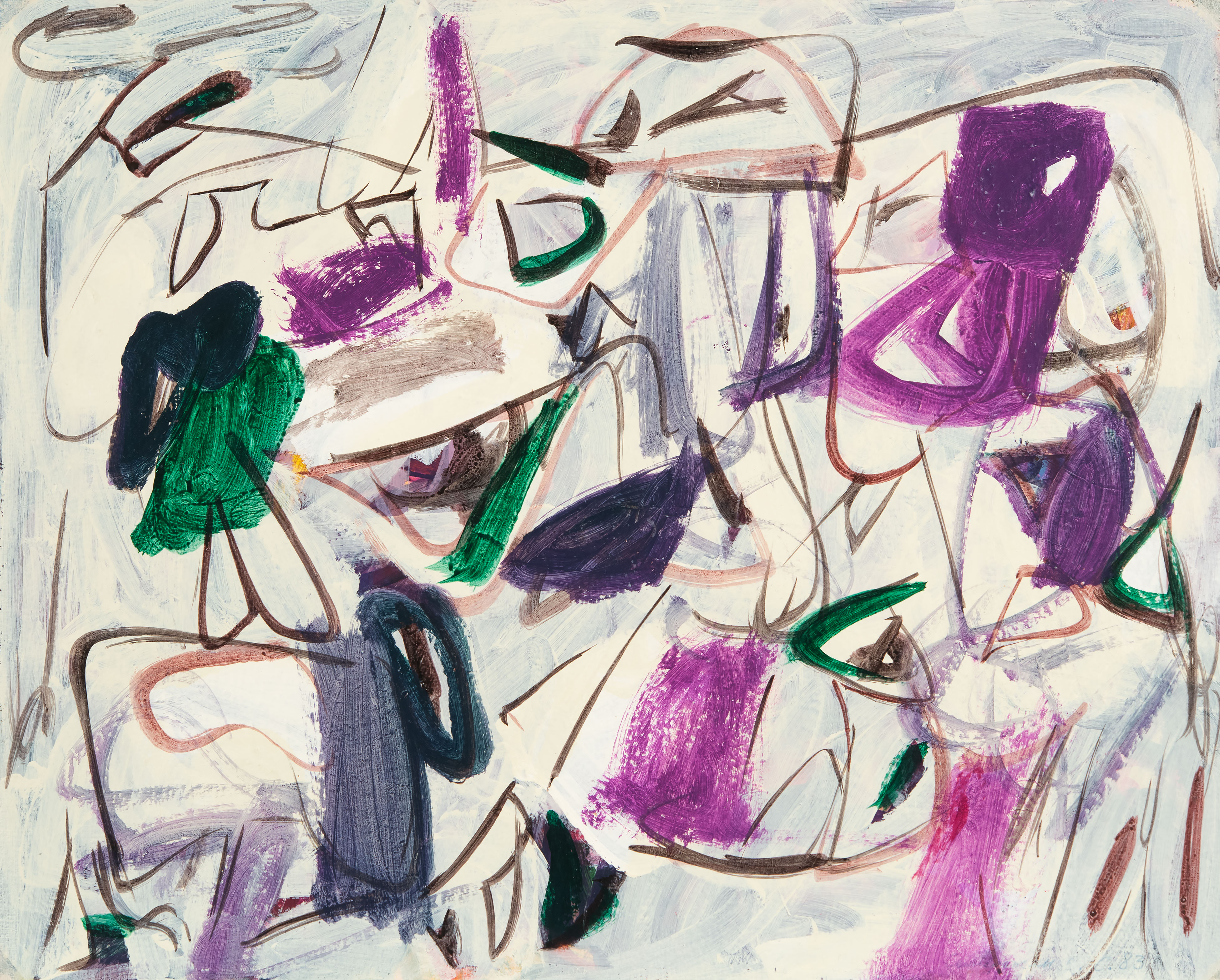
Untitled, 1983. Acrylic on wallpaper, 40.5 × 50.5 cm (15 15/16 × 19 7/8 in.). Norton and Nancy Dodge Collection of Nonconformist Art from the Soviet Union. D10979
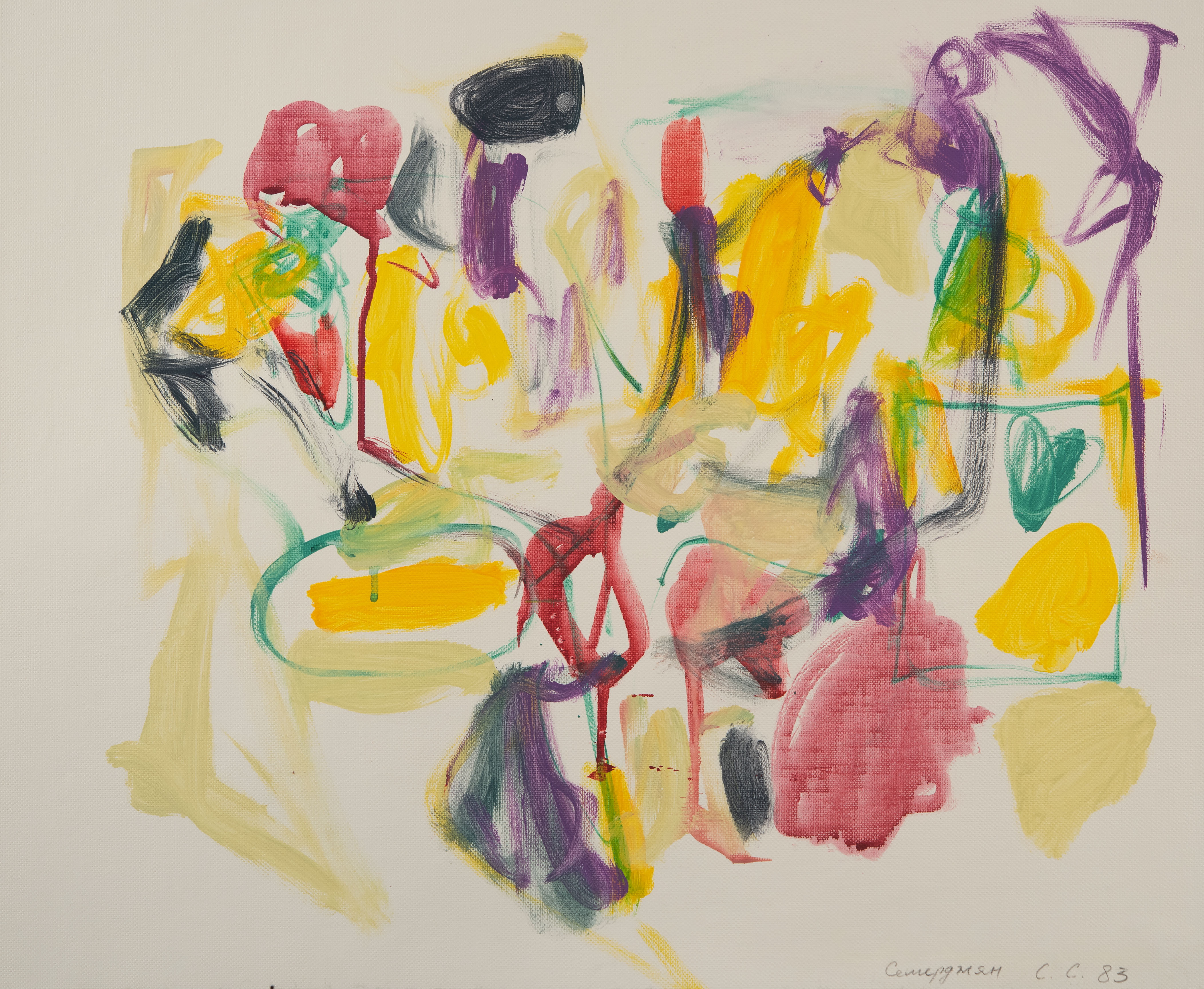
Untitled, 1983. Acrylic on paper, 40.5 × 51 cm (15 15/16 × 20 1/16 in.). Norton and Nancy Dodge Collection of Nonconformist Art from the Soviet Union. D10988
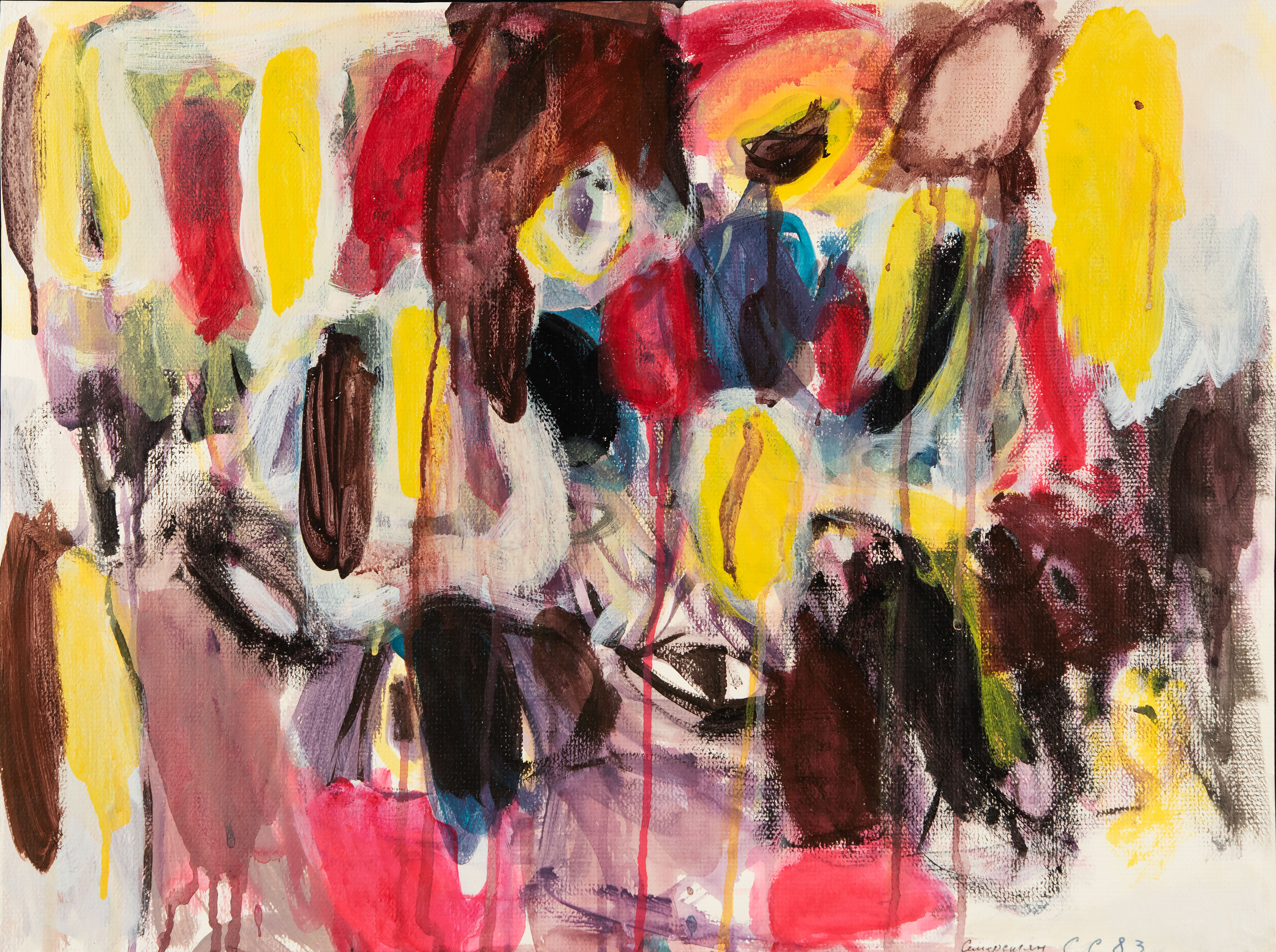
Untitled, 1983. Acrylic on paper, 48.2 × 61.4 cm (19 × 24 3/16 in.). Norton and Nancy Dodge Collection of Nonconformist Art from the Soviet Union. D10989
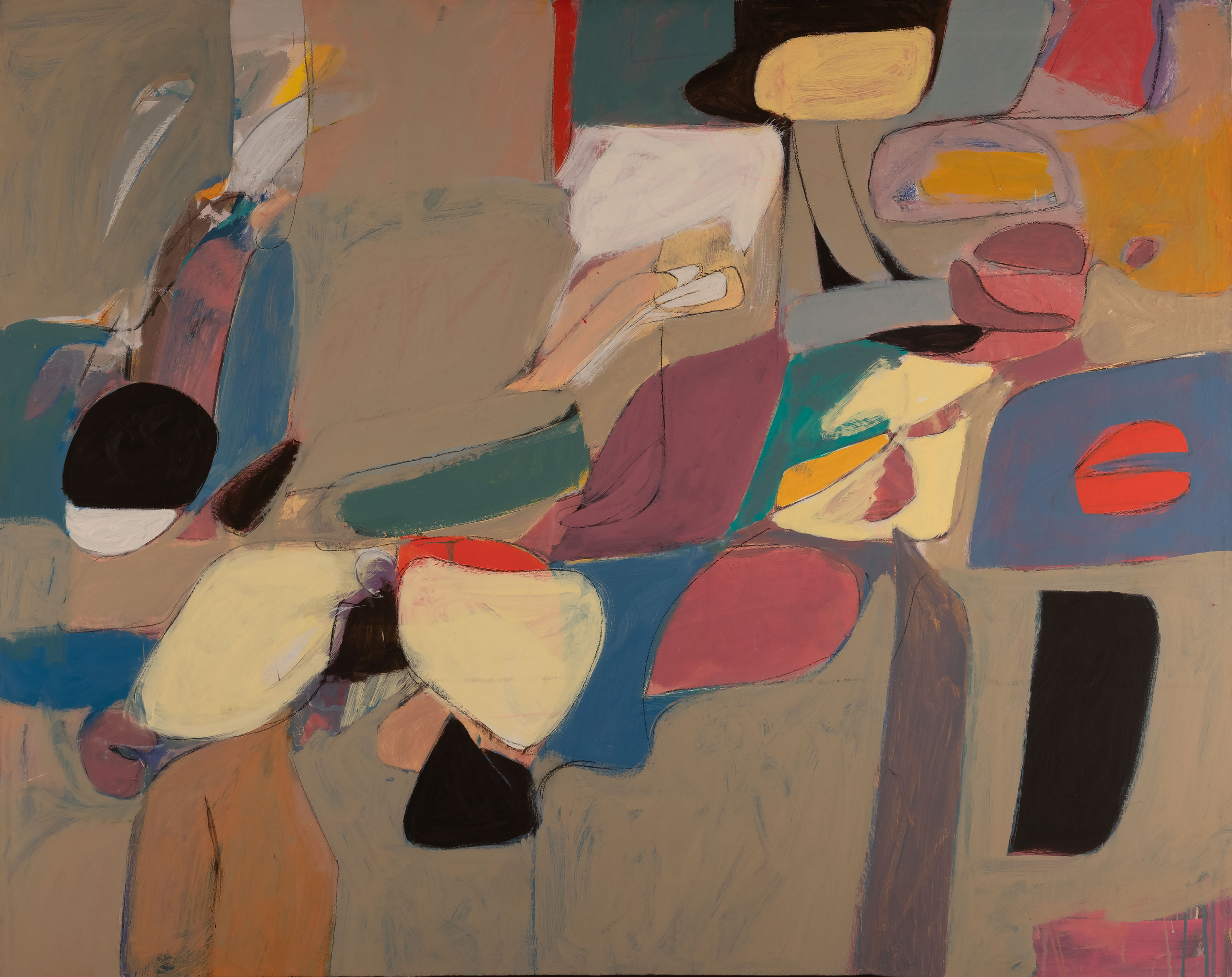
Drifting Lotus, 1983. Oil on canvas, 101.5 × 122 cm (39 15/16 × 48 1/16 in.). Norton and Nancy Dodge Collection of Nonconformist Art from the Soviet Union. D14024
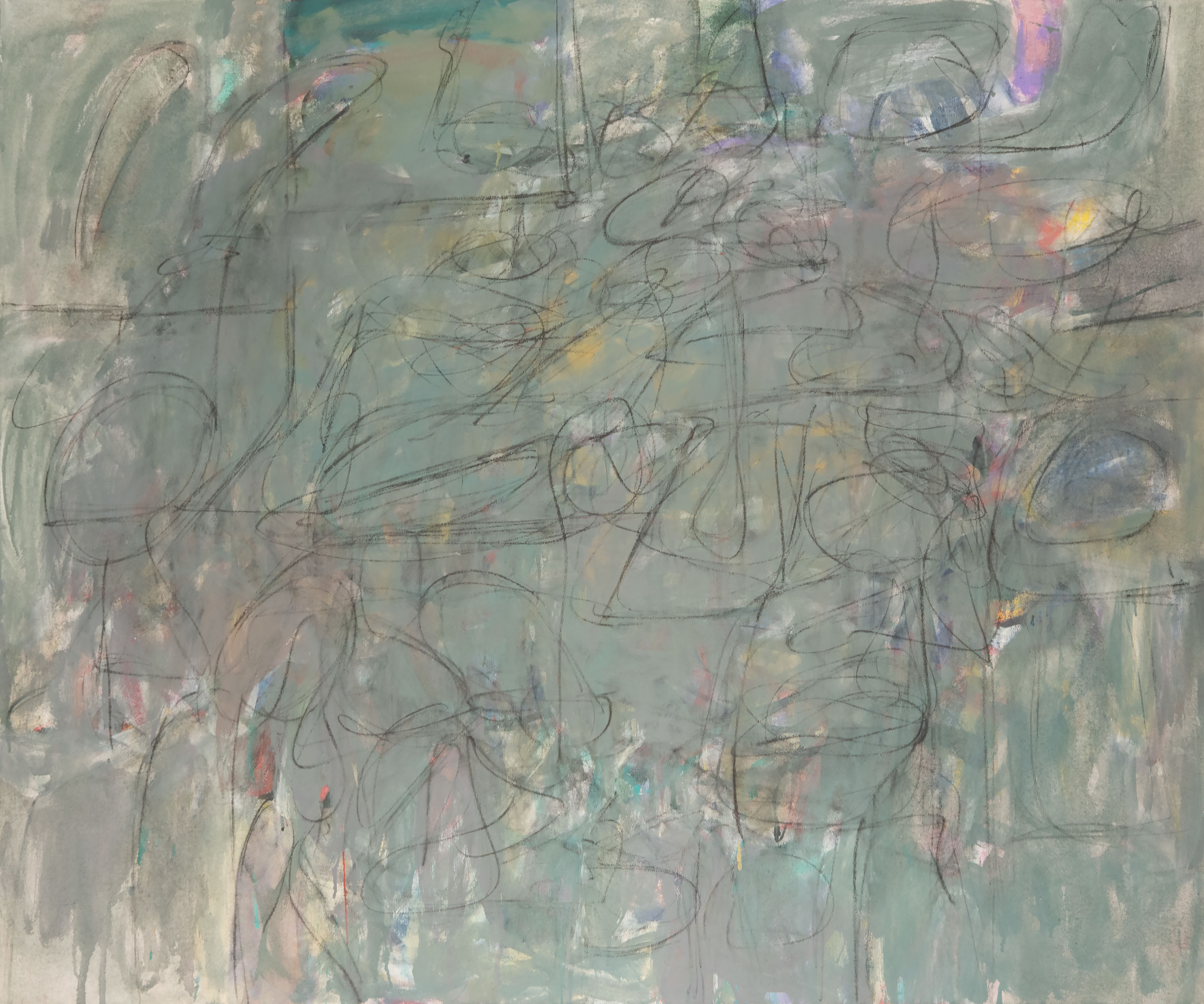
Space Inside, 1984. Oil and charcoal on canvas, 101 × 121.7 cm (39 3/4 × 47 15/16 in.). Norton and Nancy Dodge Collection of Nonconformist Art from the Soviet Union. D14023