
Shaimardan Sariev
1937 — Zaburunnoe village, Gorgovsky region (today Astrakhan region, Russia) | 1988 — Alma-Ata (Kazakhstan). Lived and worked in Alma-Ata (Kazakhstan)
Shaimardan Sariev stepped into the history of Kazakh art as a master of epic images from Kazakh culture, an innovator of the painting style of his time, and the creator of a gallery of existential portraits. He belonged to the generation of the sixties, one of the firebrands and reformers of the Khruschev Thaw period, along with Salikhitdin Aitbaev, Tokbolat Toguzbaev, Abdrashit Sydykhanov, Bakhtiyar Tabiev, and others. In distinction from their predecessors, they rejected the aims of socialist realism, striving instead to work out a national language of painting for Kazakhstan. They were interested not so much in specific events from history as in the archetypal characteristics of the Kazakh people. Painting came to be generalized, took on a great conventionality, and was purified of superfluous details, elevating reality to the level of metaphor. Happiness, hospitality, and the family are conveyed in a laconic form, but with a truly majestic figurative resolution. The visual language organically absorbed and recombined the styles of Western European modernism as it had austerely arisen and the ornamental aims of Kazakh applied art, through the generalization and enlargement of forms, the contrast and localization of color, and the emphasized contours of figures. The sharp need for change did not find expression only in the visual arts, as the generation of the sixties sought novelty in all forms of creative expression, including philosophy, literature, and theater.
In this moment of unspoken manifesto against the realist orientation of the earlier generation with which the sixties generation found itself in conflict, Sariev’s creative talent revealed itself. The strict frameworks of ideology were unable to constrict his progressive creative aspirations. Sariev was particularly bold and audacious in this search. He rejected the conventional in both his profession and his life. His career path was not a straight line but a complex curve, meandering around a mine, an army, the telegraph, a lathe—but always present was the ineluctable pull of drawing. Even while he was in the army, stationed in Riga (1956–59), he found time to work in the studio, and was already showing the early signs of his recognizable stylistic techniques—the expressiveness of his lines, love of dense or open color, interest in form as a bearer of meaning. During the period of self-determination in the style of Kazakh painting, Sariev’s dictum to “mix colors in the Kazakh way” took on a special significance, which determined the essence of his searches into the creative interpretation of ethnic origins.
In 1959, after graduating from the Nikolai Gogol Alma-Ata Art School, he began studies at the Kharkiv Art Institute, which he would abandon after two years. In 1962, he moved to Alma-Ata, where he found work at the Oner plant and took part in republican and all-Union exhibitions. In 1967, he was admitted to the Union of Artists of the USSR, receiving a number of certifications and honorary diplomas from the Central Committee of the Young Communist League of Kazakhstan and the Central Committee of the All-Union Leninist Young Communist League. But, by 1971, he had been expelled from the Union of Artists, losing his right to a studio and art materials and his access to exhibitions. In the eyes of so ideological an organization, he was simply too inconvenient, too straightforward, too independent. But this is precisely what made his work so authentic. Cut off from studio, exhibitions, and resources, he nonetheless continued to paint. Everything inspired him: flowers, the faces of those close to him, patters on fabric, light on the steppe. He sought to “learn form from flowers and plants,” forever following nature, which he boldly transformed in the space of his paintings through the prism of his own feelings. Another of his dicta, “Paint as though you were molding clay,” confirms it. His work really does feel like it’s molded from clay—thick, dense, vibrant. Originally from western Kazakhstan, he grew to embody the contrasts of that land: the resounding color of the steppe, the radiant sun, and the thick shadow. The impressions never left him. Instead, they formed the foundation of his pictorial language. His favorite color, yellow—like the sun of his homeland, like warmth, like light—took on deep meaning in his work.
Across portrait, landscape, and still life, the human figure dominates Sariev’s work: the quest to grasp the mysteries of the soul becomes paramount. The image of women, children, and men whose gazes are as a rule directed at the viewer become dialogue-portraits. He spoke with the model, through the model to the viewer. Portrait of Turar (1967, Abylkhan Kasteev State Museum of the Arts of the Republic of Kazakhstan), brimming with light, breath, and life, offers a personification of femininity and love, a symbol of Sariev’s art and an ideal of feminine beauty. His Portrait of Lebiz’s Son (1987, Kasteev Art Museum) is the finest reading of the teenage world’s fragility, an attempt to capture the unsteady moment of maturation at the point of change. In constructing a spiritual world of human personality, Sariev uses the slightest possible detail: a characteristic gesture, an incline of the head, a glance. These help us to discern the most significant and expressive qualities in a person. A person’s personality as the sphere of realizing their spiritual origin has always interested Shariev. Firstly in the context of its individuality and uniqueness. In some paintings (The Girls, 1969, Kasteyev State Museum of Arts) we can trace the influence of Gaugin in the freedom and power of color, expressiveness of line, exoticism, and monumentality of images. We cannot, however, speak of direct appropriation or stylization, but rather, a rethinking of the codes of European art through the prism of the Kazakh worldview.
In the content of works like The Shepherd (1969, Kasteyev State Museum of Arts) and The Fishermen (1971, Kasteyev State Museum of Arts), we can feel the striving for generalization and abstraction, for ever stronger-sounding epic intonations—these have taken on a meaningful character in the art of Kazakhstan. “The development of a national style became central to Sariev’s work. His portrait work has a special, intense character, a yearning to find a maximally expressive language free of temporal realities, brought entirely under the vertiginous concept of pictorial revelation… For the artist, a face, a person’s image, was no mere casting of his external appearance, no just some photo in a frame whose sole job is to convey a likeness. Sariev’s portraits are complex, color-plastic formulations of philosophical conceptions of time and humanity.” [1]
A powerful artistic instinct and an incredible capacity for work distinguished Sariev’s passionate and assertive nature. Those who watched him working noted how he would assault the canvas, immersing himself completely in the process. In the seventies, his painting became more restrained, with the palette lighter, the contours more acute, the lines sharper. “By the start of the seventies, his painting had developed a certain brutality—the colors heavier, joyful brightness replaced by earth tones: ochres, browns, blacks. The sharp outlines of figures emerge. The masses become rougher, stronger, more sculptural. … With his definitional uncompromisingness, the artist rejects external ethnographic markers (yurts, felt mats, ornaments), instead creating compositions out of nothing but human figures and space. … The once-characteristic subject matter of beautiful women, powerful men, and wise elders give way to portraits of sharply-felt specific people.” [2] This is not a fading, but a maturation of style. His protagonists are not heroes but real people. This was Sariev’s rebellion: not a shriek, not a slogan, but a silent, obstinate defense of the right to be oneself.
In the early seventies, he met his future wife, Kulpash, and the two relocated to Karaganda, where he worked for the Art Fund. In 1976, he returned to Alma-Ata, where he designed books for the Zhalyn and Zhazushy publishing houses. In October 1988, he was reinstated to the Union of Artists of the USSR, and a few days later, on October 22, in the village of Akkistau, he passed away following a serious illness.
Sariev’s path was a solitary one. He sought no teachers and founded no schools. He existed as though in a parallel reality, with a great contrast between his figure and the system surrounding him. What mattered was personal experience. In a time when clarity, the programmatic, and the utilitarian were prized in art, he depicted the bare soul. He risked not just his brush but his very destiny. Over his life, he knew hunger, poverty, and alcohol. Like many of the truest artists, he paid a personal cost for his freedom. It was precisely this vulnerability, this fragility before the world, that gave his art such life.
In his final years, Sariev was largely forgotten, excluded from the new cultural landscape. Nevertheless, his work prefigures many of the themes of post-Soviet art: the search for identity, work with tradition, and yearning for emotional sincerity. His work has returned to the art world only in our time. In 2008, twenty years after Sariev’s death, Kasteyev State Museum of Arts mounted its first solo exhibition of his work, in honor of the seventieth anniversary of his birth. The show was a revelation. Visitors didn’t just encounter a painter from the past, they witnessed a contemporary with lively, pointed, and relevant views.
Today, with interest in the Kazakh art of the previous century steadily increasing, Sariev’s work occupies a special place. It does not fit the frames of conventional classification and requires a more considered approach. His work is, first and foremost, a document of personal experience, an individual glance at the world around him. It does not so much reflect the age as it offers an account of a person living in it. Perhaps this is what makes it important, both for understanding the artist and for coming to terms with the context in which he worked.
In 2005 in Kazakhstan, the Atyrau Museum of Fine Arts was renamed after Shaimardan Sariev. His widow, Kulpash, has played a tremendous role in preserving and advancing his legacy.
Ekaterina Reznikova
Translated by Ian Dreiblatt
Notes:
1. Amir Dzhadaibaev, “‘To write, checking with eternity...’. Portrait painting by S. Sariev. On the occasion of the 70th anniversary of the artist’s birth.” Abylkhan Kasteyev State Museum of the Arts of the Republic of Kazakhstan, November 3, 2014.
2. Irina Yuferova. “Shaimardan Sariev: Punktir zhizni. Sostiyanie dushi” [Life’s dotted line. A state of mind]. In Shaimardan Sariev. Painting, graphics: catalogue of the exhibition on the occasion of the 70th anniversary of the artist’s birth. (Almaty: Kasteyev State Museum of Arts, 2007): 9–10.
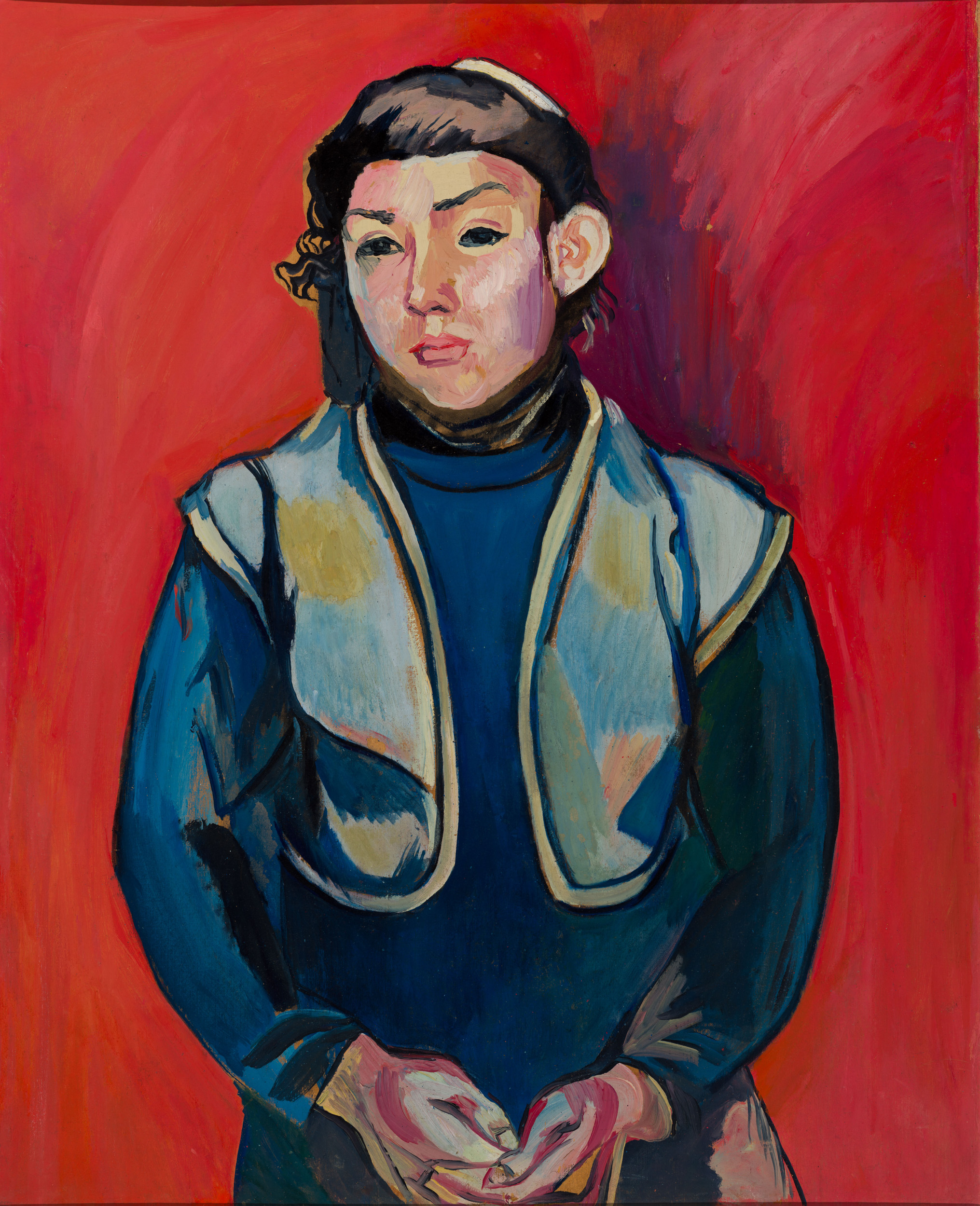
Portrait of a Girl, 1978. Oil on paperboard, 98 × 79 cm (38 9/16 × 31 1/8 in.). Purchased with funds donated by Norton Dodge and Nancy Dodge. 2000.0027