
Tetyana Yablonska
1917 — Smolensk (Russian Empire) | 2005 — Kyiv (Ukraine). Worked in Kyiv (Ukraine)
Tetyana Yablonska was a prominent and decorated Ukrainian Soviet painter who was mostly known as a socialist realist artist but also worked in impressionistic and folklore-inspired styles during her long career. She primarily focused on themes of nature, peasant labor, and motherhood, often interpreting them within the confines of socialist realistic idealization. Nonetheless, Yablonska never depicted party leaders in the genre of Soviet ceremonial portraiture, and her paintings, although positive and bright, were often lyrical and poetic, qualities that set them apart from the dominant state-sanctioned art.
Like many Ukrainians of the 1960s generation, the artist explored Ukrainian folklore aesthetics, but she was not involved in dissident activity. A member of the Soviet Ukrainian Union of Artists from 1944 and a member of the Academy of Arts of the Soviet Union from 1975, she won the Stalin Prize in 1949 and 1951 and a State Prize in 1979, and she was a member of the Ukrainian Soviet parliament from 1951 to 1958. She was also praised and recognized in independent Ukraine, receiving the highest state award, the Hero of Ukraine, in 2003.
Yablonska was born in February of 1917, the last year of the Russian Empire, to educator parents who often relocated during the turbulent postrevolutionary period. When Yablonska was ten years old, the family moved to Ukraine, where they lived in Odesa and then Kamianets-Podilskyi. From there they tried to defect to the West in 1933. After this failed attempt, the family, fearing persecution, moved to Luhansk, while Tetyana went to Kyiv and entered the Art College, later transferring to the Kyiv Art Institute (now the National Academy of Fine Arts and Architecture). At the institute she studied painting with the legendary artist Fedir Krychevsky (1879–1947), one of the few remaining founding fathers of the school, famous for his symbolist and postimpressionistic manner, and with the exemplary socialist realist Serhiy Hryhoriev (1910–1988). In 1938 she visited Moscow, where she saw French impressionist painting for the first time. In 1941, when World War II erupted on Soviet territory, she evacuated to the Volga River region in Russia, where she was employed as a farmworker. Yablonska returned to Kyiv in 1944, shortly after Nazi troops left the city in 1943, and started teaching at the Kyiv Art Institute, becoming a member of the Soviet Union of Artists the same year.
Her career developed rapidly and propitiously. Her first major canvas, Перед стартом [Before the Start] (1947), was highly praised by critics and considered for the Stalin Prize, the highest artistic award in the Soviet Union at the time. Before the Start was a tour de force in its rendering of the luminous whiteness of snow, animated by kaleidoscopic hues of pastel green, yellow, violet, and blue that shimmered across the canvas. It also boasted a daring composition in which figures were masterfully organized along a slowly receding diagonal, with an abruptly cropped figure at the center, all painted with quick, loose brushwork. The skating scene has a freshness of color and spontaneity highly reminiscent of French impressionism. However, the painting’s appearance at the 1948 All-Union Exhibition of Fine Art coincided with the antiformalism campaign, or Zhdanovshchina (1948–53), which started with a letter in February 1948 by the Central Committee secretary Andrei Zhdanov condemning Vano Muradeli’s opera The Great Friendship for not serving any societal purpose. In line with the campaign, Yablonska’s canvas received a scathing critique in the press, where it was labeled impressionistic and formalist, removed from its frame, rolled up, and hidden from public view. Yablonska was also highly criticized at the institute and forced to denounce impressionism as a foreign and deviant style. After writing a self-condemning article for the Moscow newspaper Sovetskaia Kultura in which she explained why impressionism could not be a tool for real creative tasks, [1] she was allowed to keep her job and given a second chance. Her next major undertaking would be very different in style and theme.
Yablonska’s most successful work, which earned her the Stalin Prize in 1949, was conceived in the village of Letava, not far from Kamianets-Podilskyi, where the artist had spent some of her childhood years. She took her students to this village for summer training in 1948 because the local collective farm had become a sensation with the Soviet regime owing to its bountiful harvest of wheat and beets despite the dire postwar labor shortage. (With so many men killed in the war, 717 out of 756 working peasants in Letava were women.) Based on the sketches and drawings she made in the village, Yablonska created her prominent painting Хліб [Bread] (1949, State Tretyakov Gallery, Moscow, Russia). At first glance it seems the epitome of socialist realism, with its heroization of labor, yet this sun-drenched harvest scene was more than a propagandistic cliché, which perhaps explains its phenomenal success, not only with the authorities but also with viewers throughout the Soviet Union. The painting was reprinted on stamps, postcards, and textbooks multiple times and is considered among the best socialist realist paintings ever made.
In Bread, cheerful women stand on heaps of golden grain, while stacks of wheat tower above them in the background, obscuring the sky. The figures’ infectious happiness and inviting gestures engage the viewer, as well as the masterful depiction of the almost-palpable bare feet touching the warm grain. Here, Yablonska’s earlier vivid brushwork is replaced by a more subdued and polished surface, in accordance with the required realistic manner. Although the painting adheres strictly to official doctrine in style and theme, Yablonska spoke of her sincere fascination with the women and their labor long after the dissolution of the Soviet Union. [2] The painting perfectly exemplifies socialist realism’s idealization of reality, ignoring the actual plight of the Ukrainian peasants after World War II. Destitute in a country devastated by war, they were not allowed to have passports and did not receive any wages for their work. [3]
In the 1960s, Yablonska’s art went through a naive, folk-influenced period that ran parallel to the dissident movement, [4]) in which many creative artists also explored such aesthetics. Her major paintings from the period, Паперові квіти [Paper Flowers] (1967) and Насіння [Seeds] (1969), are radically flat in their rendering of space and human form and exhibit the bright colors of folk art. In an unabashed reference to Marc Chagall (1888–1985), Seeds depicts a woman flying above the ground while sowing the black land with seeds and holding an outsize pink flower. Two untitled prints from the Zimmerli collection date from this time (1967, ZAM D11094, and 1969, ZAM D11095), and each features a mother-and-child motif in a highly stylized folk manner. Yablonska’s most criticized work from this period, Життя триває [Life Goes On] (1970), was inspired by her trip to the Carpathian Mountains and depicts an old man and a young mother and child sitting next to an old Ukrainian house in the saturated light of the evening winter sun. The painter was accused of being insufficiently optimistic and distorting the Soviet reality by picturing the peasants as too poor. Consequently, she did not exhibit much during this decade and concentrated on teaching at the All-Ukrainian Art Institute’s studio of monumental art. [5] Her work from the 1960s could be characterized as “permitted art,” [6] a term coined by the Russian art critics Ekaterina Degot and Vladimir Levashov to describe art that dared to implement some formal experimentation but did not venture into the realm of underground art and thus was tolerated by the authorities.
In 1972 Yablonska traveled to Italy, where she was inspired by Early Renaissance masters to return yet again to a more classical style, evident in such paintings such as Вечір. Стара Флоренція [Evening: Old Florence] (1973) and Льон [Flax] (1977). Flax was her favorite canvas, on which she worked for four years, including painting en plein air in Sedniv, in the Chernihiv region. The harvesting scene is reminiscent of the pastoral classicist style of Alexey Venetsianov (1780–1847), with its timeless peasant figures and undulating open fields. For Flax Yablonska was awarded a State Prize, the highest achievement in painting of the entire country, in 1979, and shortly thereafter she received the title of the Soviet People’s Artist.
In the 1980s Yablonska went through her second impressionistic period, working mainly on landscapes and still lifes. During this time, she reconsidered her earlier rejection of individualism in favor of a more personal vision of nature. After she suffered a stroke in 1991, Yablonska began what she jokingly referred to as a “post-stroke period,” [7] when she mainly painted the views from her window or portraits of close relatives. After her second stroke in 1999, she learned to paint with her left hand and made many small pastels. She died in Kyiv in 2005.
Olena Martynyuk and Anna Luhovska
Notes:
1. “Tetiana Yablonska: Pro sebe” [Tetyana Yablonska: About herself], ZN.UA, June 24,2005.
2. K. Iakovlenko, “Ekster, Yablonskaya i Kadyrova: Ukrainskie hudozhnicy na Venecianskoj biennale” [Exter, Yablonska, and Kadyrova: Ukrainian artists at the Venice Biennale], LB.UA, September 5, 2019.
3. H. Sklyarenko, “Tvorchist Tetiany Yablonskoi (1917–2005): Osobystyi shliakh v istorii radianskoho Zhyvopysu” [The work of Tetiana Yablonska (1917–2005): Personal path in the history of Soviet painting]. In Ukrainski khudozhnyky: z vidlyhy do nezalezhnosti, 19–46. Kyiv: ArtHuss, 2018. Sklyarenko says that the “painting fully satisfied all the official requirements by illustrating the Soviet myth about the happy free labor in a collective farm” (27).
4. She illustrated a book of poems by the famous Ukrainian dissident poet Ivan Drach, but the book was destroyed immediately after being printed on authorities’ orders.
5. Among her most distinguished students was Tibery Silvashi (b. 1947), who became a prominent abstract painter and one of the founders of the Painterly Preserve, a notable art group of the early 1990s.
6. Ekaterina Degot and Vladimir Levashov, Razreshennoe iskusstvo [Permitted Art], Iskusstvo, no. 1 (1990).
7. Marysia Tyshkevych, “Tetiana Yablonska: U mene v pasporti bulo zapysano – kolhospnytsia” [Tetyana Yablonska: In my passport, it was written—collective farmworker], Ukrainskyi interes, February 24, 2024.
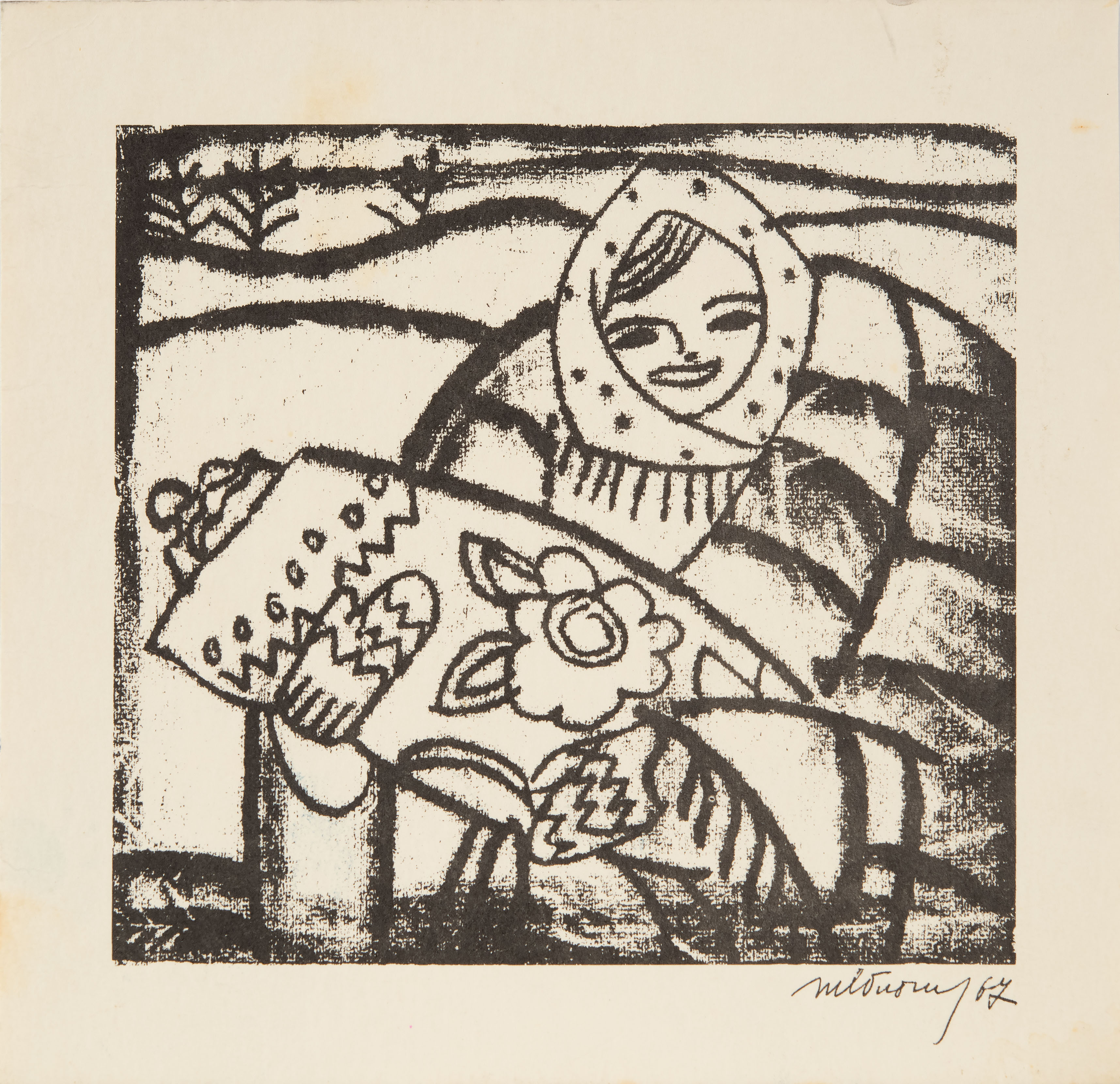
Untitled, 1967. Screenprint reproduction (?) on paper, 11.2 × 12.4 cm (4 7/16 × 4 7/8 in.) / 14.5 × 13.5 cm (5 11/16 × 5 5/16 in.). Norton and Nancy Dodge Collection of Nonconformist Art from the Soviet Union. D11094
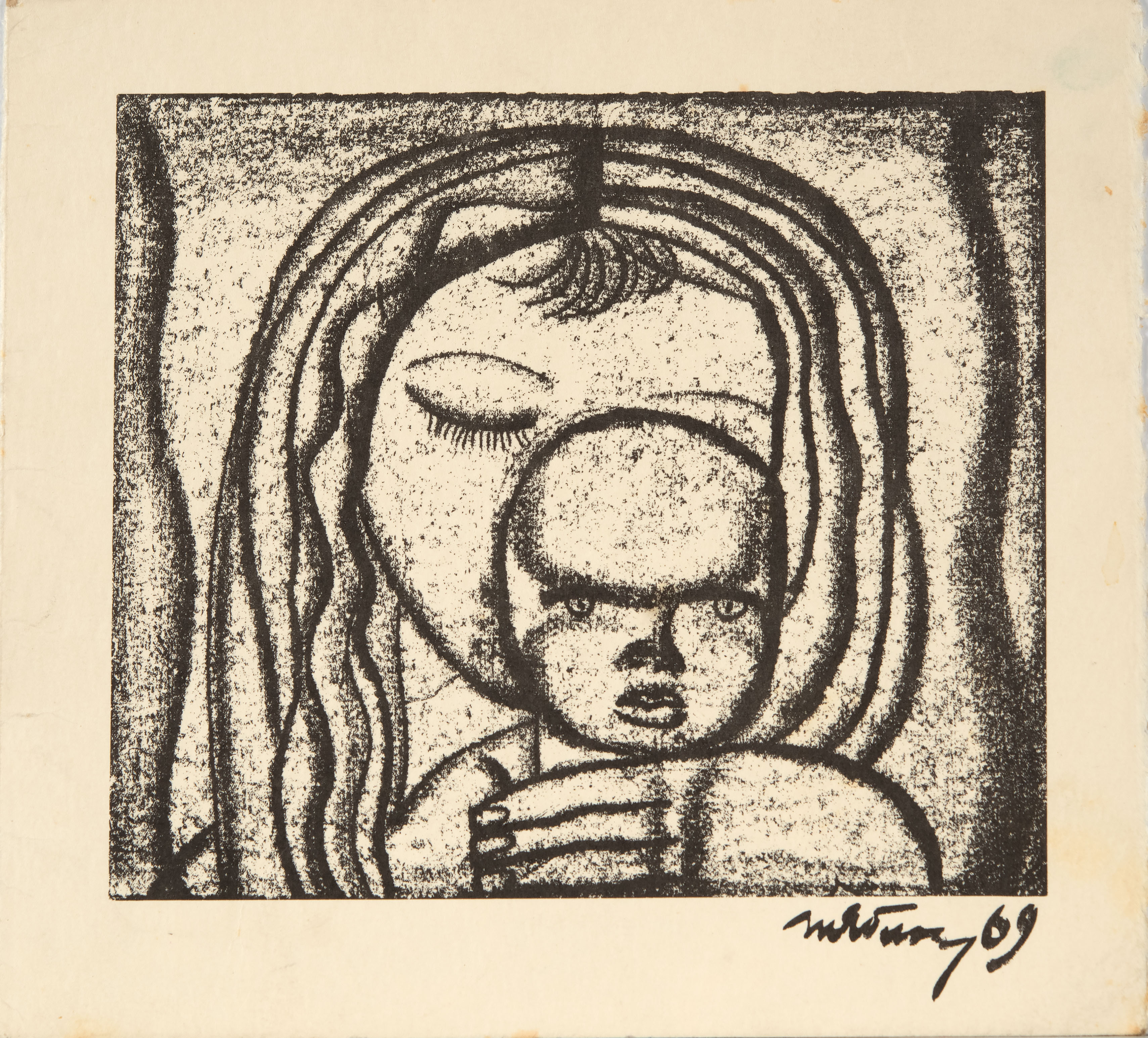
Untitled, 1969. Screenprint reproduction (?) on paper, 11.3 × 13.1 cm (4 7/16 × 5 3/16 in.) / 14.5 × 16 cm (5 11/16 × 6 5/16 in.). Norton and Nancy Dodge Collection of Nonconformist Art from the Soviet Union. D11095
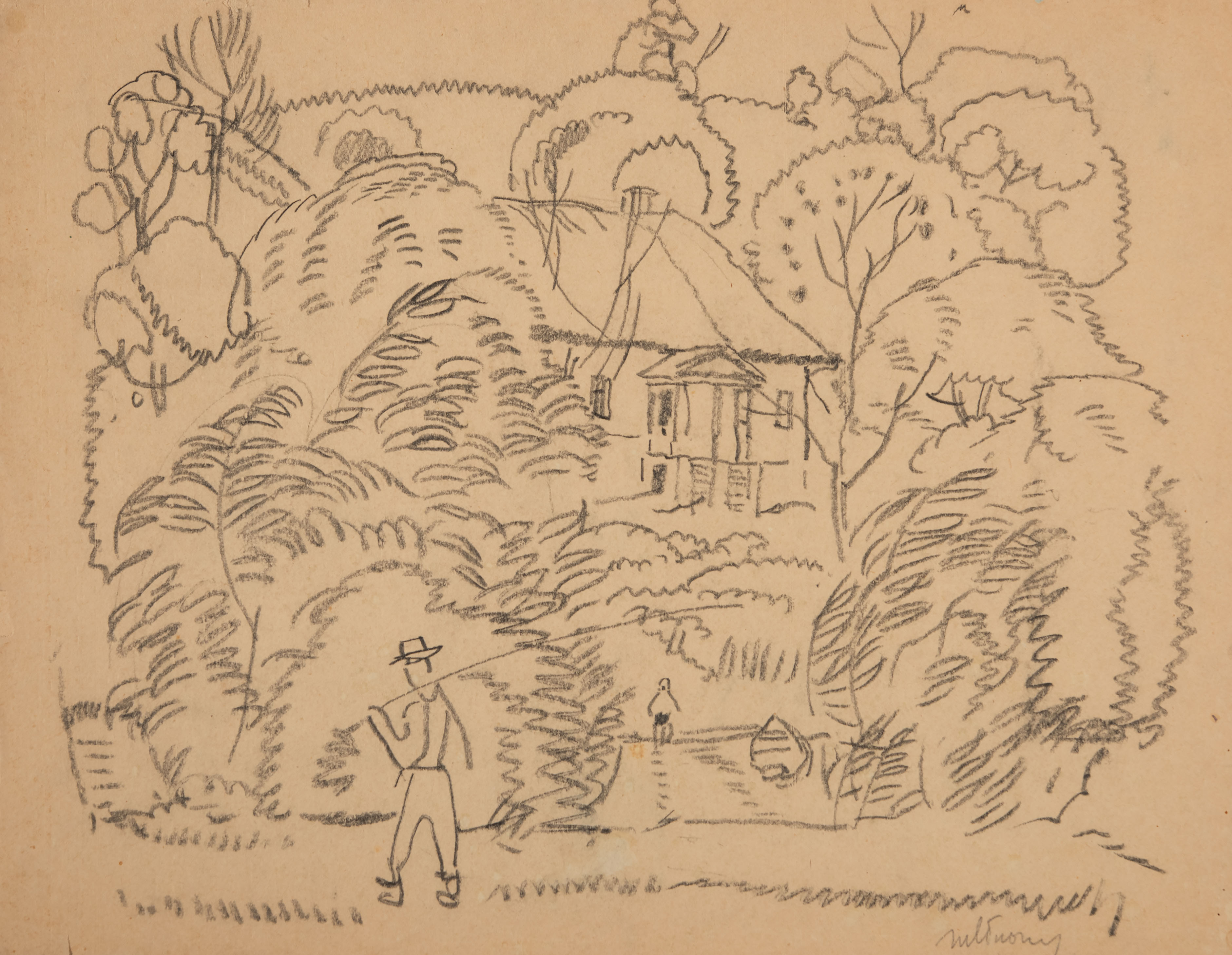
Sednev, 1963. Graphite on paper, 38.6 × 49.3 cm (15 3/16 × 19 7/16 in.). Norton and Nancy Dodge Collection of Nonconformist Art from the Soviet Union. D11117