
Valmar (Volodya) Margaryan
1948 – Leninakan (now Gyumri, Armenia). Works in Yerevan (Armenia)
Volodya Margaryan, known as Valmar, is a contemporary Armenian painter, well known in Armenia and abroad, who is also distinguished by his various cultural activities. Having founded the Valmar Art Gallery in downtown Yerevan in 2004, Margaryan is his own art dealer and gallerist. He is also an art collector, whose holdings of Armenian modern art, numbering around 150 works, were exhibited at the National Gallery of Armenia in 2024.
Margaryan was born in Leninakan (now Gyumri), the second-largest city in Armenia. He began drawing in childhood and went on to study at the Sergey Merkurov Art School in Leninakan, from which he graduated in 1996 and where his teachers included Hakob Ananikyan (1919–1977), a noted painter of poetic urban landscapes. He subsequently studied at the Yerevan State Institute of Theatre and Fine Arts in Yerevan (now the State Academy of Fine Arts of Armenia), graduating in 1972. In 1976, he became a member of the Armenian Artists’ Union, and in 1994, he joined the International Association of Art (IAA), affiliated with UNESCO.
When Margaryan entered the Yerevan art scene in the early 1970s, a large cohort of Soviet painters, having departed from the moribund canons of socialist realism and passed through the “severe style” of the 1960s, worked in a linear, cold, and monochrome figurative idiom sometimes characterized as “lyrical realism” or “linear realism.” So too Margaryan, whose first serious artistic efforts—Inqnadimankar (Self-Portrait, 1973, National Gallery of Armenia), Mankabuyzhy (Pediatrician, 1975, National Gallery of Armenia)—embodied this style. The paintings’ lyrical, contemplative, and introspective imagery, together with their delicate linear style and cool, restrained pastel palette, creates a lyrical and psychological atmosphere. Lyrical realism would remain important for the artist, who, as he continued to develop his thematic and stylistic range, derived his greatest visual effects from this early orientation.
Throughout his career, the artist worked in large, thematic-stylistic cycles united by certain motifs. Among the earliest of these is Im patuhanits (Out My Window, 1975–79), each of whose paintings consists of the same compositional scheme: a still life on a windowsill; a window that opens out onto an urban landscape with buildings; and a vertical series of trees and telephone poles that structure the composition. Devoid of people, the Out My Window paintings exude a sense of silence and alienation, an effect heightened by their restrained, almost monochrome color scheme, featuring cool and muted shades of gray, light blue, white, olive, and ocher. In these early works, Valmar incorporates mirror reflections, refractions, and fragments of objects, a strategy he would further develop in his still lifes of the 1970s–1980s.
That vision was fully expressed in Margaryan’s still lifes with mirrors of the 1970s. Here, objects appear to be situated within a space of multiple mirrors, a space in which their reflections are multiplied. This creates an optical illusion for the viewer, who at times may lose sight of the original motif. The mirror reflection was a metaphor for the uncertain, unstable reality of the Soviet dystopia amid the Brezhnev stagnation of the 1970s. Along with Margaryan, other Soviet artists at this time were employing mirror images and other visual and mental games as a means to enter an alternate world and escape their dreary day-to-day reality.
The highly aestheticized, polished style of Margaryan’s early series led to decorative-geometric abstractions—flat compositions reminiscent of Armenian tapestries, in which spatial depth is lacking altogether. In these works, the artist used subtle tonal transitions to achieve a special quality of light, which seems to glow from within the paintings. By way of example is Composition (1979, D11174), in the Norton and Nancy Dodge Collection. The geometric structure is clearly visible, expressed through alternating light and dark vertical regions. Here, as in other works, the artist abstracts, but does not lose contact with, recognizable objects (in this case, fragments of musical instruments), enabling the viewer to glimpse their figural undertones. The composition seems to consist of haphazardly scattered motifs, but in fact everything in it is carefully calibrated and laid out as a unified whole, as in the ornamental arrangements of Armenian carpets. Indeed, Margaryan's decorative-geometric abstractions overall are likely indebted to the decorative and geometric aspects and flat-surface treatment in many areas of Armenian national art.
Margaryan became an Honored Artist of the Republic of Armenia in 2006. He went on to receive other accolades: the Vazgen I gold medal in 2007, the Ministry of Culture of Armenia gold medal in 2008, the Prime Minister’s commemorative medal in 2011, and the Master gold honor in 2011. In 2013, he was awarded the Grigor Narekatsi medal of the Ministry of Culture of Armenia, and in 2015, he became a People’s Artist of the Republic of Armenia.
The list of Margaryan’s group and solo exhibitions is vast both in terms of their number (nearly two hundred) and their geography (Armenia, Russia, the Baltic states, various countries in Europe and the Middle East, the United States, Canada, Japan). His works may be found in the holdings of the National Gallery of Armenia (Yerevan, Armenia), the Yerevan Museum of Modern Art (Yerevan, Armenia), the State Tretyakov Gallery (Moscow, Russia), the Jane Voorhees Zimmerli Art Museum (New Brunswick, NJ, US), and private collections.
Arus Stepanyan, Lilit Sargsyan
Translated from Russian by Ilya Bernstein
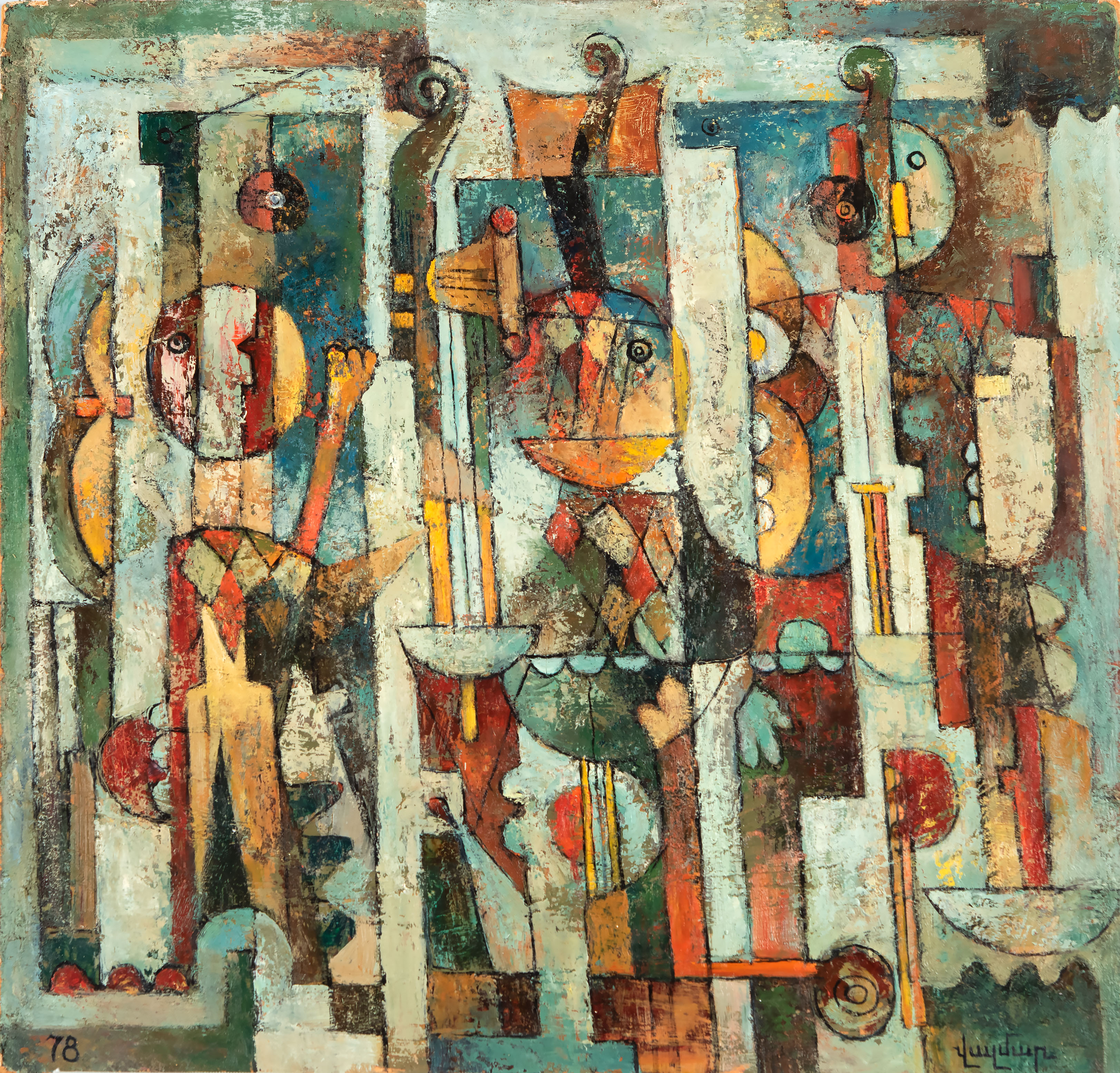
Composition, 1978. Oil on fiberboard, 60 × 60 cm (23 5/8 × 23 5/8 in.). Norton and Nancy Dodge Collection of Nonconformist Art from the Soviet Union. D11174