
Victor Skersis
1956 — Moscow (Russia). Worked in Moscow (Russia), New York (USA); currently works in Bethlehem, PA (USA)
Victor Skersis was just nineteen years old when he participated in the unprecedented group show of unofficial art in Moscow’s premier VDNKh exhibition space in 1975. That decisive early start—in a large nest of leaves and branches that he and fellow artists Gennadii Donskoi and Mikhail Roshal had woven for the exhibition—set the pattern for his work as a conceptual and performance artist. The unusual, multiday collaborative performance Hatching a Spirit brought the three young artists into direct contact with other artists, suspicious Soviet authorities, and an audience of thousands. Since that auspicious beginning, Skersis has investigated art in activities that run the gamut from “underground” work in the Soviet Union in the 1970s to performance works and philosophy in New York in the twenty-first century. Through it all, he has kept his focus on the importance of shared artistic endeavor as the surest path to collaborative discovery and innovation. A cofounder and core contributor to a variety of art collectives and creative “coauthorships” on several continents, Skersis can look back on a career that spans over fifty years. As his 2009 exhibit in the Moscow gallery GMG announced, “Iskusstvo eto Ogogo!” [Art Is Wow!].
The Nest, as the group of Donskoi, Roshal, and Skersis became known following their public debut in 1975, provided the perfect base for experimentation. Working collectively came naturally from the beginning, in part because the artists had the collaborative experience of their mentors as a creative example. Vitaly Komar and Alexander Melamid demonstrated the model that would serve Skersis consistently over decades: opening art to broader, unconstrained, and continually evolving participation offered the best chance for innovation. This cooperative approach attached the highest premium to dialogue. Although Skersis admitted later that there was a “certain idiocy” [1] to the Nest’s famous Communication Tube, also displayed at the 1975 exhibition, the group’s pointed insistence on the literal meaning of words helped establish the art object as an “essential tool for conversation” in an era of “fragmentation.” [2] That perseverance in looking for connections across artistic and political borders made the Nest a reliable source of humor, optimism, innovation, and fun at the end of the 1970s. Five Pieces of Paper Faded by the Sun Over 10 Days, a Nest work of serial art demonstrated at the blockbuster VDNKh exhibition, helped open late-Soviet art to postmodern experimentation and wider accessibility. Even the Soviet journalist tasked with mocking the show understood the surprising message: “everything touched by the artist is a fully-fledged work of art.” [3]
Skersis displays his continued belief in the value of wide and diverse artistic connections in the works he created after the Nest fell apart in 1979. His modular Chair Wrapped in Chairs, documented in the Dodge Collection (ZAM, TR9661.02), alludes to both Joseph Kosuth and Christo, juxtaposing ideas from those artists’ works to reimagine homage and appropriation as joyful cocreation. Skersis’s One and Three Chairs (ZAM, MANI2.02.36.01-07) from the same year similarly pushes Kosuth’s conceptual work to its logical extreme by making the interchangeability of object, image, and text all-encompassing. In Skersis’s expanded interpretation, Kosuth’s real wooden chair, photograph of the object, and textual description of it are each represented as interchangeable sheets of paper, now democratically accessible to imaginative viewers everywhere. Including such works in the Moscow Archive of New Art (Moskovskii arkhiv novogo iskusstva, or MANI) that Skersis, SZ collaborator Vadim Zakharov, and other unofficial artists collected in the early 1980s signaled the artist’s cheerful expectation that audiences around the globe would be interested. Two works from 1981, Fountain I and Fountain II, bring Marcel Duchamp and Robert Morris into creative dialogue, with Skersis’s own zinc water bucket in conversation with those two artists. The found object serves as both wry commentary on Soviet artistic life and powerful evidence of the continued vitality of diachronic, transnational conversation. A series of “machines” Skersis built during the same period includes the works Justice (Iustitsiia) and Propaganda (Agitatsiia), constructions that purport to turn mechanical energy into aesthetic force. His justly famous Understanding Machine (Mashina Ponimaniia), which is represented in the Dodge Collection in a 1984 recreation (ZAM, 2023.012.001), argues that art should induce the “sense of an intellectual discovery” in participants. The interactive machine requires the active participation of audience members who must make a conscious choice to pull the machine’s hammer out of its resting state of equilibrium. Once an individual initiates that dangerous “premediated act,” the hammer falls resoundingly just inches from the participant’s face. [4] The result is a predictable, yet continually surprising change in perception that can be endlessly reproduced.
In 1984, Skersis emigrated to the United States, where he participated in exhibitions of unofficial late-Soviet art, joined colleagues at Nada Gallery on Manhattan’s Lower East Side, and gradually adapted to art in the American context. The process of adjustment included a new conviction in the importance of useful art. Considering utility a more compelling criterion of art’s value than individual taste, Skersis spent nearly twenty years working as a medical illustrator. Those commercial illustrations became part of his 1993 Moscow show Irrelevant, which also built on long-distance collaborative work with Zakharov. Biology, mathematics, physics, linguistics, and philosophical history became subjects of deeper study during the same period. The breadth of those interests helps explain the development of “Skersis’s Paradox,” which followed work by A. J. Auer and Kosuth to argue that the most innovative aspect of any artwork is the part that is not “art.” Skersis honed his performative skills in numerous interactions with other artists and students, including a happening he organized as part of the 2014 International Aesthetic Conference at Moscow State University, in which he played the role of Socrates while discussing artistic catharsis with attendees.
Skersis participated in various Moscow Biennial shows as both artist and curator, and between 2008 and 2022, he was a core member of the art collectives Kupidon, Tsar of the Hill, and Edelweiss, groups that brought together Yuri Albert, Andrei Filippov, and, from 2011, Paruyr Davtyan for discussions about the role of art and art history in the twenty-first century. These groups’ evolving model for work was grounded in conversation: lengthy discussion on a particular artistic topic was followed by independent activity; each artist created work individually to be included in the eventual group show. On several occasions, the work involved pilgrimages to sites of special artistic resonance. A journey to Aix-en-Provence, for example, involved a complicated and humorous attempt to engage with Cézanne’s heritage. A trip to Normandy extended Monet’s experiments in a series of paintings of the Rouen Cathedral at midnight. The artists’ continued focus on shared inquiry, experimentation with a variety of techniques, public outreach, and good humor found audiences in Moscow, Nizhny Novgorod, and Perm.
Extended collaborative work with the Bulgarian-American artist Daniel Bozhkov in 2021 engaged both artists and the general public in further conversations about contemporary art. Their work Three Benches was part of a Day of Radical Joy held in three Brooklyn parks on May 1, 2021. The participatory event, held sequentially in McCarren, Fort Greene, and Prospect Parks, offered passersby the opportunity to draw and be drawn as they engaged in discussion with Skersis and Bozhkov. After each session, participants were handed their (self) portraits and reminded that the real work of art begins in contemplation only after the performance. Bozhkov organized an important 2023 exhibition of Moscow Conceptualism at Hunter College in New York City. The show, Distortions, was the culmination of several years’ study of the art movement that brought Skersis, Zakharov, Albert, Nadezhda Stolpovskaya, Andrei Monastyrski, and Sabine Hänsgen together with graduate students in art and art history. As part of the exhibition, Bozhkov and Skersis organized a series of “Meta-art Saturdays” to open discussions more widely. Those free-flowing conversations about the future of art continue in the newly organized art collective Zagagoolina, with Skersis, Johnny Sagan, and Bryan Ellingson. As always, the emphasis is on camaraderie, unrestrained thought, humor, and optimistic belief in a better shared future. All are welcome to join.
Mary A. Nicholas
Photo portrait: Victor Skersis, 2011. Photo by Mary Nicholas. Courtesy of Mary Nicholas
Notes:
1. Skersis’s remark about “idiocy” is part of an interview with Leonid Lerner and Bogdan Mamonov in “Opravdanie kontseptualizma” [Defense of conceptualism], Iskusstvo 1(2008): 64–73, 69.
2. This description of the Communication Tube (Kommunikatsionnaia truba) comes from a list of foundational works Skersis compiled in 1981 for the Moscow Archive of New Art (Moskovskii arkhiv novogo iskusstva, or MANI), MANI 3, #24.
3. Shpagin, M. “Soblazny fioletovoi kar’ery” [Temptations of a purple career] In Moskovskii komsomolets, October 15, 1975.
4. Skersis discusses the Understanding Machine in Aspekty metaiskusstva (Moscow, 2008, p. 23).
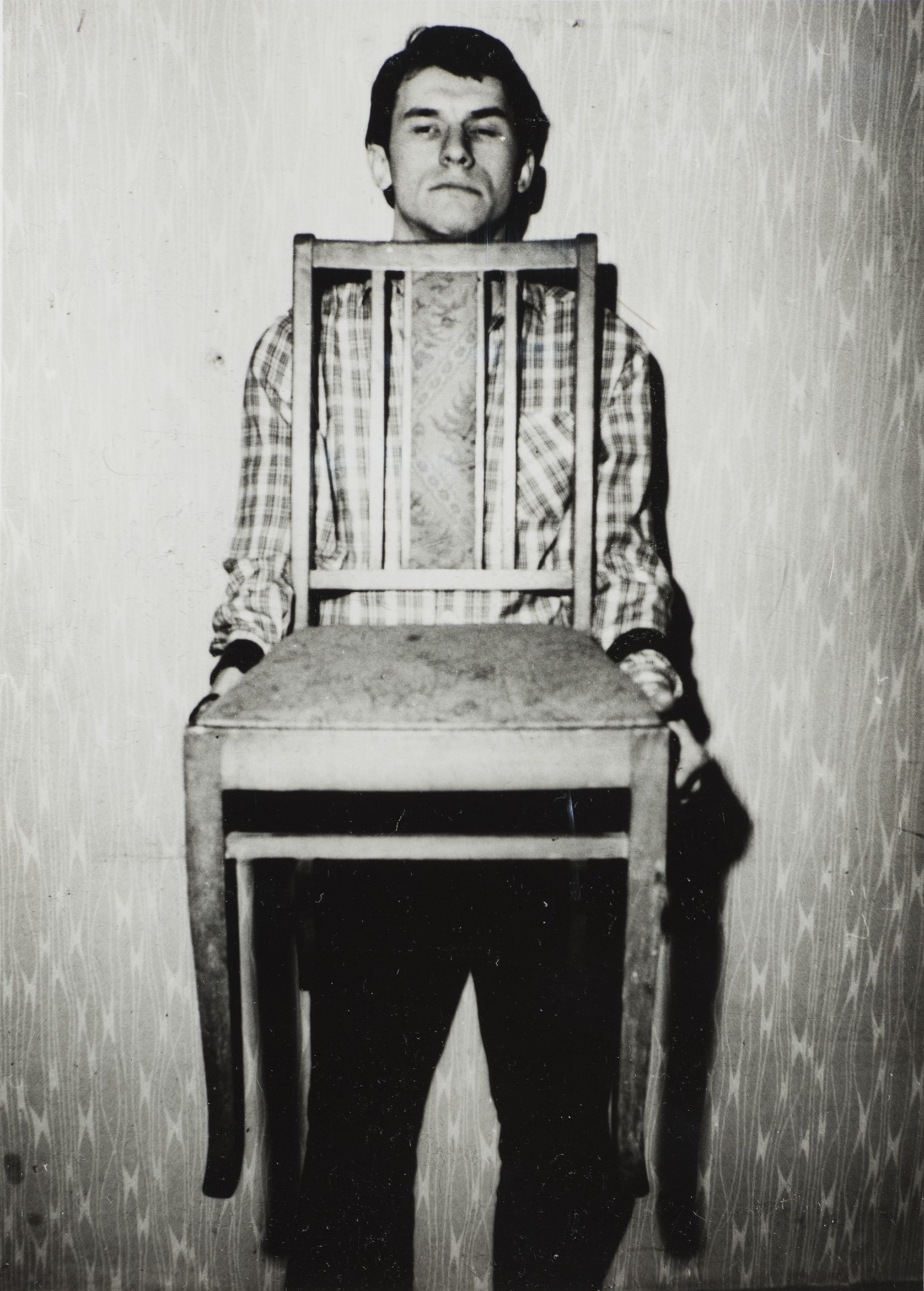
One and Three Chairs, 1979. Gelatin silver print on photographic paper, 18.2 × 12.8 cm (7 3/16 × 5 1/16 in.). Museum Purchase. MANI2.02.36.01-07
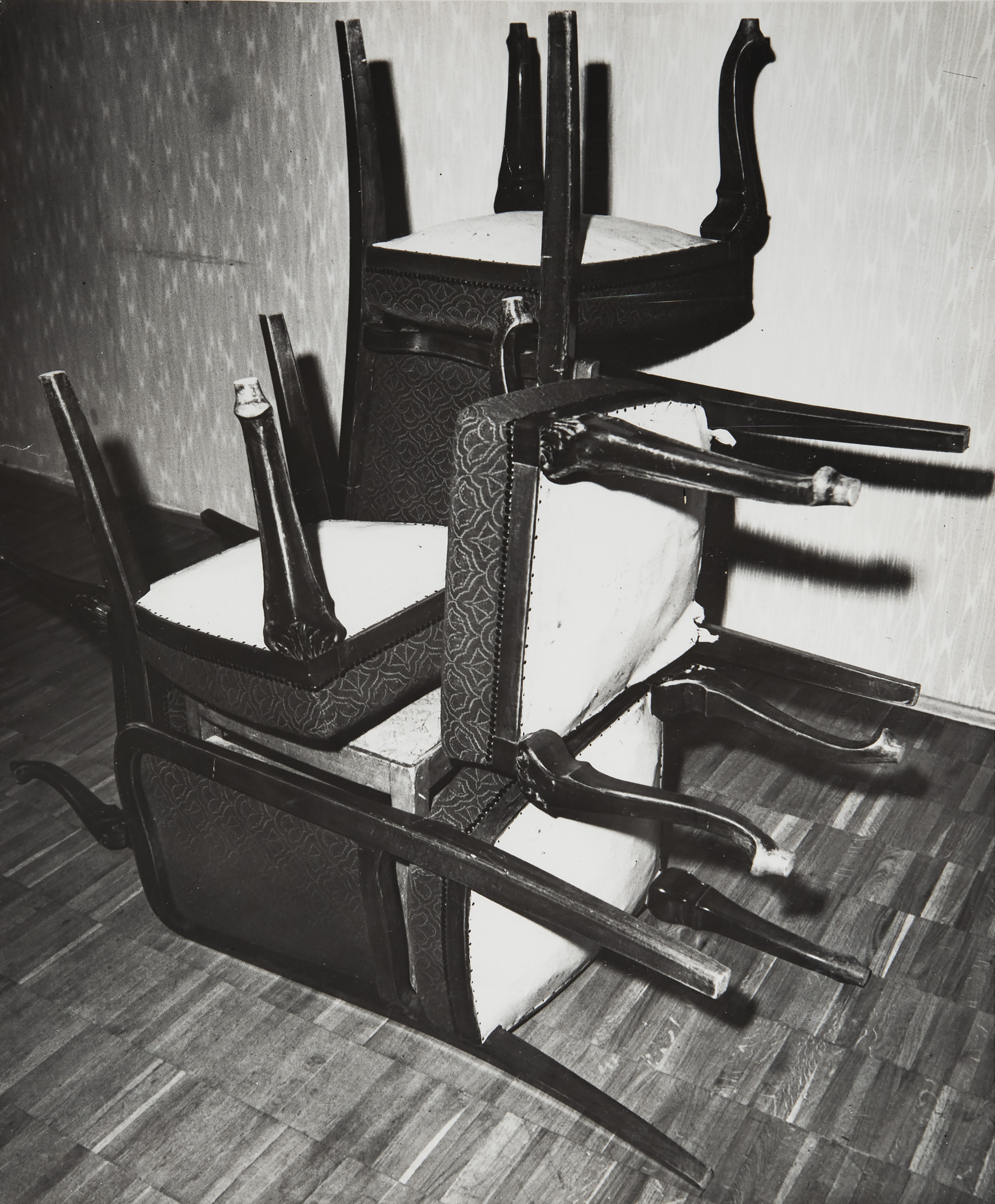
Chair Wrapped in Chairs, 1979. Gelatin silver print on paper, 30.2 x 23.8 cm (11 7/8 x 9 3/8 in.). Gift of the artist. TR9661.002
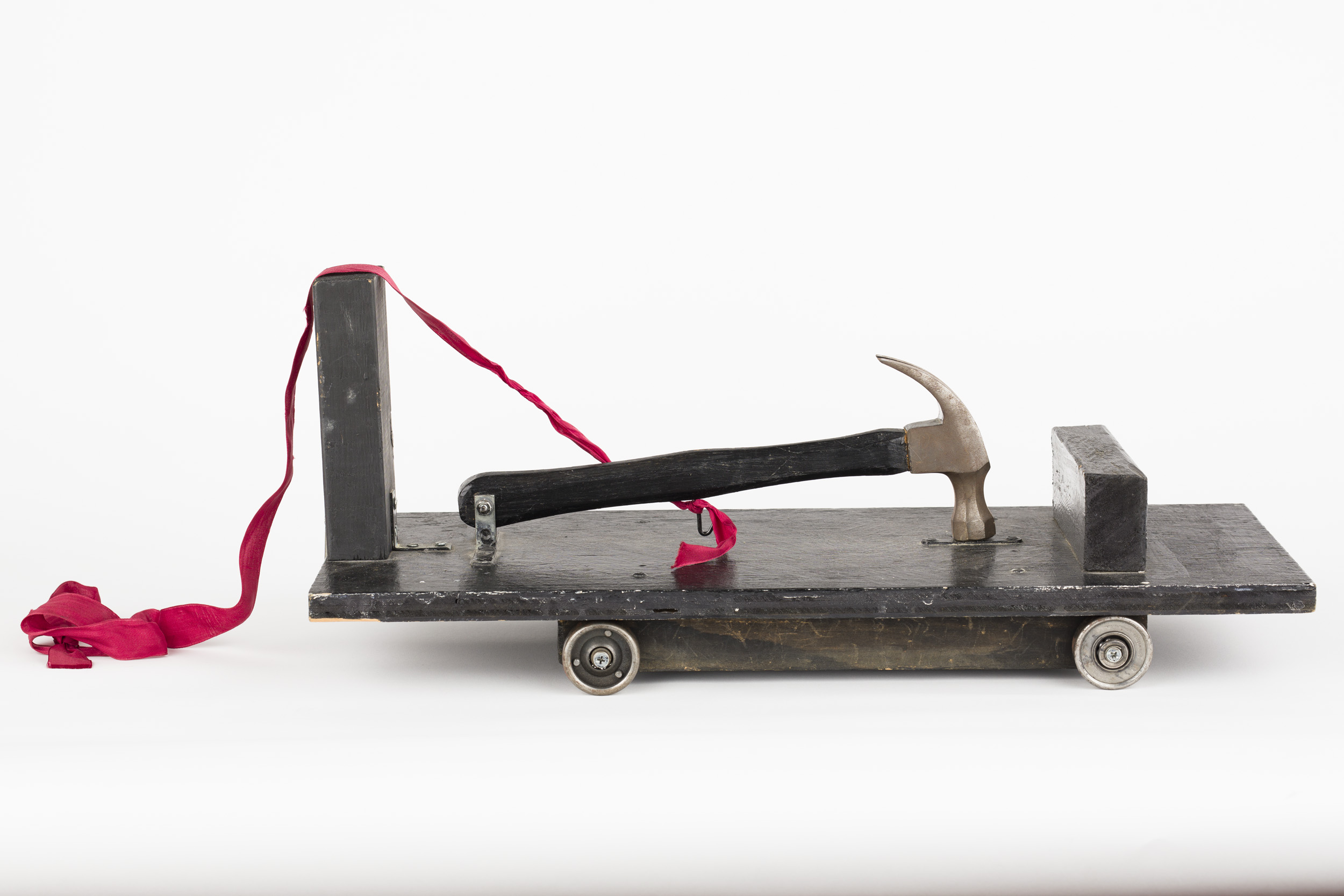
Understanding Machine (reconstruction of 1979 original), 1984. Wooden cart with hammer and ribbon, 41 x 62 x 25.5 cm (16 1/8 x 24 7/16 x 10 1/16 in.). Museum Purchase, Avenir Foundation Endowment Fund. 2023.012.001