
Vladimir Petukhov-Aksinenko
1959 — Angarsk (Russia) | early 2000s — Irkutsk (Russia). Worked in Almaty (Kazakhstan) and Saint Petersburg (Russia)
Very few accounts of this truly underground artist’s life have been preserved. Most of them are related to his period in Almaty. Vladimir Petukhov was an artist, a hippie, a wanderer, and a distinctive individual. In his friends’ recollections, he has become an inscrutable guru—“a man of the moment and spontaneity, an ascetic wiseman and Buddhist pilgrim, while at the same time as sly as a fox, capable of wrapping whoever he wanted around his finger” (according to the artist Almagul Menlibayeva).
This was his paradoxical nature.
“Volodya was one of the first hippies in Irkutsk,” wrote his friend, the artist Vladimir Olenenkov. “He would hang out in front of the Angara Hotel. He was married once. Got divorced. Participated in shows in Angarsk, Sayansk, Irkutsk, Novosibirsk. He was a part of the 5-e Dykhanie group. A very talented artist.
“In the 80s, he came to my studio at the Energetik House of Culture and asked to see my work. We started a dialogue about art. He asked to paint at my place (he didn’t have a place to live that time). I said yes. So, for two years, we made a lot of work together. We painted together (there was no alcohol involved). We worked a lot without a thought to showing our work. We always had visitors—hippies, musicians, scenesters.
“At first, it was just the two of us. Then there were three. Then Yankov and his wife showed up. We came up the name of our group really quickly—Piatoye Dykhanie (Petukhov came up with it).
“Tanya suggested we have a show in the building. We organized it in two days and called it Alternativa. So many people came. We were all in the gallery. Arguing. Discussing. And that’s how it all started.”
“In Angarsk, Volodya met Pete Krivoshchekov (a leading figure in the Alma-Ate hippie scene),” the artist Yerbol Manapov recalled. “And he told him about us [the Alma-Ata art scene]. So Volodya went to Alma-Ata to hang out with us, he worked and lived with us. The first thing he did was taught us how to put on shows. That was the most important thing he gave us.
“While we were living with him, hanging out, he was always drawing, and I copied him, I started bringing a bag with my paints and brushes everywhere. It didn’t matter what it was—canvas or panel, or fiberboard, or particle board. He taught me to stretch and prime canvases. He was always drawing and leaving his drawings wherever he made them, wherever he was crashing, he would just give his work away.
“He had a painting called, Prishel, Uvidel, Pnul [I Came, I Saw, I Kicked] and his contribution to the Alma-Ata group Zelenyi treugolnik [Green Triangle] can be summed up with this exact phase: I came, I saw, I kicked!
“This ground had already been laid for all this; it’s not like he was planting his seeds into naked soil. We were ready for a lot of things by that point. And when it came to hippie ideology and drawing—putting all that together and tying it in with the skills of putting on shows, exhibitions—in many ways, Petukhov was the one who modeled all this.”
“Petukhov reminds me of these lyrics from one of Shevchuk’s songs: ‘And the serious men drive the spikes in,’” wrote artist Ablikim Akmullayev. [1] “Volodya gave off this air of severe Siberian masculinity.”
“Volodya said that artists don’t need crutches to make their work,” Almaty artist Saule Suleimenova recalled. “For him, drugs and alcohol were crutches. He believed that you needed to be in a pure spirit, with a pure message, in order to move through art. And he was this authentically hippie person. From an older generation. I think that in terms of his aesthetics, his values, he was closer to the beats. He believed that art needed to be very precise and clear in terms of its message—minimalist. He totally avoided any kind of romanticism. And he had a deep love of the mountains, of life. … He did start out because he had been using. He arrived because he wanted to get off of that stuff.”
Petukhov’s paintings are ascetically laconic. His work gives the impression of his being well-trained and reveals a confident, masterly hand. His talent was evident in his landscape paintings, as well as in his geometric abstractions and primitivist works.
Everything he tried—whether it be abstraction with geometric forms or figurative, faceless silhouettes of people on the streets, reminiscent of bowling pins—was imbued with his brutal, masculine energy.
Petukhov’s paintings demonstrate an irreproachable sense of color and form. He was brave with the brush, sometimes sweeping, other times graphic, like in poster art, and minimalist.
In all of his work, we sense movement and monumentality; even in small works, there is a precision of articulation and composition—rhythmic, often geometric, reminiscent of Vladimir Mayakovsky’s jagged stanzas.
In the film Abreviat–Ura (1989), Green Triangle members are led by Petukhov out of the basement of the exhibition hall of the Artists’ Union onto Panifilov Street in Alma-Ata. They symbolically ascend the steps that lead to the second floor, where the exhibition hall of the Artists’ Union is located. That is, they are leaving the “underground” and moving toward the general public. Some time later, after Petukhov had already left Alma-Ata, Green Triangle really did have a show in that space. It had been manifested by this work itself.
In Abreviat–Ura, he does a performance: he spreads out a copy of Pravda newspaper on the floor, puts a stump on it, and then cuts off the heads of bowling pins. He then covers his face with his bloodied hands. When I asked why Petukhov left Almaty, Manapov quoted him: “My mission has been accomplished. It’s time for me to go!”
After his departure, the Triangles (Green Triangle members) visited Saint Petersburg, where Petukhov was like a fish in water. He was friends with many of the artists there, mainly from the Novye Dikie group, and he was close with the Mitki. Volodya always made sure that artists who came to Saint Petersburg from Almaty were not left to languish. He wanted people to grow, to learn to understand art better.
His move to Saint Petersburg allowed Petukhov to dive into the very center of the roiling cauldron of the arts center at Pushkinskaya-10, the city’s citadel of underground culture and the oldest independent art center in the city on the Neva river. He had a studio at this legendary squat. In that space, he found endless, fascinating conversations, chance encounters, discussions, exchanges of ideas and information, tea drinking, and of course regular drinking, as well.
I came across a story by Andrei Tsunsky online, titled “Neprilichnye istorii” [Indecent stories] [2], in which he described an episode from Volodya’s life. I got in touch with Tsunsky, and here is how he retold it:
“I’m glad that I documented this funny although not very decent memory about Volodya. All that I have left of our relationship is joy from having known him and memories of a man ‘with a thick braid down to below his knees,’ who always had a bit of a surprised expression. Volodya was very kind and intelligent, pleasant to be around, and talented. We were not friends for very long, and I knew very little about his life. But he made a very big impression on me with his work and perspectives as an artist, as well as his kind of helpless generosity, which he extended to everyone.
“He experimented with forms, including with figurative ornamentation for some time. He was drawn to the Mitki, he was really close with Volodya Yashke, who passed. He loved his piece S’ekhavshaia naproch’ baba, [A woman went completely mad], depicting pretty evil-looking witch: this old, sinewy bag with a sour face and her tongue out (this painting was inspired by some fleeting affair he had). Petukhov made that painting under the influence of the Mitki. The ornamental elements in it were call outs to the artist Nika Blagodatov and Salekh, who traveled to the Far North and were very inspired there.
“He drank heavily, but I couldn’t tell whether what he had was alcoholism or just a regular, insatiable artistic drunkenness. Everyone drank back then and those who managed to work on top of it were considered teetotalers. I worked with Volodya a lot. He had shows in movie theaters, he tried to make work for the Ariadna gallery, but whether anything came out of that and where the woman who ran Arianda is today—I have no idea. All I know is that her name was Inessa. He was also connected with Nikolai Innokentievich Blagodatov, who was a collector of Leningrad nonconformist art, who acquired a lot of work by Volodya—but where is that collection today?”
Andrei Basmanov recalled, “Petukhov was a gentle person, kind, absolutely incapable of adapting to the new, dog-eat-dog era. … A classic mitek.
I saw Petukhov for the last time in 2000, on a trip to Saint Petersburg to see Ruchnaia rabota (Handmade), a show at Pushkinskaya-10. He was all smiles, drowning in his beard. We sat on a bench listening to a sad and short tale about a fire at his apartment that had destroyed all of his paintings. He asked about the Triangles, about Saule … tears ran down his cheeks.”
Petukhov painted Igra v go shakhmatami s Inokentiem [Playing Go with Chess Pieces with Inokentii], which is now in the Dodge Collection, in Saint Petersburg in the early ’90s. Petukhov was friends with Innokentii Blagodatov, and the way they usually spent time together was playing chess and drinking tea, a kind of Zen practice. The painting is balanced by the relationship between white, red, and yellow fragments on a pearlescent blue gradient, with a green frame that holds the composition in place. On the lower part of the painting, we see a sketchy version of a chessboard resembling a white table, with clearly outlined squares and blue lettering: A, B, C. In the upper part of the painting, there is a brain-teasing thoughtform rendered as overlapping spots: red on yellow, yellow on white, and zig-zag-like black stripes.
Petukhov was friendly with the artist Lucian Dolinksy, who died in 2014. We found his widow, the famous nonconformist artist Barti (Tatiana Baranova), who is still living in her studio at Pushkinskaya-10, and she confirmed that Petukhov had passed. He traveled to Angarsk to receive an inheritance and never came back. Barti and Lucian heard rumors that he was killed in his native Irkutsk in the early 2000s.
“We live our lives in order to destroy the darkness,” Vladimir Petukhov-Aksinenko wrote. “Love is the only thing we have. And we must love this misery, this filth. And then the darkness will recede.”
Zitta Sultanbayeva
Translated from Russian by Bela Shayevich
Editor’s note: This essay is largely a collection of undocumented accounts of the artist’s life from other members of artistic community. Materials on Vladimir Petukhov’s life and work are close to nonexistent, so the Dodge editorial team decided to publish this essay as is, lacking proper references, but picturing a lively image of the artist.
Photo portrait: Vladimir Petukhov at the 5-Dykhanie (5 Breath) group show at the Energetik House of Culture, 1988. Courtesy of Zitta Sultanbaeva
Notes:
1. Yuri Shevchuk (b. 1957) is a frontman of a legendary Russian rock band DDT, founded in 1980.
2. Andrei Tsunskii, Neprilichnye istorii. Lib.web-malina.com.
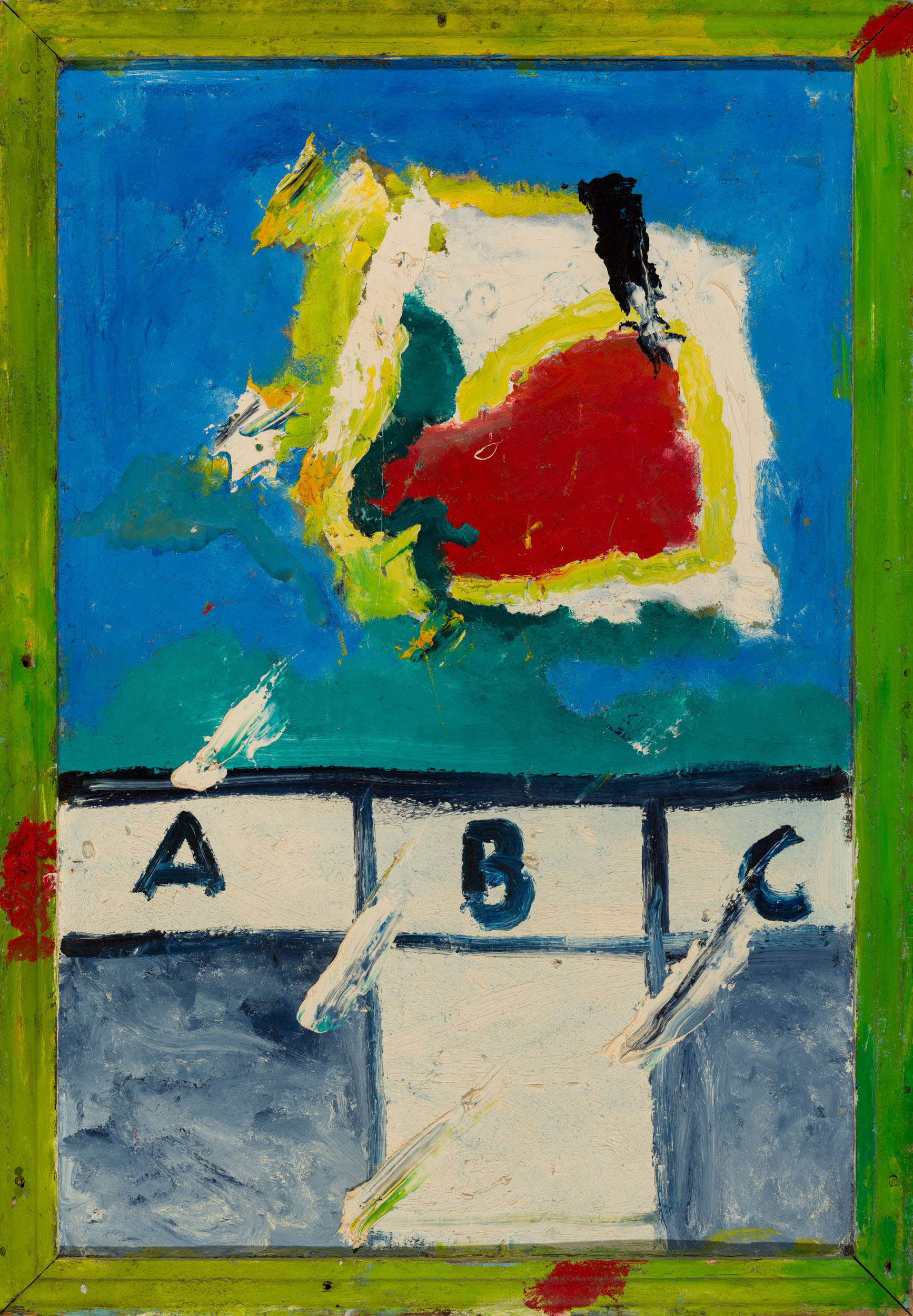
Playing Go with Chess Pieces with Inokentii, 1988. Oil on panel, 99.5 × 69.5 cm (39 3/16 × 27 3/8 in.). Purchased with funds donated by Norton Dodge and Nancy Dodge. 2000.0735