
Volodymyr Bovkun
1951 — Uman (Ukraine). Works in Kyiv (Ukraine)
Volodymyr Bovkun, a visual artist associated with the Kyiv painting school, creates art in various mediums, including works on paper, sculpture, assemblage, and easel and monumental painting. In his work, the artist uses a dynamic interplay of symbols and concepts, and he merges principles of abstraction, surrealism, and conceptualism, allowing viewers to immerse themselves in the depth of the artwork’s space. He is a unique figure in the history of Ukrainian art, one who never looked to join an artistic group but preferred to work on his own.
Bovkun graduated from the Kyiv Art Secondary School (now the Taras Shevchenko State Art High School) in 1969, and in 1975 he graduated from the Kyiv State Art Institute (now the National Academy of Fine Arts and Architecture), where he studied in the monumental painting studio under the guidance of Tetyana Yablonska (1917–2005). He started exhibiting in 1977 in republican and all-union exhibitions of drawing and graphic art. Since the late 1980s, he has actively participated in art exhibitions in Ukraine and abroad. His pieces are featured in museums and private collections worldwide, including in Chile, Singapore, the UK, the Netherlands, France, Belgium, Austria, Russia, and Germany.
Among Bovkun’s contributions are monumental objects in architectural locations, including mosaics (Man, Nature, Civilization [1978–81, Kyiv] and Motherhood [1981–82, Kyiv]), stained glass works (Science—Production [1982–83, Kyiv region]), tempera murals (The Human Dream of Flying [1983–84, Civil Aviation Engineers Institute, today the National Aviation University, Kyiv]), and tapestries (Youth and Peace [1985–86, Molod Publishing House, Kyiv]). A unique example of the artist’s early period is the large-scale mosaic bas-relief XX Century (1978–81), which decorates the facade of the O. M. Marzieiev Institute for Public Health in Kyiv. In this same period he experimented with various techniques—including pencil, ink, pastel—and searched for a new visual language. Most of his graphic works of the 1970s and ’80s (about sixty to eighty works) have been purchased by the Union of Artists, the Ministry of Culture, and several Ukrainian museums.
After joining the Union of Ukrainian Soviet Artists in 1986, Bovkun stopped taking commissions from the Combine (kombinat) and became completely immersed in his own creative work as a graphic artist. He was able to live off selling his own works rather than executing commissions of the state. This continued until 1990, when he completely switched from works on paper to painting. The next phase of his creative practice commenced in 1997, when he started working with sculptural objects such as assemblages and abstract and figurative sculpture, using techniques that combined various materials, including metal and plastic. Although in the 1990s there was reported interest from two central Kyiv groups—the Paris Commune and the Painterly Preserve—Bovkun studiously avoided associating with groups, always preferring to work in an unaffiliated capacity. He also rejected an offer to teach at the Kyiv Art Institute. In 1996 he won a grant from the US government that included a trip to the States. While there, he participated in an exhibition at the Kismet Gallery in San Jose, California.
In the first half of the 2000s, Bovkun worked on a series of abstract artworks that were based on relief. Each composition in his Geometric Progression series (2004) features triangles, squares, and circles in unique abstract patterns that create a sense of volume. This experimentation with relief to search for the three-dimensional in painting was inspired by the artists Vasyl Yermilov (1894–1968) and Vladimir Tatlin (1885–1953), who were the first to use this technique. [1]
Bovkun’s artworks of the early 2010s manifest his admiration of battle scenes. Some of these were inspired by Eugène Delacroix, Peter Paul Rubens, and Cimabue. They are not only monumental in size (2 by 3 meters) but also multifigurative, complex compositions in which animals and crowds of people transform into a bright tapestry. Artworks from this period were presented in the exhibition Freedom (2012, National Museum of Fine Arts, Kyiv); Bovkun’s large pieces in that exhibition convey his admiration of Ukrainian history—both historical figures and fictional characters. National motifs are clearly visible in As Taras Bulba Lost His Pipe Smoking—and Found (2010, private collection, USA). There were also works that combined social criticism, commentary on the relationship between government and society, and references to the Bible, such as Secret Dinner (2010, National Art Museum of Ukraine, Kyiv), in which the artist engages in dialogue withThe Last Supper by Leonardo da Vinci. Social themes are also present in such works as War Militants with Criminals (2010, private collection) and The Fall Leadership (2016, Museum of the Avant-Garde, Kyiv). In these works the artist reflects on the confrontation of various forces in society, social values, and the nature of relationships and their coexistence with issues such as social inequality and corruption.
Bovkun often explores materials and mediums, focusing not on genres themselves but on the boundaries between them. While some of his works can be clearly defined as historical figurative painting and others as abstract, many merge these boundaries. He also experiments with volume and the interpretation of form—ranging from a realistic approach to a deliberate flatness of the picture plane, where depth is suggested through added objects that create texture. “I want to get rid of the text,” the artist once said. “I avoid the content, leaving only the senses.” He prefers artworks that do not have a composition, creating optics that can be perceived as a “floating” composition. “I try to destroy the smallest compositional center with another center,” he has said. “The perception of my work is not a result, but a process. This allows me to hope that I give a viewer the opportunity to see something that is important and relates to the inner sensory experience.” [2] This effect is especially visible in his quite decorative works of the late 2010s, presented in the exhibition Information, Air (2018, Goldens Auction House, Kyiv).
The theme of “presence” has been central to Bovkun’s artistic practice since the 1980s, arising as a result of his interest in metaphysics during his student years. [2] “In all Bovkun’s works, there is a moment of folklore cosmology, and an element of ephemerality in the possibility of disappearing at any moment, dissolving into nothing, flowing in the opposite direction,” writes Oleksandr Naiden. [3] It is a practice that covers more than forty years, featuring multiple transformations. Bovkun is often called an abstract artist, which refers to his periods of the early 1990s, late 2010s, and early 2020s, but his pieces from 1995 and the early 2010s rather illustrate his inclination toward figurative art. This trajectory adheres to a logic of austerity of visual methods, derived from the artist’s preference to limit the number of techniques he uses. Additionally, he vigorously avoids narrativity in his works. He defines his art as invisible, because it leaves a lot of space for the viewer’s imagination. [4]
Anna Luhovska
Notes:
1. Volodymyr Bovkun, “Pro” [About], in Volodymyr Bovkun: Informatsia Povitria. [Exh. cat.] (Kyiv: Huss, 2018).
2. Leonid Kovalenko, “Volodymyr Bovkun: ‘Kyiv Art School,’” Ukrainska molod, April 20, 2019.
3. Oleksandr Naiden, Folklor i modernizm. Spilne i vidminne: Try narysy na zadanu temu [Folklore and modernism: Common and different: Three essays on a given topic] (Stylos, 2023).
4. Kovalenko, “Volodymyr Bovkun.”
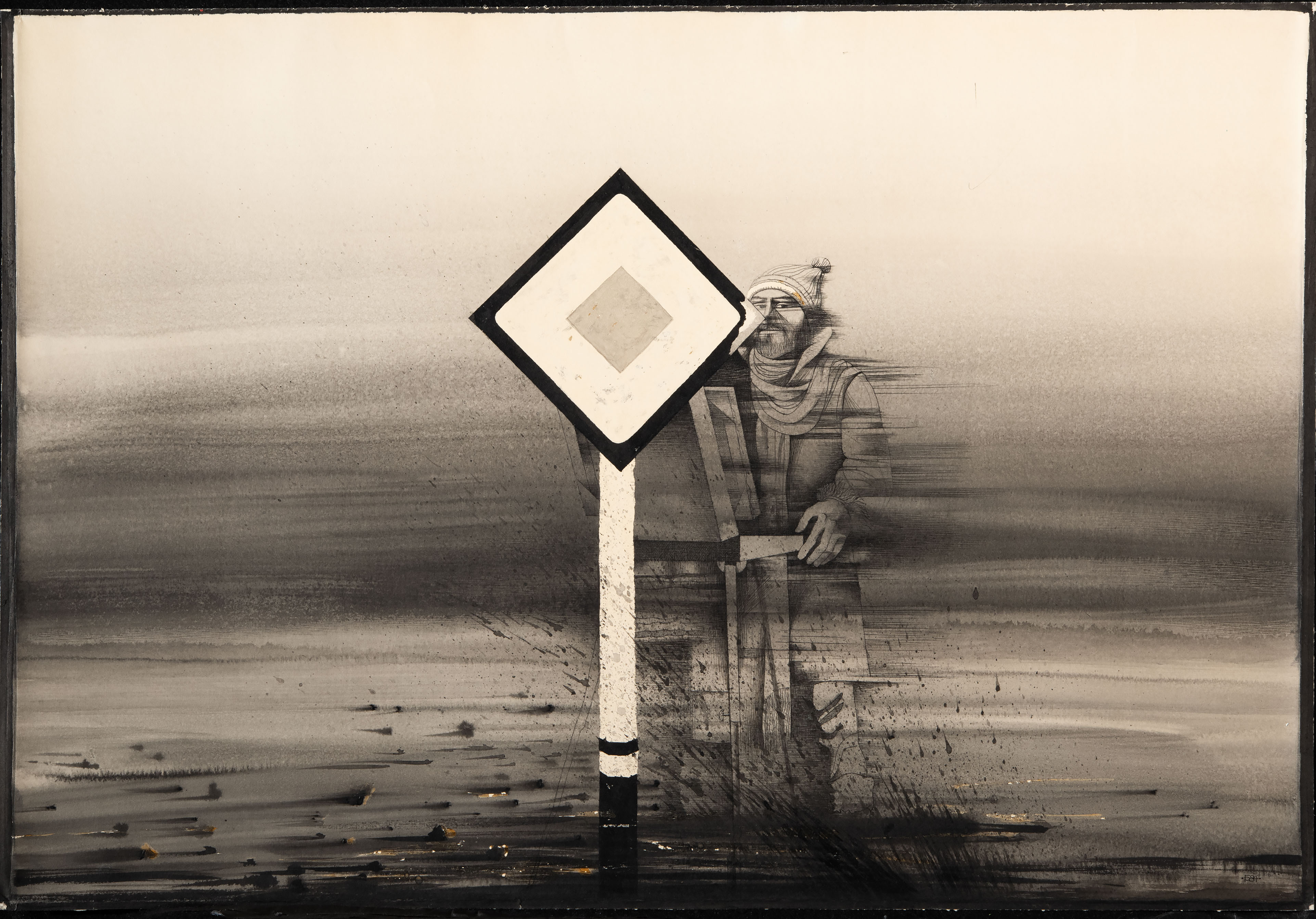
The Main Road, 1984. Ink on paper, 45.9 × 66 cm (18 1/16 × 26 in.). Norton and Nancy Dodge Collection of Nonconformist Art from the Soviet Union. D10490
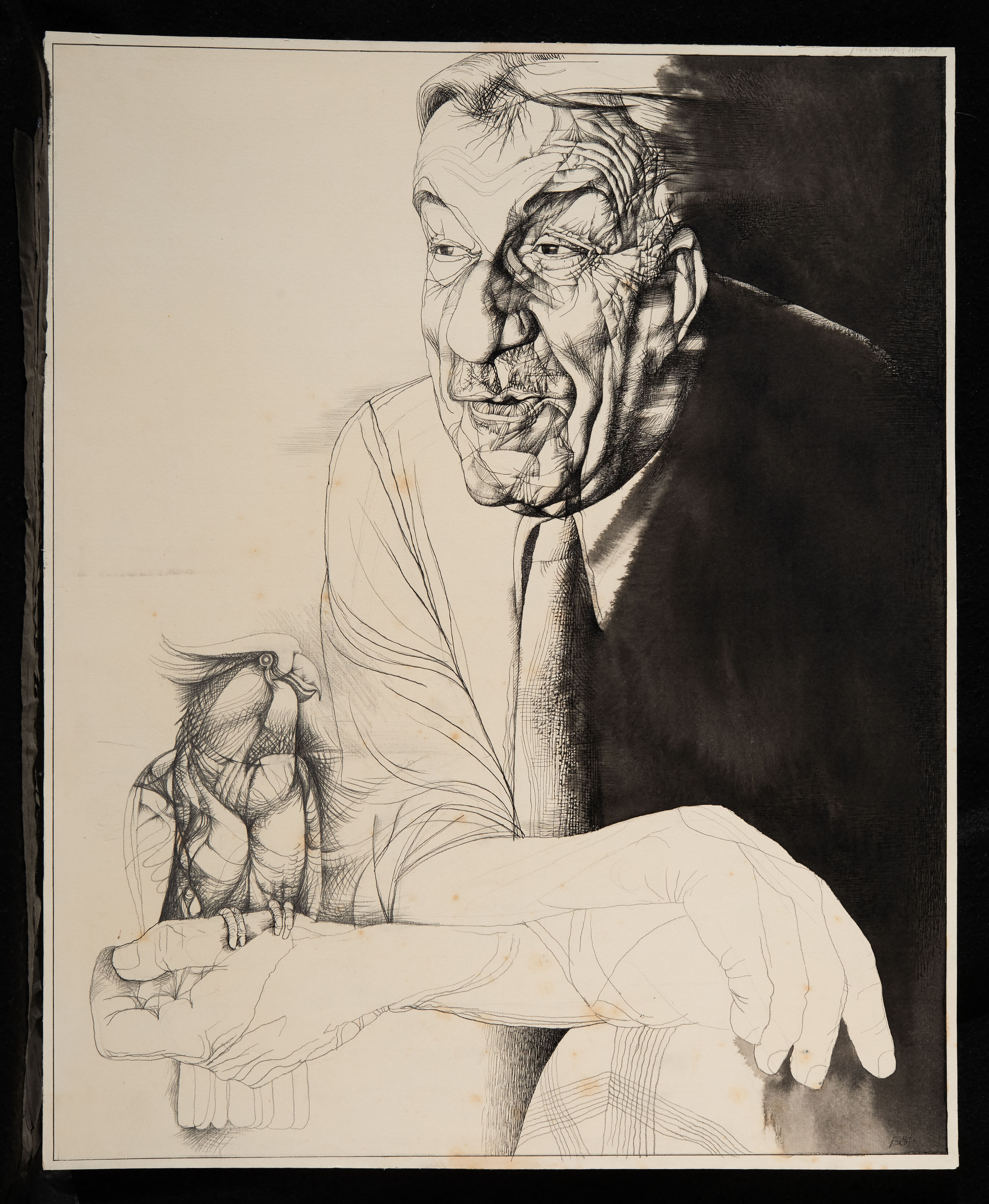
Fernand Léger, 1984. Ink and graphite on paper, 58.1 × 47 cm (22 7/8 × 18 1/2 in.). Norton and Nancy Dodge Collection of Nonconformist Art from the Soviet Union. D10489