
Zhanatai Shardenov
1927 — Kovylenka (Kazakhstan) | 1992 — Almaty (Kazakhstan)
Zhanatai Shardenov’s uniqueness lies in his radical approach to landscape painting: the artist took this traditionally peripheral Soviet genre and transformed it into a deeply personal artistic statement. He became the first Kazakh painter to turn the landscape into more than just a reflection of nature—it was a form of inner experience and concentrated emotion, an artistic experiment. His art is not an attempt to affix reality, but a way to achieve a dialogue with the world, in which a brushstroke becomes a word, texture becomes intonation, and color becomes the movement of feeling.
The painter’s artistic identity took shape during the Khruschev Thaw period, when the “sixtiers” generation focused on finding a new artistic language for national painting. The experimentation typical of the era determined the basis of Shardenov’s artistic system—as well as its continued relevance today.
Within the artistic system of socialist realism, Shardenov found his own expressive language, which was almost entirely free of ideological restrictions. Against the background of the Soviet representational paradigm, which required predetermined themes and purposeful conviction, Shardenov chose landscape painting—a marginal genre, poorly paid, not subject to censorship—and made it the main arena of his creative freedom. Here he developed his own visual philosophy, combining expression, decorativeness, texture, and unique color flair. His work is a pictorial chronicle not so much of the landscape itself as of his inner perception of nature, the world, and his own being.
The artist’s trademark is his recognizable style. He used complex color mixes in a dynamic, dense, pastose mass of paint, through which he sought to convey changing movements, special kinds of light and air density, and other spatial shifts. Most of his compositions are balanced in a transitional state between abstraction and reality; as provisional as the image is, it is surprisingly effective at conveying a portrait of the place.
Shardenov was born in the village of Kovylenka in the Akmola region. Orphaned at an early age, he could have become lost in the vast expanses of the Kazakh steppe if not for a series of happy coincidences and helpful people who noticed the boy’s talent. In 1949, he graduated from the Nikolai Gogol Alma-Ata Art School (now the Almaty College of Decorative and Applied Arts), and later completed two years at the famous Leningrad Repin Institute (now the Saint Petersburg Repin Academy of Fine Arts). However, Shardenov was not taken with the academic school—it only honed his skills, giving him tools to express his own worldview and perception.
Shardenov’s artistic language is complex and multilayered. At first glance, his works could be considered mere chamber sketches with elements of the traditional plein-air style. But this impression is deceptive. His landscapes are like living organisms, saturated with the energy of the brushstroke, the vibration of color and texture. While official art required the artist to depict “feats of labor” and “the builders of the new world,” Shardenov painted his land—always breathing, always alive. His palette includes more than just the colors of the natural world; it is a spectrum of states and experiences, transforming into pure expression, emotional response, an intense statement of the self.
For Shardenov, nature is not a backdrop or scenery; the artist presents it as his main character. There are almost no people in his paintings. If a figure appears, it is only as staffage—a reference point, a measurement of scale to emphasizes the greatness and independence of the natural world. Earth, mountains, snow, road, sky: in Shardenov’s works, everything follows a separate set of laws, a different system of coordinates, a dimension independent of human logic. For Shardenov, the autonomy of nature becomes a metaphor for the independence of the spirit.
Shardenov’s work does not fit into the usual schema, since it is not didactic, narrative, or symbolic in the classical sense. He does not depict nature, he becomes it: his brushstrokes breathe in the same way as snow, grass, or stone. His mountains are not just a form; they are pure essence. His winter landscapes have a special expressiveness. The whiteness of their snow is not emptiness, but a dynamic environment in which light, shadow, and form are in constant dialogue. Shardenov’s winter is a state of mind, a moment of insight and purification. He chose winter subjects not for the sake of romanticism, but because winter exposes all structures, removes the unnecessary, allows one to speak honestly.
Shardenov’s painting is difficult to classify. His early works gravitated toward impressionism, but as early as the 1950s, he began to realize the limitations of this method. Like Cézanne, he sought not just to convey light and air, but to express the stability and depth of form. At the same time, he refused the analytical approach. Instead of calculation, he used intuition; instead of applying theory, he relied on sensation. His method is based on a sensory synthesis built on trust in the work of the eye and the hand.
Actually, Shardenov should not be compared to any other landscape painters. He is a truly singular artist. In his unique technique, he painted an underpainting alla prima outdoors, choosing compositional, tonal, and color elements suited to his motif. Then, in his studio, he worked his magic on the texture, enhanced contrasts, added the necessary strokes, squeezed paint directly onto the canvas or cardboard, and finished the work with the dynamic movements of a brush or palette knife. He remained faithful to this technique for many decades, painting more than two thousand canvases.
His painting was revolutionary for the Kazakh school of that time. His experiments with pastose technique, texture, density of application, and the addition of gypsum powder or sand to paint made his works almost sculptural. Shardenov’s brushstroke is not just an element of the painting—it becomes an event, a carrier of energy. From a distance, the canvas unfolds as a landscape composition, and from up close it immerses the viewer in a microcosm of movements, force vectors, and internal rhythms. The space, which is devoid of linear perspective, acquires depth through the artist’s original techniques and methods. In his mature works, this structure acquires greater abstract conventionality: the form is more generalized, the color scheme often laconic, almost monochrome.
Art historian Bayan Barmankulova writes: “Zhanatai Shardenov, a sincere and joyful person, having successfully finished a canvas, ran out of the studio, grabbed his brother and, shouting ‘I painted a masterpiece!,’ dragged him over to admire the painting. And the radiant landscape really was very good. Talking about his creative process with a smile, he said: ‘When I paint, it rains color all around me.’ His paintings are a mixture of brash lines, soft and decisive zigzags, points, spirals, and streams of paint. And inside each stroke of paint, there are subtle combinations of shades born from a touching emotional tenderness. His landscapes are akin to poetry or musical improvisation rather than stories. When he painted, he would be seized by creative passion: he picked up the paints with fervor and threw them at the canvas with exacting force. Shardenov not only had a passionate sensitivity for the world, but also a talent for transforming the image of natural forms into a structure of living metaphors: steep slopes fall toward the bottom of a gorge; mountains plunge into the blue of the sky. Each of his images arose from a creative fusion of sincere emotion and pictorial skill, discovering anew the beauty of nature in every moment of its endless existence.” [1]
Shardenov always kept his distance from official art and the politics surrounding it. His work was rarely accepted for exhibitions, and museum commissions initially assessed it with reluctance and restrained enthusiasm. Nevertheless, fame reached him—first, thanks to American artist Rockwell Kent, who came to Kazakhstan and expressed interest in his work, then, because of the recognition by world-famous Armenian artist Martiros Sarian. Today, beyond the national context, the figure of Shardenov is more and more clearly seen as a global phenomenon in the history of art. His work is increasingly made part of the international art scene and context: the works of the Kazakh artist are presented at prestigious foreign auctions, and they are part of private collections around the world, from Europe to America, in which the artist is of interest not only as an exotic representative of Central Asia but as an accomplished high modernist painter. Shardenov is one of the few artists in the post-Soviet space who was able to create his own inimitable artistic language, comprehensible and significant beyond cultural or geopolitical boundaries.
Shardenov died in 1992 at the easel, in the plein air, in the Medeu tract near Almaty. This emblematic death of the artist was an apt ending for a life inextricably linked to the earth, light, and color. His works, painted in dialogue with mountains, roads, and the sky, became the legacy of a great artist who recorded the internal geography of time, earth, and the human soul.
Ekaterina Reznikova
Translated from Russian by Maria Vassileva
Notes:
1. Bayan Barmankulova, ed. Нұрлан Смағұловтың коллекциясындағы Қазақстан өнері [Art of Kazakhstan in the collection of Nurlan Smagulov]. (Almaty: RUAN, 2014): 184.
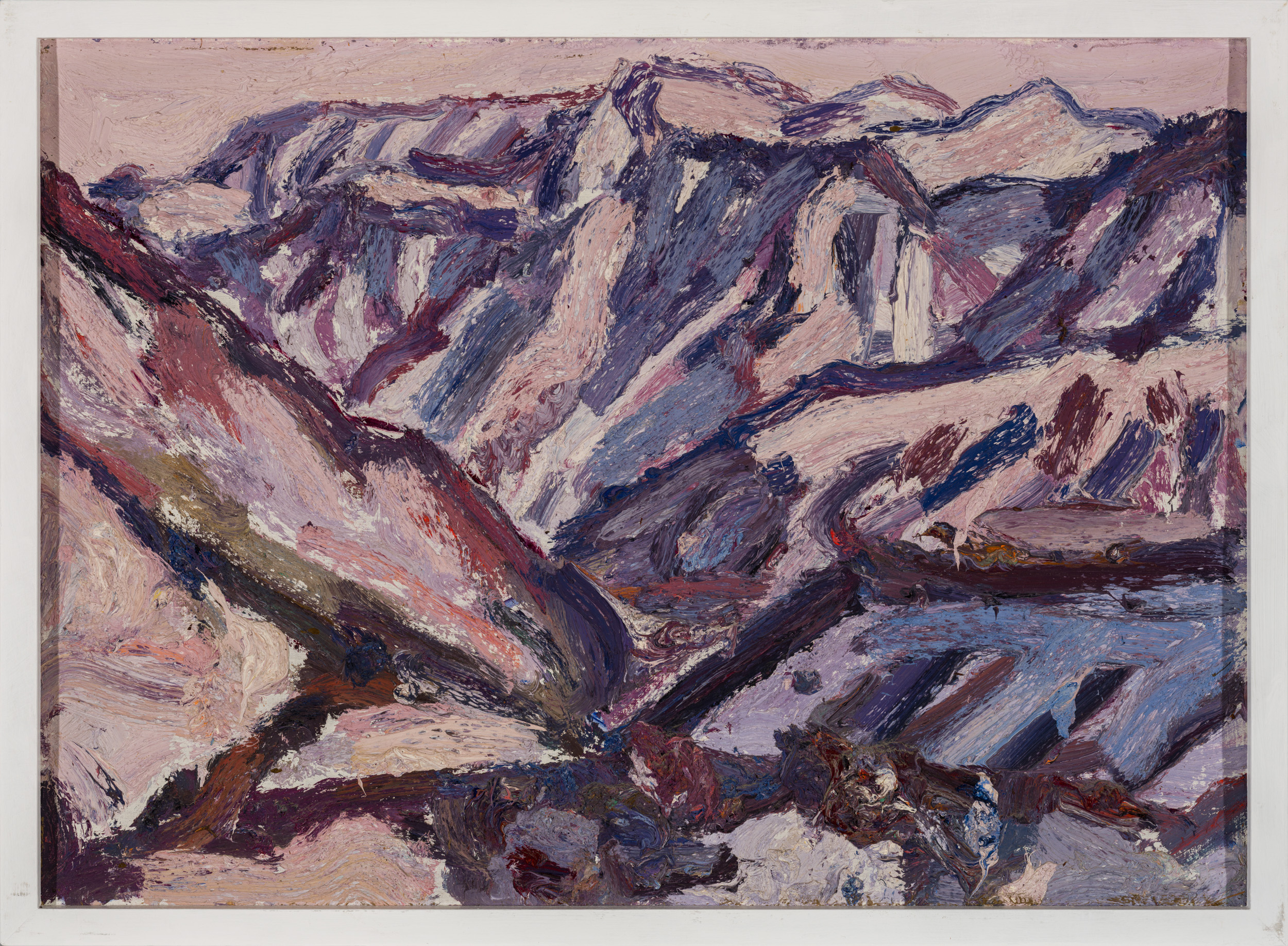
Landscape, 1970. Oil on linen mounted on board, 50 × 71 cm (19 11/16 × 27 15/16 in.). Purchased with funds donated by Norton Dodge and Nancy Dodge. 2001.0118