
Defining Russian Graphic Arts: From Diaghilev to Stalin, 1898-1934
This comprehensive exhibition explores for the first time an unparalleled four decades of energetic innovation in Russia. The period begins with an explosion of creativity initiated by Serge Diaghilev (1872–1929), the renowned empresario of the Ballets Russes, and ends in the mid-1930s with Stalin's seizure of complete control over the arts.
The exhibition gathers more than 300 works—some never before exhibited outside Russia—mostly from two remarkable Saint Petersburg collections: the National Library of Russia and the research Museum of the Russian Academy of Fine Arts. Also included are many expressive examples of Russian and Soviet graphic arts belonging to the New York Public Library, The Judith Rothschild Foundation, art libri, ltd., Boston, a number of private collections, and the Zimmerli Art Museum itself.
Defining Russian Graphic Arts treats the development of Russian graphic arts in the early twentieth century as a continuum; it places the movements of Suprematism and Constructivism in the context of other major but lesser-known manifestations of the period. The exhibition features posters, illustrated books, journals, lubki (popular prints), sheet music, and other printed ephemera, as well as watercolor and gouache costume and stage designs. The exhibition presents a major aspect of Russian art in depth, drawing on the Zimmerli's increasingly significant holdings in this important area.
Curated by Dr. Alla Rosenfeld
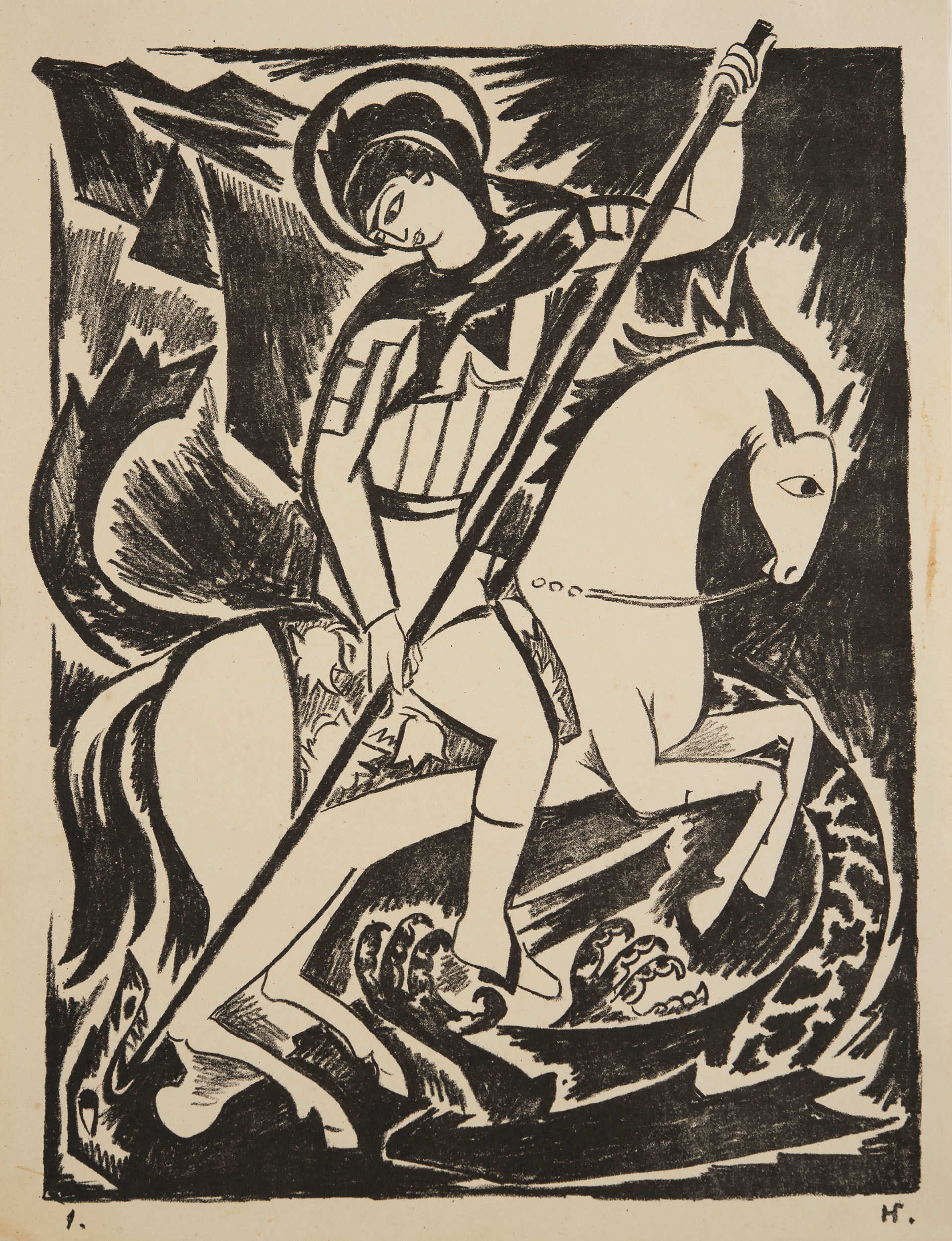
Natalia Goncharova, from the portfolio of War from the series War, 1914. Lithograph on paper, Image: 30 × 22.5 cm (11 13/16 × 8 7/8 in.). Gift of University College Rutgers New Brunswick Alumni Association. 1996.0177.001.
Accordion Content
-
203-EXH-TEMP-BOX-102, 203-EXH-TEMP-BOX-103; exh-00019
203-EXH-TEMP-BOX-178; exh-00110
203-PUBL-TEMP-BOX-160; publ-00014
203-pub-temp-box-147; 0183
203-pub-temp-box-148; 0422-0424, and 0725